
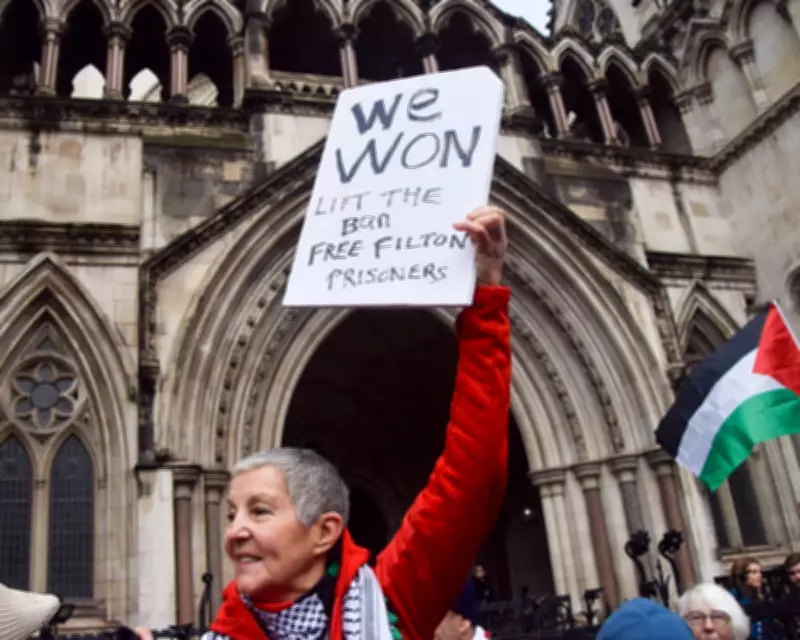
High Court Declares Palestine Action Ban Unlawful in Major Legal Defeat for Government
In a landmark judgment delivered on 13 February 2026, the High Court in London has ruled that the government's decision to ban the direct-action group Palestine Action was unlawful. The ruling represents a significant legal and moral victory for activists who have been protesting against Israel's actions in Gaza, while delivering a stinging rebuke to the Home Office's approach.
A Day of Vindication and Humiliation
The court found that placing Palestine Action on the same legal footing as terrorist organizations like al-Qaida and Islamic State was disproportionate and unjustified. This classification had meant that simply showing support for the group risked a prison sentence of up to 14 years. The consequences were severe: more than 2,700 people were arrested for holding placards opposing what many describe as genocide in Gaza and supporting Palestine Action, including elderly individuals and a retired octogenarian priest.
While the judges acknowledged that Palestine Action's tactics—which include damaging property belonging to Israeli arms manufacturer Elbit Systems—go beyond traditional civil disobedience, they emphasized that normal criminal law remains available to address such acts. The court recognized that the proscription interfered with fundamental rights to freedom of expression, peaceful assembly, and free association.
Historical Parallels and Moral Questions
The ruling invites comparison with historical movements like the suffragettes, who employed far more extreme tactics including bombings and arson but are now celebrated as pioneers of social justice. As the court noted, the suffragettes were not merely engaging in civil disobedience; their actions were revolutionary. Yet history judges them through the prism of the greater crime they opposed: the disenfranchisement of women.
Similarly, Palestine Action operates in a context where numerous international bodies—including a UN independent commission, genocide scholars, and NGOs like Amnesty International and Médecins Sans Frontières—have concluded that Israel has committed genocide against Palestinians. The International Criminal Court has issued arrest warrants for Israeli Prime Minister Benjamin Netanyahu and his former defence minister for alleged war crimes and crimes against humanity.
Government Complicity and Legal Obligations
The British government's position is increasingly untenable. Britain supplies crucial components for Israel's fighter jets, shares intelligence, and allows its citizens to fight in Israel's army. Home Secretary Shabana Mahmood has vowed to fight the judgment in the Court of Appeal, but her colleague Wes Streeting has previously stated that Israel is committing war crimes. The government's refusal to acknowledge this reality appears driven by legal necessity: admitting war crimes would make it unlawful to continue arms exports to Israel.
This raises a profound moral question: if one has strong grounds to believe their government is facilitating genocide—the crime of crimes—should they do whatever it takes to stop it, even if that means breaking the law? English juries have repeatedly acquitted Palestine Action activists, suggesting public sympathy for this dilemma.
Political Cowardice and International Pressure
Only 26 MPs voted against the legislation that has now been ruled unlawful, highlighting what critics describe as a soulless and cowardly political establishment. Meanwhile, polling indicates that the British public believes Israel's attack on Gaza was unjustified, supports an arms embargo and sanctions against Israel, and backs the arrest of Netanyahu. In the US, half of Americans believe Israel has committed genocide.
The ICC's issuance of arrest warrants despite immense Western pressure signals a shifting global consensus. As the court's ruling makes clear, those complicit in genocide will be damned by history, while those arrested for holding placards will be vindicated as courageous opponents of atrocity. Whether the government wins its appeal or not, that reckoning is inevitable.




