Twelve Arrests at London's Al-Quds Day Rally and Counterprotest
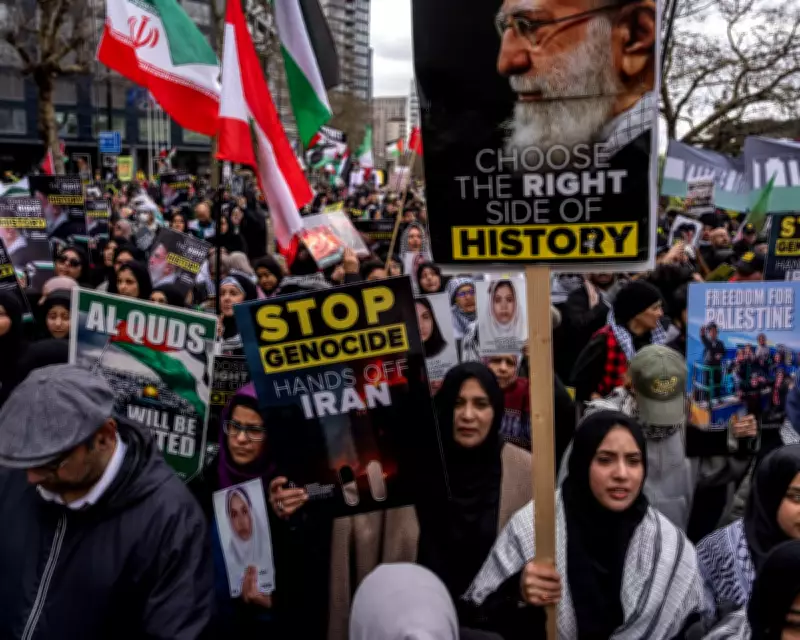
The Metropolitan Police confirmed twelve arrests during rival demonstrations in London on Sunday, as hundreds gathered for the annual al-Quds Day rally while counterprotesters assembled across the River Thames. The events exposed deep divisions within the Iranian community in the United Kingdom, with police deploying over 1,000 officers to maintain separation between the groups.
Police Investigation into Controversial Chants
Metropolitan Police Assistant Commissioner Ade Adelekan announced that authorities are investigating chants made by speakers at the al-Quds protest. The police later confirmed they are specifically examining chants of "death, death to the IDF" led by Bobby Vylan, whose real name is Pascal Robinson-Foster. The punk-rap artist previously led the same chant at Glastonbury Festival last year, prompting a police investigation that concluded without further action.
"We made 12 arrests including for showing support for a proscribed organisation, affray and for threatening or abusive behaviour," Adelekan stated. "We are also investigating chants made by a speaker at the al-Quds protest."
Protest Restrictions and Security Measures
For the first time since 2012, Home Secretary Shabana Mahmood granted a police request to ban al-Quds protesters from marching. Mahmood emphasized: "I expect to see the full force of the law applied to anyone spreading hatred and division instead of exercising their right to peaceful protest."
Police warned al-Quds demonstrators on the Albert Embankment that they would arrest anyone displaying placards, flags, or chanting that crossed into hate crime territory or showed support for proscribed organizations. Some participants carried placards featuring Iran's new supreme leader, Mojtaba Khamenei, or his father and predecessor, Ali Khamenei, who was killed on the first day of the war.
Counterprotest Across the Thames
Across the river at Millbank, a heavy police presence monitored a counterprotest co-organized by Stop the Hate and the Lion Guard of Iran group. Some counterprotesters carried both Israeli flags and the flag of the Iranian state before the 1979 Islamic revolution, showing support for Reza Pahlavi, the son of Iran's former pro-western monarch.
Lambeth Bridge, the nearest river crossing between the two rallies, remained closed throughout Sunday afternoon as police worked to prevent direct confrontation between the opposing groups.
Divergent Perspectives from Protest Participants
Georgie Stagg, a 70-year-old retired arts administrator from Lewisham wearing a Palestinian keffiyeh, expressed frustration after being moved along by police near the pro-Israeli demonstration. "We've marched on al-Quds Day for 40 years, and I have never seen any trouble," Stagg said. "You can't criticise the Iranian government for being anti-democratic when we've got a government here that's arresting people holding placards."
Raham Moshami, 52, who fled Iran in 2010 after being tortured in jail, showed scars on her forehead as proof of her experience. "We are here to support our people, because the Iranian government is holding my people hostage," she stated, adding that she viewed Netanyahu and Trump as trying to help Iranians.
On the al-Quds side, Fereydun Bahrami, 71, traveled by coach from Glasgow with 50 other Iranians to join the protest organized by the Islamic Human Rights Commission. Carrying a placard reading "Stop Using UK bases to bomb Iran," Bahrami said: "They are brainwashed to support Israel, rather than their families under bombardment."
Police Assessment and Aftermath
Assistant Commissioner Adelekan reported that fewer people attended than anticipated due to the restrictions, noting that both groups dispersed as planned from 1500 hours. "Our policing plan worked, with both groups kept apart and we saw no attempts from either side to breach conditions by marching," he concluded.
The al-Quds Day demonstration, which takes its name from the Arabic word for Jerusalem, was established by Ayatollah Ruhollah Khomeini after Iran's 1979 revolution as an international show of support for Palestinian rights. This year's events highlighted the complex geopolitical tensions and community divisions playing out on London's streets.