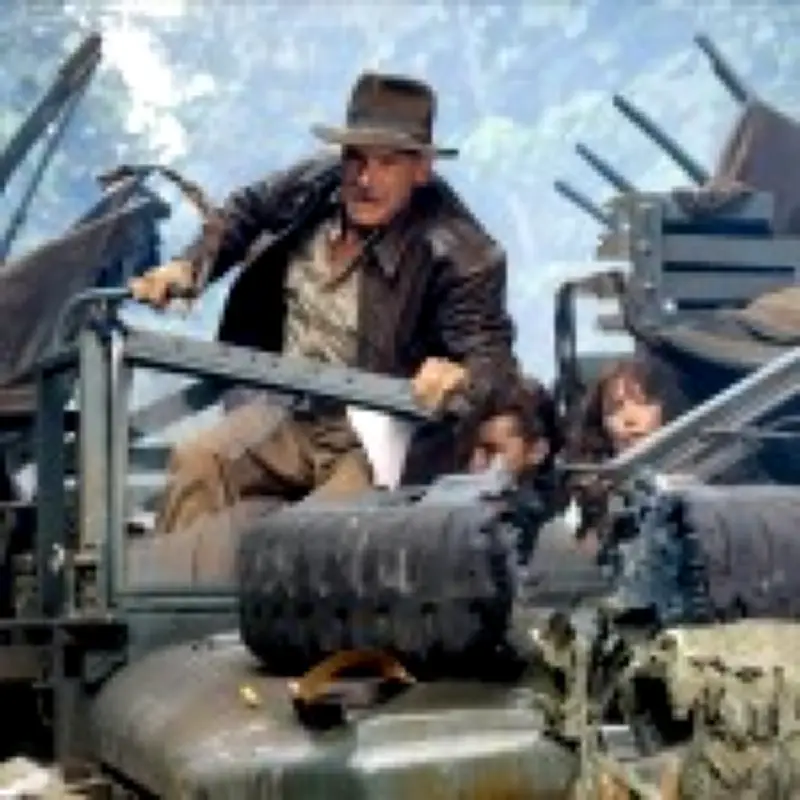
Indiana Jones is one of the most beloved franchises in cinema history, spanning over 40 years, five films and a TV prequel series, and raking in nearly $2 billion at the box office. It also cemented Harrison Ford as one of Hollywood’s truly iconic leading men and thrilled fans with its throwbacks to 1930s adventure serials and derring-do. The Nazis were the bad guys, fedoras and whips were the accessories of the moment and archaeology was sexy – all thanks to creator and producer George Lucas, and longtime director Steven Spielberg, to whom Lucas offered the project on the promise that it was ‘better than James Bond’ after the Jaws filmmaker had been rejected from the 007 franchise.
But while every Indiana Jones film has been eagerly anticipated and provided a flavour of its own, the fans’ reaction was pretty unanimously muted to Indy’s fourth adventure. Indiana Jones and the Kingdom of the Crystal Skull was a long-gestating comeback, nearly 20 years after Indy and his father Dr Jones Snr (Sean Connery) had ridden off into the sunset in the pointedly named Indiana Jones and the Last Crusade. And while The Kingdom of the Crystal Skull may have become the highest-grossing entry in the franchise, earning $786.6m, it’s also widely considered the weakest in the franchise – and now we know why.
The 1950s Setting and Controversial Ending
Propelling Indy forward into the 1950s and seeing him deal with being the grumpy elder when it came to his tearaway greaser son Mutt (Shia LaBeouf) might have made sense for the then 60-something Ford, but the character seemed to flounder as well in this new setting. Then we come to the controversial ending, which saw Indiana Jones suddenly go all sci-fi on us with the revelation that the titular ancient crystal skull from Peru belongs to interdimensional beings that the early Ugha tribes worshipped as gods. The alien then escapes in… a flying saucer. This final act flourish was always difficult for many fans to swallow and now we’ve been vindicated with the revelation that both Ford and Spielberg felt that way too.

Behind-the-Scenes Conflict Revealed
‘Steven was struggling with that movie. Harrison was struggling with the movie. They didn’t want to do a Raiders movie that involved aliens, and they kind of got into a fight with George about it,’ confessed producer Kathleen Kennedy in a recent Spielberg oral history piece in Vulture. ‘I wanted it to be kind of a War of the Worlds sort of thing. Harrison said, “I’m not going to do another science-fiction movie.” And Steven said, “I’m not going to do another science-fiction movie”,’ added Lucas. ‘I said, “Steven, this is perfect because it’s the 1950s, when flying saucers were a whole thing,” but he said “no”.’ Lucas then explained that after ‘about five scripts’, he and Spielberg finally compromised with ‘Look, what if they’re not aliens but from another dimension’. Many would argue that’s not much of a difference, with Kennedy confirming ‘they ended up all of them doing what George wanted to do, which was probably the right thing’.
‘But Harrison and Steven were not 100 percent onboard. That’s why the movie, out of the four that Steven made, is the weakest,’ she shared, explaining that that is why Ford was so ‘deeply committed’ to The Dial of Destiny in 2023 – because ‘he didn’t want that to be the end’. Again, fans were happy as well to get another Indy adventure and try to end the series on a brighter note. Destiny, which was directed by James Mangold, may not have reached especially near the heights of the original trilogy, and certainly 1981’s first outing, Raiders of the Lost Ark – but it at least stayed away from aliens.
Lucas Defends the Flying Saucer
In this same oral history discussion, Lucas also said that it was Spielberg who ‘put that last shot in, where they get into a flying saucer and take off’. ‘He was rationalising it by saying, “Well, they’re going to another dimension. They have to get there somehow.” I said, “It looks like a flying saucer.” He did make a science-fiction movie after that, and Harrison did an alien movie.’ And this, of course, is the issue that every die-hard Indiana Jones fan has always recognised with the movie.