In an unprecedented legal move, South Korean prosecutors have called for the death penalty to be imposed on former President Yoon Suk Yeol. The demand comes at the conclusion of his historic trial on charges of insurrection, stemming from his attempt to declare martial law in late 2024.
The Core Charges and Prosecution's Case
Prosecutors told the Seoul Central District Court that Yoon had "directly and fundamentally infringed upon the safety of the state and the survival and freedom of the people". They characterised his actions as the "serious destruction of constitutional order by anti-state forces".
The case centres on events from the night of 3 December 2024, when Yoon, then president, deployed troops to the National Assembly. He allegedly ordered them to block lawmakers from voting to lift his martial law declaration. The tense six-hour standoff ended when 190 MPs broke through military lines to pass an emergency resolution, forcing Yoon to back down.

In their closing arguments, prosecutors asserted that Yoon, a former prosecutor general, was fully aware his declaration was unconstitutional. They claimed he began planning the operation before October 2023 to "monopolise power through long-term rule", strategically placing loyal military personnel in key positions.
Shocking Details and Wider Fallout
Prosecutors revealed chilling details from documented plans, which included:
- Preparing to torture election officials to confess to fabricated election fraud.
- Cutting power and water to critical media outlets.
- Allegedly ordering drone infiltrations into Pyongyang airspace to provoke North Korea and create a pretext for martial law.
They condemned senior officials who "chose loyalty to Yoon and greed for power-sharing", noting that if just one cabinet member had informed the outside world, implementing martial law would have been impossible. A key aggravating factor cited was Yoon's complete lack of remorse; he has never properly apologised and instead blames the then-opposition.
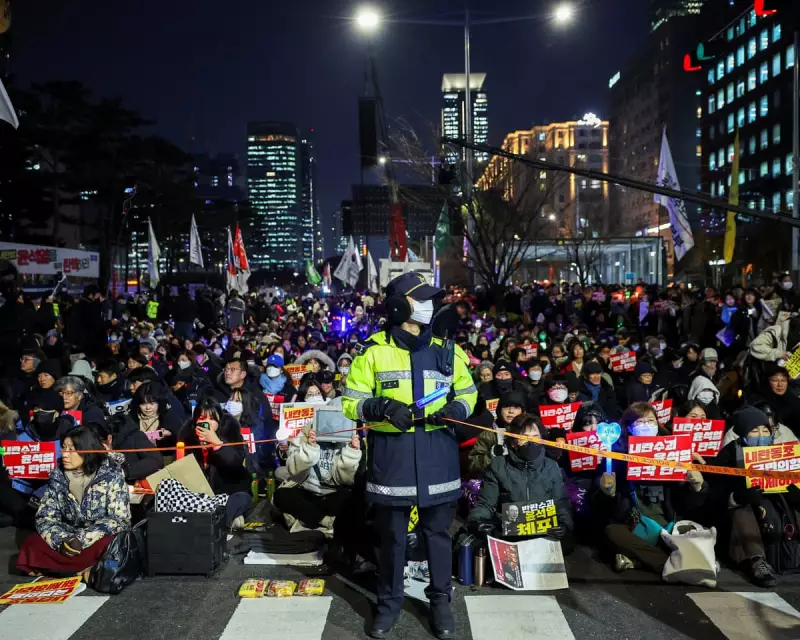
Following his arrest, some of his supporters stormed a courthouse in violent protests.
Historic Precedents and Concurrent Legal Battles
This is the first insurrection trial of a Korean head of state in three decades, since the 1996 trial of military dictators Chun Doo-hwan and Roh Tae-woo. Prosecutors then demanded death for Chun and life imprisonment for Roh; both were convicted but later pardoned.
Yoon was formally removed from office by the Constitutional Court in April 2025, after being impeached by parliament in December 2024. A snap election brought his rival, Lee Jae Myung, to power.
The insurrection case is just one part of a vast legal onslaught. Yoon faces eight separate criminal trials on charges from abuse of power to election law violations. Three special prosecutor probes have indicted over 120 people across the political and military establishment.
Furthermore, his wife, Kim Keon Hee, faces a verdict on 28 January on stock manipulation and bribery charges, with prosecutors seeking a 15-year sentence. Yoon's first verdict arrives on 16 January in an arrest obstruction case, where prosecutors have demanded a 10-year term.
A verdict in the landmark insurrection trial is expected in mid-February. Under South Korean law, the charges carry only three possible sentences: death, life imprisonment with labour, or life imprisonment without labour. South Korea has not carried out an execution since 1997 and is considered a de facto abolitionist state.