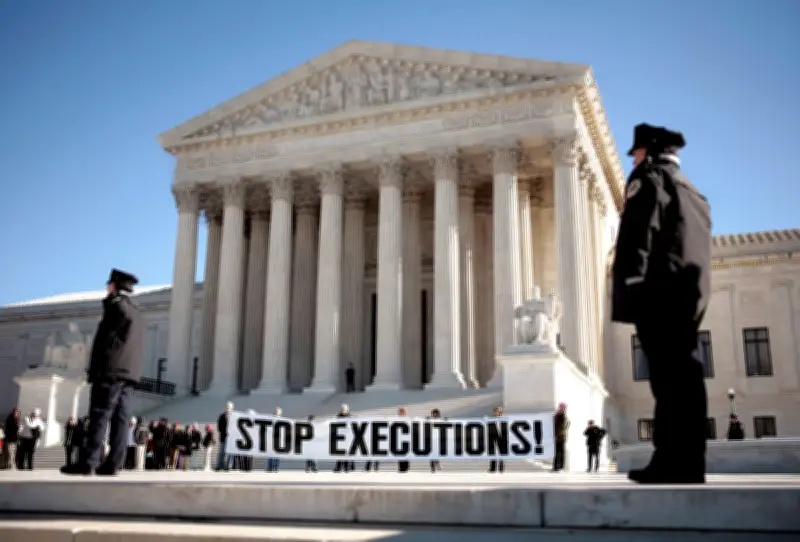
Thursday marks the 50th anniversary of the rebirth of the death penalty in the United States. On 2 July 1976, the Supreme Court handed down decisions in five cases that laid out a formula for passing constitutional muster. The formula the court devised and explained at length in one of those cases, Gregg v Georgia, was built on a wish and a prayer. It was a fantasy of fairness, powerful enough, its authors thought, to keep capital punishment alive and to lend it legitimacy, but it was a fantasy nonetheless.
What has happened since shows the hollowness of that hope. History has not and will not look kindly on the court's misbegotten effort, according to Austin Sarat, associate dean of the faculty and William Nelson Cromwell professor of jurisprudence and political science at Amherst College.
The Road to Gregg: Furman v Georgia and State Responses
Four years before the 1976 quintet of court rulings, the court had halted capital punishment in a case called Furman v Georgia. It did so on the grounds that the sentencing discretion that state laws gave judges and juries created an unacceptable risk that it would be used in an arbitrary and discriminatory manner. Opponents of the death penalty celebrated, believing that it would not survive the setback the court delivered. One, Professor Hugo Adam Bedau, predicted: 'We will not see another execution in this nation in this century.' Another, Jack Greenberg, then a lawyer working for the Legal Defense Fund, went further: 'There will no longer be any more capital punishment in the United States.'

But that celebration was both premature and unwarranted. As historian David Oshinsky explained: 'The justices were so divided that each one wrote a different opinion.' In his view, 'the two 'pivotal' opinions are those of Justices Potter Stewart and Byron White. They concluded that the system of absolute jury discretion in sentencing had yielded death sentences with such infrequency and irrationality as to be cruel and unusual and therefore in violation of the eighth amendment.' While abolitionists celebrated, Oshinsky observes: 'Capital punishment advocates saw an opening in the decision. Furman … did not outlaw capital punishment. It said if 'you want it, you have to rewrite your laws.'' And 37 states took the opportunity to do so.
The 1976 Rulings: A Formula for 'Guided Discretion'
Half a century ago, the question was whether the court would go further than it had in Furman and end the death penalty once and for all, or find one of the recently enacted sentencing schemes acceptable. When the court announced its rulings, abolitionists' hopes were dashed. As Justice Potter Stewart, now writing for a seven-judge majority, argued: 'It is now evident that a large proportion of American society continues to regard … [the death penalty] as an appropriate and necessary criminal sanction.' Stewart added: 'We now hold that the punishment of death does not invariably violate the Constitution.' That single sentence has stood as an ironclad barrier to judicial abolition from then until now.
The court struck down mandatory death penalty laws, calling them 'unduly harsh and unworkably rigid.' At the same time, it ruled that statutes providing 'guided discretion' were enough to mitigate the problems identified in Furman. Georgia, in Stewart's view, now 'suitably directed and limited' jury discretion 'so as to minimize the risk of wholly arbitrary and capricious action.' He confidently asserted: 'It is possible to construct capital sentencing systems capable of meeting Furman's constitutional concerns.' The court imagined that a 'bifurcated proceeding where the trial and sentencing are conducted separately' and 'specific jury findings as to the severity of the crime and the nature of the defendant, and a comparison of each capital sentence's circumstances with other similar cases' would ensure that 'the jury's discretion is channeled. No longer can a jury wantonly and freakishly impose the death sentence.'

Five Decades of Failure: Exonerations, Bias, and Botched Executions
Over the last five decades, we have learned a hard lesson: all that was pure fantasy. According to the Death Penalty Information Center, since 1973, '202 former death-row prisoners have been exonerated of all charges related to the wrongful convictions that had put them on death row.' In addition, a study conducted in 2014 'estimated that at least 4% of those sentenced to death are innocent.' It is also clear that the court's 'guided discretion' has not ended arbitrary and discriminatory treatment. People of color still fare badly at every stage in America's post-Gregg death penalty system and are even more likely to have their executions botched than are white people.
The Legacy: A System 'Doomed to Failure'
Writing in 1994, Justice Harry Blackmun exposed the myth that has sustained the US death penalty since Gregg. As he explained: 'Once the pool of death eligible defendants has been reduced, the sentencer retains the discretion to consider whatever relevant mitigating evidence the defendant chooses to offer … Over time, I have come to conclude that even this approach is unacceptable: it simply reduces, rather than eliminates, the number of people subject to arbitrary sentencing.' Blackmun went on: 'The decision whether a human being should live or die is so inherently subjective – rife with all of life's understandings, experiences, prejudices, and passions – that it inevitably defies the rationality and consistency required by the constitution.' For him, no set of 'procedural rules or verbal formulas' can ever 'provide consistency, fairness, and reliability in a capital sentencing scheme.' The last half century has only proven that, in Blackmun's words, the effort is 'doomed to failure … and the death penalty – must be abandoned altogether.'