
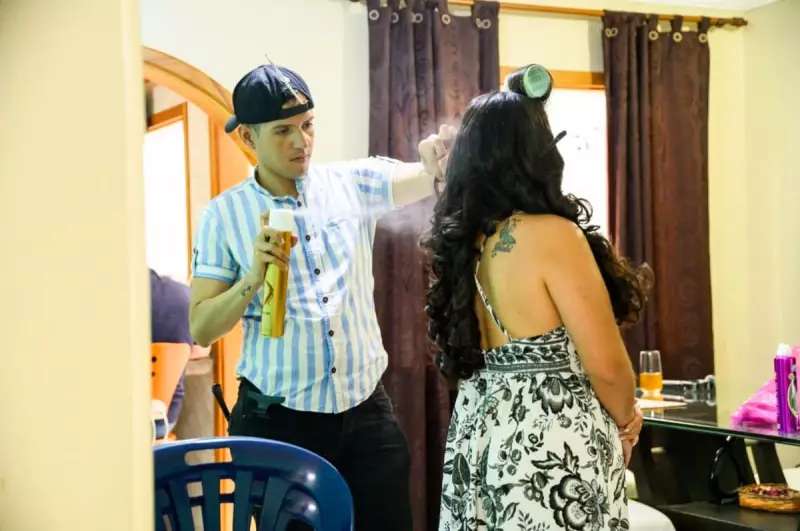
Andry Hernández Romero, a 32-year-old makeup artist, carefully styles the hair of Gabriela Mora, the fiancée of his close friend Carlos Uzcátegui. This simple, intimate act of friendship in Venezuela is a world away from the horrors they recently survived. Both men were among 252 Venezuelans who endured what human rights groups call systemic torture in El Salvador's notorious Terrorism Confinement Center (Cecot), after being deported from the United States.
A New Year's Cleansing Fire
Five months after his release, Hernández Romero is helping his family build an año viejo—a human-sized doll stuffed with fireworks to be set ablaze at midnight on New Year's Eve. For him, the tradition holds profound meaning. "This is our way of welcoming the new year with joy," he said, viewing it as a ritual to purge the trauma of the past.
That trauma began when the Trump administration accused him and 251 other Venezuelan men of being members of the transnational Tren de Aragua gang. Without due process or warning, the group—many asylum seekers with no criminal records—were rounded up across the US and flown to Cecot in March 2024.
Four Months of Systemic Abuse
For four months, the men were subjected to daily beatings, psychological abuse, and sexual assault. A joint investigation by Human Rights Watch and Cristosal concluded they faced "serious physical and psychological abuse on a near-daily basis."
Edicson David Quintero Chacón, 29, describes relentless violence. "If we talked, they would beat us," he recalled. Medical care was a cruel fiction; when Quintero developed a agonising headache after a beating, a doctor blamed him for drinking too much water. Detainees were routinely isolated in a dark room known as "La Isla." Hernández Romero alleges he was dragged there and sexually abused, an experience he now hopes will see divine, if not earthly, justice.
Out of desperation, the men staged hunger strikes. José Manuel Ramos Bastidas, 31, witnessed a "blood protest" where a fellow detainee cut himself. "We fought for our lives, for our freedom or for them to kill us so we could stop suffering," Ramos said. Guards told them no one was looking for them and they would never leave.
The Bittersweet Return and a Shattered 'Normal'
In July 2024, in a sudden diplomatic deal between Venezuela and the US, the men were released and flown home. Their return was emotionally chaotic. "It was such a mixture of – happiness? Sadness?" said 36-year-old Jerce Reyes Barrios.
Quintero initially savoured freedom's simple pleasures: a pool day with his children, a long motorcycle ride. "I told my friend just how beautiful freedom felt," he said. But the memories persist like an unwatched film. "It's an experience that remains engraved in the mind. Like a tape that is never erased."
Ramos now struggles to be alone. "When I am alone, I feel like I'm both there and not there at the same time," he explained. Reyes suffers insomnia, waking after only three or four hours. "Sometimes I wake up talking to myself," he said.
Fame, Stigma, and an Uncertain Future
The men returned to the same economic desperation that originally drove them to migrate. Ramos had left to pay for his newborn son's respiratory treatments. Quintero sold his motorcycle to travel north, hoping to build a house for his family. Now, earning a living in Venezuela's crippled economy feels impossible.
Compounding this is a painful paradox of fame and stigma. Their case became an international cause célèbre. Hernández Romero was named an honorary grand marshal of a New York Pride parade while still imprisoned. Yet, the Trump administration's label of "ruthless terrorist gang members" has stuck. US Homeland Security Secretary Kristi Noem used images of their incarceration as a deterrent, and Salvadoran President Nayib Bukele promoted the operation in a dramatic video.
Back home, this has tangible consequences. "No hair salons in Venezuela want to give me a job because they think I'm a member of Tren de Aragua," said Hernández Romero, whose alleged gang affiliation was based solely on two small wrist tattoos honouring his parents. Others suspect him of being a government agent for Maduro's regime, which secured their release.
The only true understanding comes from his 251 "brothers." They stay connected through therapy, texts, and calls. Hernández Romero has grown close to Carlos Uzcátegui, for whose wedding he did the makeup. He now looks forward to being godfather to the couple's expected child—a fragile new beginning amidst the scars.
"We became almost famous," Hernández Romero reflects. "At what cost?"




