
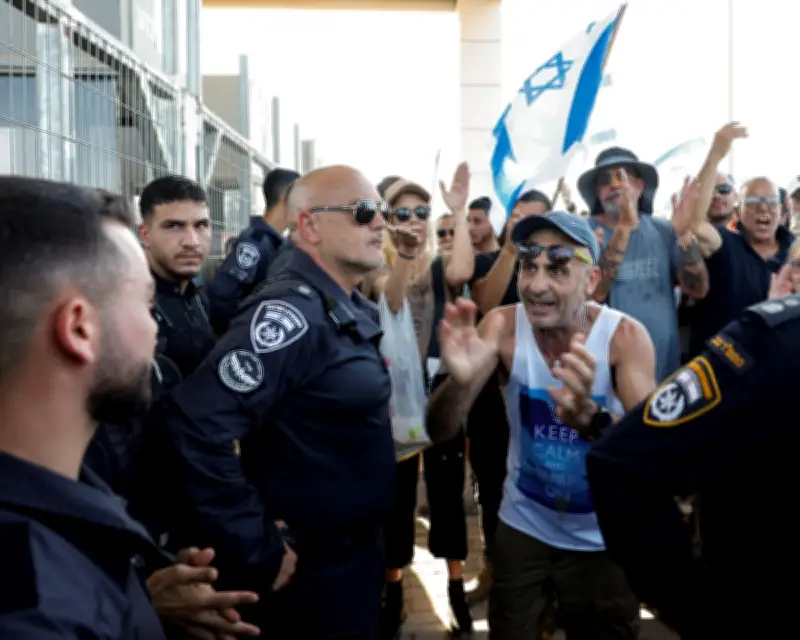
Protesters outside Sde Teiman military base near Beersheba show support for Israeli soldiers accused of sexually abusing Palestinian detainees, 29 July 2024. Photograph: Amir Cohen/Reuters
The UN has shamed Israel over sexual violence in conflict. Now there must be accountability
Janine di Giovanni
Russia is also included on the UN’s blacklist – and it faces enormous pressure from sanctions. The same consequences must apply to Israel. Janine di Giovanni is executive director of The Reckoning Project, a war crimes reporting unit in Ukraine, Sudan and Palestine.
Yousef, a Palestinian journalist, and I stood on a beach in Gaza during the first intifada – the uprising that began in 1987, defined by popular resistance and young men throwing stones. He was in his early 20s at the time, but he had already spent time in Ansar III, the dreaded Israeli prison in the Negev desert. He had recently been released.
This was before post-traumatic stress disorder (PTSD) was widely understood, but I knew my friend was deeply traumatised. Staring at the sea, his hands shook as we spoke. Even though he was free, he doubted he would ever feel safe again. Prison had meant beatings, torture, sleep deprivation. “The soldiers kept asking me if I wanted to be a woman,” he said. “That is the worst thing – to threaten to destroy your manhood.”
Every year, the UN releases an annexe to the secretary general’s report on conflict-related sexual violence. It names parties that are credibly suspected of perpetrating rape and sexual abuse in armed conflict. For years, the usual suspects appeared: the Democratic Republic of the Congo, South Sudan, Syria, Iraq, Myanmar. This year, two new names appeared: Israel and Russia.
Russia’s inclusion was unsurprising. My organisation, The Reckoning Project, is well aware of the reports of sexual violence from our work. Russia is also an outlier in the international order, widely criticised by other states. But seeing Israel listed was a shock given the existing support for the nation by many actors in the international community, such as the US and the EU. The UN is a cautious institution and this listing was not made on a whim.
The evidence is meticulous. Between 2023 and 2025, UN investigators verified sexual abuse inflicted on 31 Palestinian detainees – 14 men, seven women, nine boys and one girl – held in Israeli military bases, prisons and detention centres. The violations included rape, gang-rape, genital violence inflicted as torture, forced nudity, abusive strip-searches and repeated threats of rape. Some victims endured multiple assaults, continued humiliation and pain. Perpetrators included the Israel Defense Forces and Israel Prison Service.
The report documents a systemic lack of accountability, “perpetuating a climate of impunity”. The most well-known case is that of five soldiers who were indicted for alleged physical assault. Despite apparent medical and video evidence of a sexual assault, charges of sexual assault or rape were not included in the indictment. After much public outcry in defence of the soldiers, the charges were eventually dropped.
These findings build on years of work by courageous Israeli and international human rights organisations. B’Tselem exposed systemic cruelty in Israeli prisons long before the UN acted. A recent report, Welcome to hell: the Israeli prison system as a network of torture camps, documents the experiences of 55 Palestinians held after 7 October and released without charge. B’Tselem calls the prisons “a network of camps dedicated to the abuse of inmates as a matter of policy”.
In response to the report, Danny Danon, Israel’s UN ambassador – a hardline former Israel Defense Forces officer and one-time Likud MP – said: “The secretary general and his team continue to spread lies against Israel. To put us and Hamas terrorists on the same list, that’s unacceptable.” (Hamas rightly appears in the report for sexual violence during 7 October.) Danon announced that Israel would cut ties with António Guterres until the UN secretary general leaves office in December.
What next for Israel? States that appear repeatedly on the blacklist are barred from UN peacekeeping missions, but enforcement rarely extends beyond that. The UN requests that investigators access detention facilities, but unless the accused state is cooperative, they are unable to arrange access. Perpetrators repeat their crimes, unpunished. The systems that enable them continue, unhindered.
Real accountability would mean bringing Israel before the international criminal court for the use of rape as a war crime. This is difficult when Israel is not a signatory to the organisation, and as we have seen, Benjamin Netanyahu has already been indicted for starvation as a weapon of war and crimes against humanity in Gaza to no avail. (He denies wrongdoing.)
However, international pressure could come in other forms. Russia denies investigators access to detention facilities, yet still faces enormous pressure from economic and diplomatic sanctions as the aggressor in Ukraine. Israel still benefits from trade with other nations and participates in western institutions in ways Russia cannot – the OECD, the World Economic Forum, the Olympics – but could be expelled until it acts to end sexual violence.
There should be compensation from the Israeli state for survivors through reparations and legal aid for those seeking justice elsewhere, but most fundamentally, the Israeli state must acknowledge that these crimes occurred and will not recur.
There is form for this. Human rights monitors in Ukraine documented 31 cases of sexual violence by Ukrainian forces – beatings of genitals, electric shocks, forced nudity. After these allegations, Ukraine continued to allow UN monitors access, is facing up to its crimes and has acted to strengthen its laws and institutions. If Israel has nothing to hide – as it insists – it should grant investigators unrestricted access to prisons.
I wonder if Yousef, with whom I lost touch many years ago, would see this documented record of his pain as a victory. For survivors such as him, this means there is now an official archive preserved, waiting for the day when the world has the political will to act on it. I imagine he would wish for more action.
For those of us working in accountability, the blacklist signals that there are witnesses. The world is watching, the world does know. The question now is whether the world will ever do more than merely stand by and watch. Janine di Giovanni is a war correspondent and the executive director of The Reckoning Project, a war crimes unit in Ukraine, Sudan and Palestine. She is the author of The Morning They Came for Us: Dispatches from Syria.




