
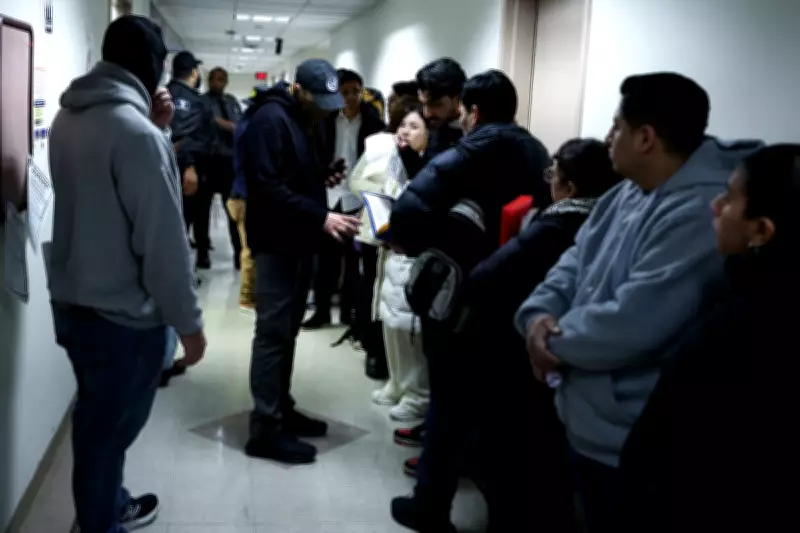
Masked Federal Agents Scrutinize Documents at New York Immigration Court
On March 5, 2026, masked federal agents conducted rigorous document checks on individuals awaiting hearings at the New York Federal Plaza immigration court. This scene illustrates the intensifying crackdown under the Trump administration's aggressive anti-immigration policies, which increasingly target not only those who have violated immigration law but also immigrants residing legally in the United States.
The 'Great De-Legalization Campaign'
Throughout the past year, numerous policies—many currently challenged in court—have systematically attempted to strip people of their legal status. Countless individuals suddenly find themselves undocumented or facing imminent loss of status and deportation threats. Ghita Schwarz, litigation director for the New York-based International Refugee Assistance Project (IRAP), described this as a deliberate strategy: "They are looking for every way to make the undocumented population as enormous as possible" to meet mass deportation targets. She termed it "the great de-legalization campaign, rendering vulnerable to detention and removal millions of people who were not here unlawfully."
Refugee Program Suspension and Travel Bans
Historically, refugees fleeing war and persecution underwent intense vetting abroad before being resettled through the federal refugee program, with green card applications required after one year. On his second administration's first day, Donald Trump signed an executive order suspending this program—critics call it a "refugee ban"—stranding thousands abroad and leaving those in the U.S. in limbo with minimal assistance. The administration has since issued two separate travel bans blocking entry from 39 countries, extended to refugees, and paused green card processing for refugees while ordering a broad review of Biden-era admissions.
For 2026, the refugee admission cap was set at 7,500, a drastic reduction from Biden's 100,000 in 2024, with Trump favoring white South Africans. Alarmingly, there is a new trend of arresting and indefinitely detaining refugees without green cards, putting an estimated 100,000 at risk.
Temporary Protected Status Revocations
People with Temporary Protected Status (TPS)—granted to those from countries deemed unsafe due to war, political instability, or natural disasters—face revocation under Trump. TPS does not offer a citizenship pathway but allows legal residence and work. The administration has revoked TPS for approximately 1 million people from countries including:
- Afghanistan
- Cameroon
- Ethiopia
- Haiti
- Honduras
- Myanmar
- Nepal
- Nicaragua
- Somalia
- South Sudan
- Syria
- Venezuela
- Yemen
Lawsuits challenge these actions with mixed success. Blanca Hernández of the American Immigration Lawyers Association (AILA) warned of the dangers: "What are they going back into?"
DACA Recipients Under Pressure
The Deferred Action for Childhood Arrivals (DACA) program, established in 2012, protects undocumented individuals who arrived as children, allowing them to live and work with deportation protections. Approximately 533,000 active DACA recipients, known as Dreamers, face increasing stress from litigation and anti-immigrant attacks. More Dreamers are being arrested and deported or pressured to leave, though exact numbers are unclear. Former Homeland Security Secretary Kristi Noem reported at least 260 arrests and 86-174 deportations last year.
Hernández, a former DACA recipient, emphasized: "They are individuals who came here as minors, who didn't have any other choice... Now, this current administration decided: 'No, you shouldn't have been here to begin with.'"
Asylum System Restrictions and Pretermission
While Biden restricted asylum, Trump immediately barred all access for new arrivals, leading to historic lows in border encounters despite asylum being a human right. Existing asylum seekers face arrest at ICE check-ins or court hearings, often resulting in detention and deportation, with families torn apart in violent scenes. The administration has secured "third country" agreements with over 20 nations to accept deportees, some not guaranteeing against refoulement.
DHS increasingly uses "pretermission" to quickly remove asylum seekers without proper hearings, a power expanded to immigration judges in April last year to clear case backlogs. In one case, a Nicaraguan asylum seeker was ordered removed to Ecuador without a hearing but later released by a federal judge.
Victims of Crime and Humanitarian Parole
Immigrants applying for U and T visas as crime victims—helping police in investigations—now face arrest, detention, and deportation under ICE policies, prompting lawsuits. Humanitarian parole programs, which protected sponsored individuals from arrest and deportation, have been paused for Ukrainians, Afghans, Cubans, Haitians, Nicaraguans, and Venezuelans, with only the Ukrainian program resuming by court order. Nearly 1 million people who used the CBP One app under Biden have had parole terminated, and programs like CHNV and Family Reunitation are paused, stripping protections from over 1.5 million people.
Student and Work Visa Crackdown
The administration targets immigrants with valid student and work visas, using rare provisions to detain and deport pro-Palestinian student activists. A massive ICE raid at a Hyundai plant in Georgia rounded up 475 people, sparking a diplomatic dispute with South Korea. Additionally, applying for high-skilled H-1B visas now incurs a $100,000 fee, making legal immigration more challenging.
This multifaceted assault on legal immigration pathways represents a significant shift in U.S. policy, with profound implications for immigrant communities and the nation's humanitarian commitments.




