
Trump Shares Disturbing Florida Murder Video to Advance Immigration Agenda
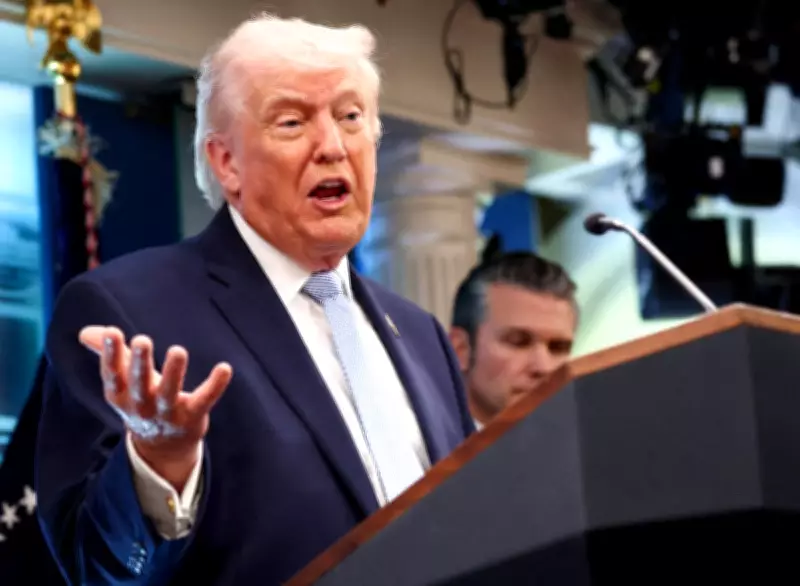
In a calculated move to redirect national attention from pressing questions about foreign policy and personal controversies, former President Donald Trump posted a graphic surveillance video on his Truth Social platform showing a woman being brutally beaten to death at a Florida gas station. The video, which depicts a man identified by authorities as a Haitian immigrant attacking a clerk with a hammer, represents Trump's latest effort to use shocking violent imagery to stoke fear about immigration and justify aggressive deportation policies.
A Pattern of Exploiting Violence for Political Gain
Trump's decision to share the unblurred video of the Fort Myers killing follows a consistent pattern of leveraging graphic content attributed to undocumented immigrants to advance his immigration agenda. During his January State of the Union address, Trump emotionally described the murder of Ukrainian woman Iryna Zarutska in North Carolina, falsely claiming her attacker was an immigrant despite the suspect being U.S.-born. "No one will ever forget the expression of terror on Iryna's face as she looked up at her attacker in the last seconds of her life," Trump declared as the victim's mother wept in the gallery.
Origins and Context of the Disturbing Footage
The surveillance footage first surfaced through Fox News correspondent Bill Melugin before being shared by the Department of Homeland Security in a slightly blurred form. Trump subsequently posted the unedited version with a lengthy caption attacking what he incorrectly termed "temporary protective status." According to the Fort Myers News-Press, the homeless suspect had attempted to withdraw cash from an ATM before demanding money from the clerk, who was reportedly an immigrant from Bangladesh, and fatally attacking her the following day.
Systematic Campaign Against Haitian Immigrants
Trump's amplification of this particular video aligns with his ongoing efforts to demonize Haitian immigrants who have received temporary protected status in the United States. During his 2024 campaign, Trump notoriously spread the false claim that Haitian immigrants in Springfield, Ohio were "eating the pets of the people that live there"—a baseless conspiracy theory originally popularized by Ohio Senator JD Vance, who later became Trump's vice-presidential running mate. Vance has argued that Haitians with legal temporary protected status should be considered "illegal" due to alleged abuse of the system.
Government Agencies Fueling Anti-Immigrant Sentiment
The Department of Homeland Security's decision to share the violent footage on social media reflects what immigration advocates describe as an official policy of inflaming anti-immigrant sentiment. Aaron Reichlin-Melnick, a senior fellow at the American Immigration Council, condemned the actions, stating that DHS and Trump shared the video "for exactly as vile a reason as you can imagine; basically Breitbart's old 'black crime' vertical as official government policy. There hasn't been an administration this openly racist since Wilson invited the KKK to the White House."
Historical Precedents and Policy Implications
This approach echoes strategies documented during Trump's previous administration, where journalist Michael Edison Hayden obtained emails showing Stephen Miller—now Trump's main domestic policy adviser—urging Breitbart editors in 2015-2016 to focus on violent crimes committed by people of color and immigrants. The current administration's efforts to strip temporary protected status from Haitians and other immigrant groups have faced multiple legal challenges, while their stated goal of deporting over a quarter of the current U.S. population continues to drive policy decisions.
The graphic video sharing represents more than just sensationalist social media activity—it reflects a systematic strategy of using fear and racial animus to justify extreme immigration policies while distracting from other political vulnerabilities. As Trump faces scrutiny over his approach to Iran and personal associations, violent imagery attributed to immigrants serves as a reliable tool for shifting national conversation toward his preferred political battleground.




