
As widespread violence erupted in Belfast, a list of addresses began circulating on social media. Spread across dozens of streets, the addresses reportedly targeted houses of multiple occupation (HMOs) where immigrants reside.
Fear among refugees
Joseph and Solomon, both from Eritrea and refugees in Belfast, now have leave to remain and work full-time. They live on the same street as one of the listed properties, but Joseph believed his home was the intended target. “It’s obviously for us,” he said. “I don’t know how to feel. When something is too much, you don’t feel anything.”
Until now, Joseph, an interpreter, felt safe in Belfast. “The majority of the people out there are good,” he said. But now he plans to leave. “I don’t know where, somewhere safe. I’m planning my escape.” Solomon, who works in manufacturing, said: “I couldn’t go to my work for my shift; I feel it’s not safe.” He is also planning to leave. “I have to decide tomorrow maybe, a place with security.”
Community response
As the Guardian spoke to the men, a white woman from a nearby house came out to check we were not there because of the list. “I’m petrified,” she said. “It’s really upsetting and I want to cry. I just wanted to check you weren’t giving them any bother, because they’re lovely.”
Paul Doherty runs a community solidarity hub in south Belfast. On Wednesday night, a mother arrived in hysterics with three children crying in her car. “She said that their house had been listed on a social media post.” Her children had seen the post. “She didn’t want to go home. The kids didn’t want to go home.” In response, community members quietly stepped up, looking out for neighbours. “There were people actually looking out,” Doherty said, adding that someone had likely already been at her door while she was out.
Violence and displacement
The list has stoked a culture of fear in Belfast’s small minority ethnic communities, compounded by violent attacks over two nights. On Wednesday, a mob tried to attack a hotel housing asylum seekers but clashed with police when blocked. The previous night, minority ethnic families were forced from homes, businesses looted and burned, and vehicles set on fire.
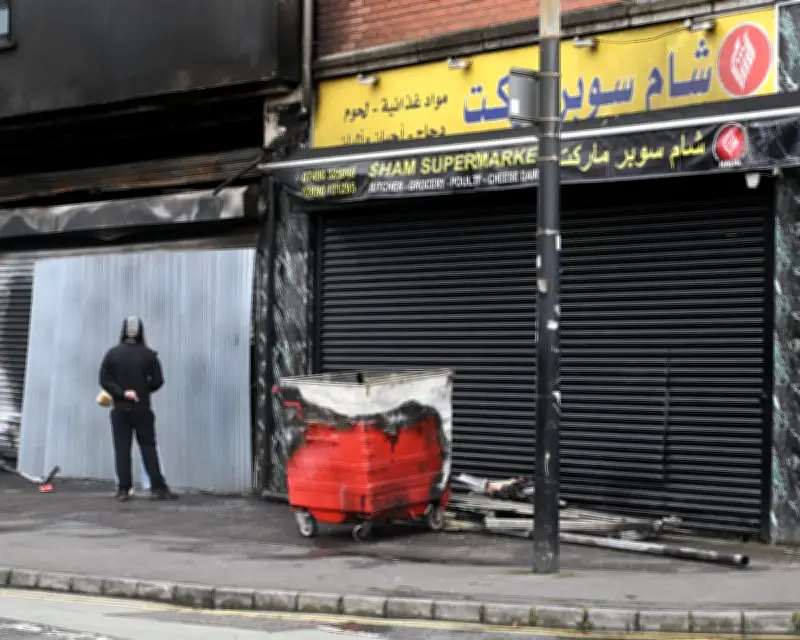
Mohammed fled Syria in 2015 and shows an injury from a bomb blast. His children were born in Belfast and speak with local accents, but he plans to leave this summer, possibly for Syria or Egypt. “We are not like this guy [the knife attack suspect],” he said. “We are looking just only for a new life.” His supermarket in a loyalist area was set on fire, destroying all stock. “At home it’s very bad. My kids are crying. We don’t sleep. This morning, my wee boy told me: ‘I don’t want to go school.’”
Sultan, whose family owns the shop, watched it burn on the news. “We knew it was gone. There’s nothing more you can do. It’s wrong. It’s all happened to the innocent people.” When they called emergency services, the disorder hindered response. “The police said they were doing their best. It was a terrible night.”
Evacuations and ongoing fear
Kfloum Tekly Kassa was evacuated from flats above the supermarket with his wife and two-month-old daughter. They stayed with friends. “It’s very hard. My wife was very afraid. This is not humanity.” He fears for his children. “Maybe I don’t know what’s going to happen. Hopefully, we come to a better place.”
The violence highlights racism in Northern Ireland, where racist incidents hit record highs last year, outweighing sectarian incidents. Kashif Akram from the Belfast Islamic Centre said, “We were expecting something every summer since August 2024. Summer is a very tough time.” Last year, someone tried to enter the centre, smashed a window, and threw an incendiary device. “It’s almost like it’s been allowed. The dehumanisation of immigrants and Muslims has been ongoing, with vigilante groups prowling streets. Far-right politicians have normalised violence and legitimised fear of immigration.”
Tim Magowan, executive director of the 174 Trust, works to build relationships between local and immigrant populations. After Monday’s incident, refugee English classes stopped, and displaced people came to the charity’s clothes bank. “What was clear was it was underneath the surface, bubbling away. Most people of colour have stories. We have only 3% people of colour in our communities, so we’re not used to a multi-ethnic world. Our culture is fundamentally about division, with psychologically defended mindsets and identities constructed by what we are not.”




