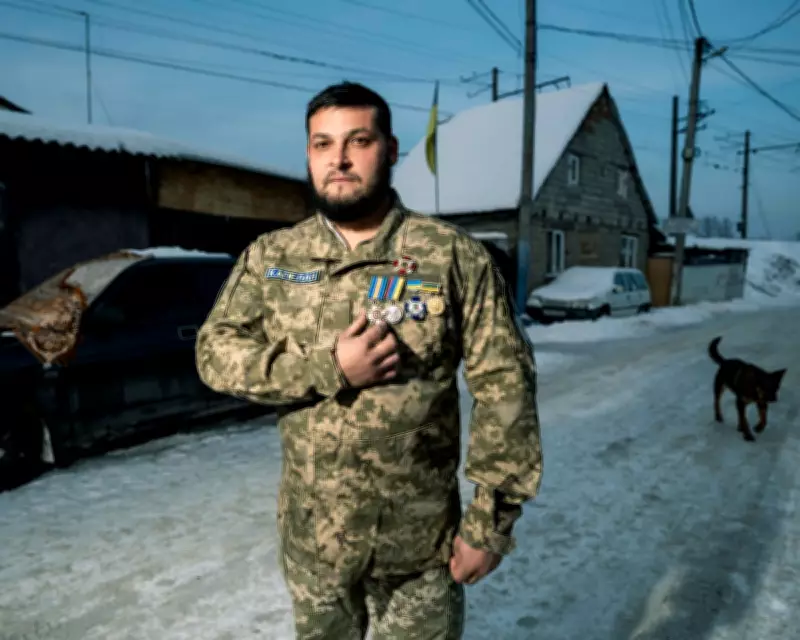
Roma Soldier Defies Exemption to Serve Ukraine
Viktor Ilchak, a father of four children, was legally exempt from military service under Ukrainian law, which spares men with three or more children from mobilization. His family pleaded with him not to enlist, but he remained resolute. "A typical Capricorn, so stubborn," his wife Sveta recalls. In 2015, as the conflict in Donbas escalated, Ilchak was motivated by a television comment criticizing Roma for not defending their homeland. He volunteered at a recruitment center in Uzhhorod, surprising officials who had no choice but to accept him.
Life in Radvanka Settlement
Ilchak resides in Radvanka, a Roma settlement in Uzhhorod, the capital of Transcarpathia province in western Ukraine. This region borders Hungary, Slovakia, Romania, and Poland and hosts Ukraine's largest Roma population. Myroslav Horvat, the sole Roma councillor in Uzhhorod, estimates around 3,500 people live in Radvanka, where streets are unpaved and many homes lack running water.
The Ilchak family occupies a windowless room measuring approximately 10 square meters, with basic furniture. Parents and three daughters share a large bed, while a teenage son sleeps on the floor. Ilchak served in Donbas and later near Mariupol after the full-scale invasion, working as a tank mechanic. He was wounded four times and carries shrapnel from a Russian bomb in his arm. His military jacket displays several medals, including the Order for Courage presented by President Volodymyr Zelenskyy and an award from the city council for his decade-long service, unmatched by any other Roma in Uzhhorod.
Establishing a Veteran Association
Since returning home in September, Ilchak focuses on his children and community initiatives. His primary goal this year is launching an NGO, the Transcarpathian Roma association of combatants, war veterans, chaplains, and volunteers. This organization is the first of its kind in Ukraine, aiming to support Roma veterans and their families. All necessary documents have been filed, marking a significant step toward recognition and assistance.
Compensation Challenges for Roma Families
The families of deceased Ukrainian soldiers are entitled to compensation of 15 million hryvnia (about £250,000), with a portion paid upfront and the remainder distributed over 40 months. However, Roma families often struggle to access these funds due to bureaucratic obstacles. Roman Bigunets, a Ukrainian lawyer, notes that Roma soldiers rarely write wills, and kinship ties are frequently undocumented. "Sadly, if Roma do have documents, they very often contain mistakes," he explains.
Documentation Errors and Missing Persons
Marianna Eötvös illustrates this issue vividly. Her brother-in-law, Yevhen Varady, was killed by a suicide drone near Kramatorsk in Donetsk after being conscripted from prison. His family name was misspelled as "Varody" in his ID, preventing her husband from receiving compensation as the legal heir. Bigunets emphasizes that such errors are shockingly common and costly to correct, disproportionately affecting Roma communities.
For those missing in action, like Aleksander Pap, the father of 17-year-old Jana Churay, the situation is even more dire. Pap was forcibly conscripted from his job at a waste dump and never returned. Jana, now head of her household, has no legal blood relation documented on her birth certificate, complicating any claims. She is expecting her third child with her partner Tolik, who may face mobilization when he turns 18, adding to the family's uncertainty.
Ethnic Minorities and EU Accession Talks
Ukraine's treatment of ethnic minorities, particularly the Roma as the most underprivileged group, is a key topic in its EU accession negotiations. Pilot projects are underway to identify paperless Roma and issue them documents, a crucial step toward full citizenship. Horvat believes up to 30,000 Roma live without identification in Ukraine, limiting access to basic services. "Without ID, people have no access to basic services and are reduced to second-rank citizens," he states.
The exact number of Roma serving in the Ukrainian army is unknown, with Horvat estimating around 500 from his region alone, potentially thousands nationwide. Ukraine does not collect ethnicity-based statistics, adhering to a policy of non-division along ethnic lines. However, this lack of data obscures the specific challenges faced by Roma soldiers and their families.
Language Barriers and Institutional Neglect
Many Roma in Transcarpathia speak Hungarian or Romanes rather than Ukrainian, creating additional hurdles when dealing with state institutions. Ilchak observes that city officials often demand extra documents or delay meetings, leading many to give up. "At the frontline it doesn't matter one bit who is Roma and who is not," he says. "But back in civilian life things are different. In the face of death, we are equal. In the face of state institutions, we are not."
Joseph Pap, whose son Robert was conscripted from the street and killed ten months later, receives only 20,000 hryvnia monthly in compensation, far below the standard amount. The family, primarily Hungarian speakers, relied on Horvat to organize the funeral and navigate paperwork. Robert's portrait now hangs in Uzhhorod's "Alley of Glory," a gallery honoring fallen soldiers, yet his family's struggle for fair compensation continues.
Ilchak's NGO aims to address these disparities by providing legal and logistical support to Roma veterans and their families. As Ukraine progresses toward EU integration, the plight of its Roma community underscores the need for systemic reforms to ensure equality and justice for all citizens, regardless of ethnicity or background.