
UK Government Reconsiders Kanye West Entry Amid Wireless Festival Backlash
Following significant public and political backlash, the UK government is now reportedly reconsidering whether to grant Kanye West permission to enter the country. This development comes after the controversial American rapper, aged 48, was announced as the headliner for all three nights of the London-based Wireless Festival in July. The festival booking marks West's planned return to the UK stage, representing his first performances there since the cancellation of his Saint Pablo tour back in 2016.
Controversial History and Recent Apology
West's inclusion in the festival lineup has sparked intense criticism due to his well-documented history of making homophobic and anti-Semitic statements, alongside incidents such as dressing in Ku Klux Klan attire and releasing a song dedicated to Adolf Hitler. Earlier this year, the musician attributed this past behavior to his bipolar disorder and issued a public apology. He explicitly stated he was 'not a Nazi or an antisemite' and expressed being 'deeply mortified' by his previous actions.
Despite this apology, the decision to book him has been condemned by numerous figures, including Prime Minister Sir Keir Starmer, who labeled it 'deeply concerning.' The controversy has also led four festival sponsors to withdraw their support. According to BBC reports, government ministers are now actively reviewing whether West should be allowed entry under immigration rules that permit banning foreign nationals if their presence is not deemed 'conducive to the public good.'
Political Pressure and International Precedent
The Conservative Party has publicly urged the government to refuse West a visa, arguing that 'allowing someone with his track record to headline a major public event sends entirely the wrong message.' Shadow Home Secretary Chris Philp emphasized that West's past antisemitic actions constituted 'not a one-off lapse, but a pattern of behaviour that has caused real offence and distress to Jewish communities.'
This situation is not without precedent for the rapper. Australia previously refused him entry and cancelled his visa after he released the song 'Heil Hitler' in May of last year. While a final decision on his UK visa application remains pending, this case highlights the broader issue of celebrity entry bans. Below is a detailed overview of other notable stars who have faced similar restrictions from entering the United Kingdom over the years.
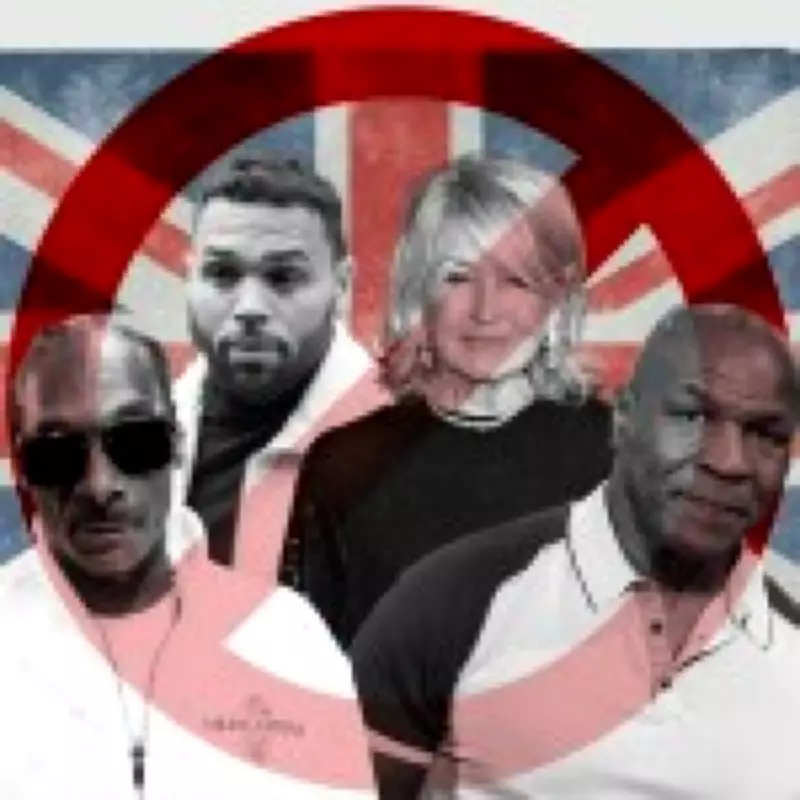
Notable Celebrities Banned from the UK
Chris Brown
The American rapper was banned from entering the UK in 2010 following his conviction for assaulting his then-girlfriend, Rihanna. The Home Office denied his visa application, citing public safety concerns, which forced the postponement of his UK tour. This ban lasted over a decade before being lifted in 2020, allowing him to perform at the Wireless Festival in 2022.
Snoop Dogg
In 2006, Snoop Dogg was banned after a violent altercation at Heathrow Airport involving his entourage and police officers. His planned 2007 tour was cancelled, but the ban was overturned two years later following a legal battle. He has also faced entry restrictions in Australia and Norway.
Mike Tyson
The former boxer was banned in 2013 under tightened immigration laws targeting foreign nationals with serious criminal convictions, stemming from his 1992 rape conviction and prison sentence. He chose not to challenge the decision, cancelling a planned book tour.
Martha Stewart
The businesswoman and TV personality was refused a UK visa in 2008 due to her 2004 convictions for conspiracy, obstruction, and making false statements, for which she served five months in prison. This prevented her from attending planned business meetings in the UK.
Tyler, the Creator
Banned from 2015 to 2019 by then-Home Secretary Theresa May, the rapper was barred due to concerns that the homophobic and violent content in his early albums fostered hatred and public disorder. He was forced to cancel festival appearances and later joked about the ban at the Brit Awards.
Ja Rule
Two years ago, the rapper was denied entry, forcing the cancellation of his Sunrise tour. The ban was linked to his prior convictions for weapon possession and tax evasion, for which he served a two-year prison sentence.
Lil Wayne
In 2022, his visa was rejected due to prior gun possession convictions, preventing his performance at the Strawberries and Creem festival. He had received a presidential pardon in the US but was still barred under UK immigration rules.
Duane Lee 'Dog' Chapman
The TV personality, known as Dog the Bounty Hunter, was banned from entering the UK in 2012 due to a 1976 murder conviction, which also prevented his appearance on Celebrity Big Brother. He served 18 months of a five-year sentence.
The UK maintains strict immigration policies, often denying entry to individuals with criminal records, particularly those involving sentences of 12 months or more in prison. The ongoing review of Kanye West's case underscores the government's continued application of these standards to high-profile individuals, balancing artistic expression with public order and safety concerns.




