
Iranians Describe Nightly Bombings and Internet Blackouts at Turkish Border
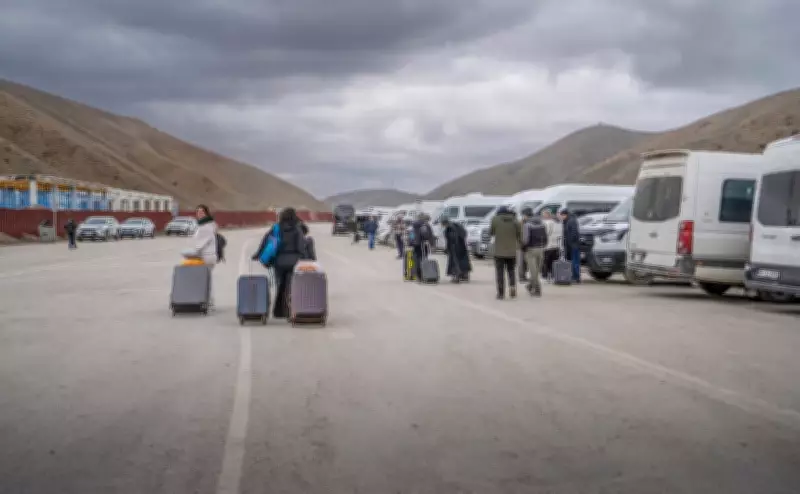
At the Kapıköy border crossing in eastern Turkey, a mountain pass between snow-topped peaks that serves as one of the few gateways from Iran to the west, the reasons for crossing have shifted dramatically in recent weeks. What was once a bustling route for Iranian daytrippers heading to shop in Van or visit discreet nightclubs has become a passage for those fleeing conflict and economic collapse.
"Boom. Because of the War"
Amir, a 33-year-old foreign exchange and cryptocurrency trader from Tehran whose name has been changed for safety, couldn't help but laugh when asked why he was leaving Iran. "Boom," he responded simply. "Because of the war. Every night they are bombarding."
Behind him, barely visible, flew the lifeless black flag raised by the Iranian regime after the death of Supreme Leader Ali Khamenei under US and Israeli strikes. Amir expressed no bitterness toward the American and Israeli campaign. "We must want to get rid of the regime," he said, adding with a weary nod, "Thank you to Trump."
For Amir, the internet blackout imposed by the Iranian regime over the past month has made professional life impossible. "No internet, no job," he explained. "I hope [the bombing] is working. Every night, bombs. Nearby cities, industrial areas and military bases, completely destroyed."
Complex Migration Patterns
Despite the dramatic stories emerging at the border, Kapıköy—which translates as "village of the gate"—has not witnessed massive numbers fleeing Iran. According to the UN refugee agency, approximately 64,000 Iranians arrived in Turkey between March 3 and 30, while more than 48,000 Iranian nationals returned to the Islamic Republic during the same period.
"The current volume of movement remains notably lower than pre-conflict levels, when crossings from both sides averaged approximately 5,000 individuals per day," a UNHCR spokesperson reported.
Turkey has prepared contingency plans for potential influxes, creating buffer zones and establishing tent cities capable of accommodating up to 90,000 people. While these measures haven't yet been necessary, heavily armed soldiers patrol four army and security service checkpoints along the route from the border to Van.
Economic Collapse and Internal Displacement
Salvador Gutiérrez, chief of mission in Iran for the International Organization for Migration, reported via video call from Tehran that people are primarily moving internally within Iran, largely to northern provinces near the Caspian Sea. However, he noted that people have begun returning to Tehran and other cities in recent days as part-government-owned corporations central to Iran's economy have started ordering employees back to work.
"Many people have savings or are receiving some support from their families, so I would say they are waiting to see what the outcome will be of this situation," Gutiérrez explained.
The International Organization for Migration estimates that more than 82,000 residential units have been hit by US and Israeli strikes, affecting approximately 180,000 people. Yet for many at the Kapıköy border, the economic impact—compounded by longstanding sanctions—is hitting harder than the immediate dangers of war.
Daily Life Amid Conflict
Muhammed, a 42-year-old travel business owner heading to Oman, described the economic devastation. "I have had to completely close the offices," he said. "I have said to my staff to go and just rest for minimum two months and after that I don't know what will happen. I am sure that for one year I cannot do anything."
Living near Tehran's airport, Muhammed has become accustomed to nightly bombardments. "Each night you hear the big noises. More than a hundred times we have had the bombings. Each night I hear the big noises and then boom, boom. It was very hard for the first three days, but after four, five days it is normal to your mind."
A 39-year-old woman traveling from east Tehran to Istanbul described similar experiences. "The people live day by day, go shopping, but at night we are a little bit scared," she said. "I hope for a change to [the] regime. For more than one month, no internet. It is 2026 – without internet!"
Not All Seek to Leave
The sentiments expressed by those passing through Kapıköy—largely western-facing, often well-educated individuals with financial resources—don't necessarily represent broader Iranian public opinion. Selma Ghaemzadeh, a 24-year-old from Maragheh in northeast Iran, expressed pride in her country despite recent attacks on her city.
"It is not safe, but Iran is my country and it is safe for me," she said while traveling to Van with her family for shopping. "I am proud that I live in a strong not a weak country."
Fear and Reticence
Many at the border remain too frightened to speak openly. High-profile dissidents hiding in Van have been captured and returned to Tehran in the past. One well-dressed woman abruptly stopped speaking after being told by a male companion to keep quiet. "They are from Iran International," he explained, referring to the Persian-language TV station based in the UK that the Iranian regime has labeled a terrorist organization.
Similar caution prevailed at Van train station when the Iranian Raja Rail Transportation Company's 24-hour sleeper train from Tehran arrived with a full load of passengers. "It isn't safe to talk here," one man said simply.
Personal Stories of Loss
Among those willing to speak was Soha, a 29-year-old computer programmer heading to Bangkok after a bomb landed just a kilometer from her home. "Safety was my biggest problem—a bomb hit next to my house," she explained, adding that the internet blackout had eliminated her work opportunities.
Arash, 56, from Kiraj, described the lack of warning systems. "There are no sirens or shelters. People are getting hurt when they go to the windows to watch the bombs fall."
Moji, 75, and his wife Sholeh, 73, were traveling to the US to stay with their sons for six months after their neighborhood in Tehran was particularly badly hit. The retired accountant knew many people injured in the attacks. "People hope it will lead to big changes," he said. When asked if he held hope himself, he responded simply, "Not much."
Returning to Peril
In a striking reversal, some days see more people returning to Iran via Turkey than leaving, often to be closer to relatives in danger. The Iranian men's national football team passed through Kapıköy after their 5-0 victory against Costa Rica in Antalya.
Among other returnees was a Canadian-based doctor couple. The husband declined to speak, but his wife insisted on telling her story. "This war is affecting everybody," she said, explaining that her 65-year-old mother had died from a stress-induced heart attack. "She didn't have anything wrong with her at all. This war is affecting everyone, either directly or like my mum."
The woman planned to stay in Tehran as long as her father needed her. "Thank you," she added. "I just wanted to tell my story."




