
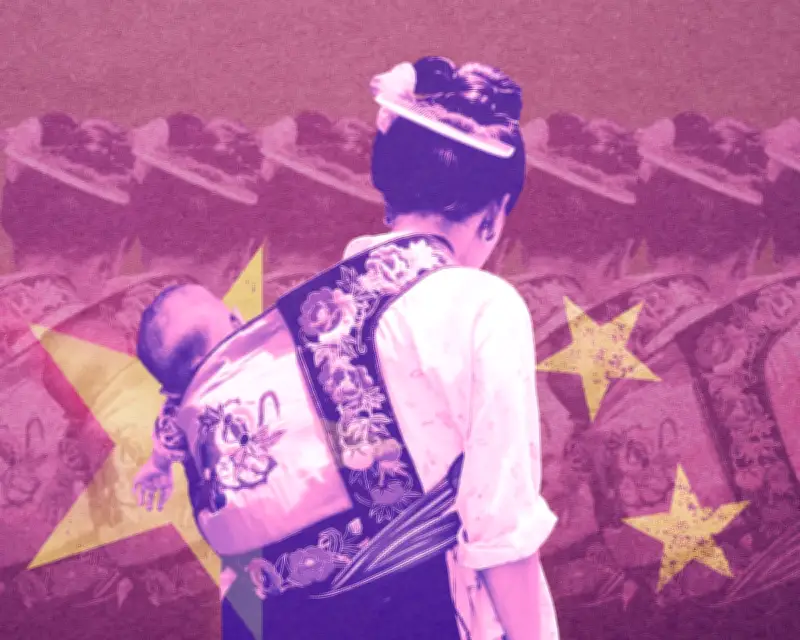
Women in China are facing increasing pressure to devote their bodies to childbearing as the government tries to encourage more pregnancies. However, many are pushing back, making their own choices about reproduction in ways that were not possible in the past.
State Control Over Women's Bodies
Since the founding of the People's Republic of China in 1949, women's bodies have been subject to state control. In the 1950s, labor was organized according to menstrual cycles. Then came the one-child policy, enforced with brutal severity across vast regions, including forced abortions and sterilizations.
Now, with a falling birth rate, the government is pressuring women to have more children. But women are increasingly resisting, while the legacy of the one-child policy continues to echo.
Echoes of 'Childless 100 Days'
Between 1980 and 2016, the state banned most couples from having more than one child. The policy was abandoned a decade ago, but scars remain. In Shen county, Shandong province, Ms Li, now in her 60s, recalls being forced into a tubal ligation in 1991 after giving birth during the so-called "childless 100 days."
This policy dictated that no child should be born from May 1, 1991, for 100 days. Women were often sterilized after giving birth to prevent further pregnancies. Li was heavily pregnant when officials rounded up women for forced abortions. She gave birth early in a hospital boiler room, and her son survived. However, she was fined and sterilized.
Another woman recalled being injected to induce labor, killing her fetus, after refusing would result in her house being torn down or arrest.
Failed Policies and Changing Attitudes
In 2013, retired official Zhang Erli admitted the one-child policy went too far, saying, "We failed the women of China." There are no reliable estimates of how many women were affected by the 100 days policy, but neighboring counties saw drastically fewer births that year.
Today, China's birth rate is plummeting, reaching a record low of 5.63 per 1,000 people last year. Research shows the one-child policy reduced ideal family size. High costs and competitiveness of child-rearing deter many, despite government subsidies.
Wang Yixuan, a 26-year-old practitioner, says, "People now don't care as much about having bigger families." Jia, a filmmaker, adds, "Women don't feel obligated to have a baby any more."
A recent study found nearly 50% of women aged 18-24 don't want children, up from 6% in 2012. The share for men increased to nearly 20%.
Yun Zhou, a social demographer, says the one-child policy created a sense that reproductive rights are not inalienable. In Shen, Li now plays with her two-year-old grandson, one of China's much-needed new babies.




