
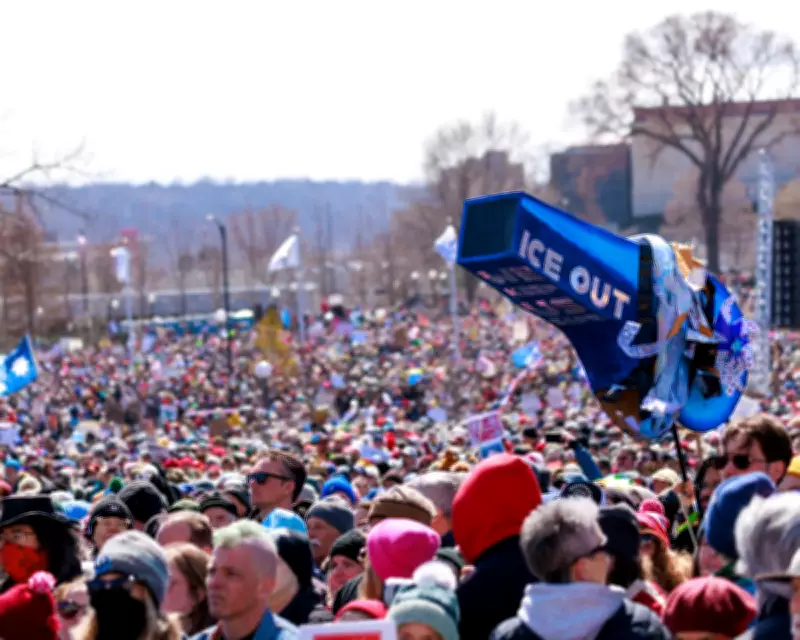
How Anti-ICE Resistance Movement Slowed Trump's Deportation Agenda
In physics, resistance represents the force that hinders the flow of charged electrons, generating heat as they move from point to point. Similarly, popular resistance obstructs and slows governmental operations, creating political heat that further impedes progress. This dynamic has played out dramatically against the Trump administration's mass deportation campaign, where a growing movement has successfully applied pressure through multiple channels.
The Escalation of Immigration Enforcement
The campaign began with Immigration and Customs Enforcement agents arresting international students who protested against the Gaza war. Soon, masked agents began ambushing migrants in courthouse hallways following routine check-ins and mandated status proceedings. Court watchers organized by immigrants' rights advocates and lawyers appeared to bear witness and offer assistance to those targeted.
Before long, ICE and border patrol agents expanded their operations to the streets of Washington DC, Chicago, Los Angeles, Portland, Oregon, and other predominantly Democratic cities. They indiscriminately detained brown, Black, and non-English-speaking individuals, broke down doors without warrants, and escalated confrontations with protesters who challenged their methods.
Organizing a Mass Movement
In response, small groups of immigrants' rights advocates transformed into a broad-based movement for immigrant defense. Collaborating with community organizations and progressive groups, they established hyper-local rapid response teams, created hotlines and encrypted mobile-app chat groups, developed ICE tracking software, and printed know-your-rights cards in multiple languages.
The movement distributed whistles with coded signals—repeated short blasts indicating "ICE in the area" and long blows signaling "form a crowd, stay loud"—while teaching protocols for nonviolent protest and effective documentation of government abuses. This organized resistance prepared communities for what was to come.
Confrontation in Minneapolis-St. Paul
When "Operation Metro Surge" targeted Minneapolis-St. Paul, Minnesota, residents were ready to fight back. People of every age, race, and political affiliation emerged from houses and stores, using cars and bicycles to track ICE movements wherever they went. Protesters wore inflatable animal costumes, flak jackets, and heavy parkas to withstand freezing temperatures that reportedly froze ink in reporters' pens.
They endured tear gas, police batons, and arrests. When agents fatally shot two U.S. citizens in January, cellphone videographers captured the killings and disseminated the images globally through social media platforms. This documentation proved crucial in shifting public opinion.
Political Consequences and Retreat
Public opinion swung decisively against then-President Trump, Homeland Security Secretary Kristi Noem, and "commander at large" Greg Bovino. The government faced mounting pressure to retreat. Bovino was dispatched into early retirement, replaced by the less overtly aggressive "border czar" Tom Homan. Trump announced he would no longer deploy federal troops to intervene in anti-ICE protests, though he maintained a defiant public posture.
The administration hadn't pulled back until Minnesota's attorney general and Twin Cities' mayors filed lawsuits challenging ICE's unconstitutional actions during the surge operation. Soon after, Noem was removed from her position. During confirmation hearings, new DHS chief Markwayne Mullin promised to require judicial warrants for entering homes or businesses.
Legislative and Legal Battles
On February 14, Democrats refused to fund homeland security's immigration enforcement functions unless Republicans agreed to significant reforms reining in ICE's lawlessness. A partial government shutdown ensued. Six weeks into the standoff, Democrats left Washington without the reforms, but Republicans departed without funding ICE, continuing to negotiate how to proceed.
Democratic Senate minority leader Chuck Schumer declared victory but, unlike previous shutdowns, did not end the confrontation. Many observers believe that without rising popular pressure, he would have compromised earlier.
On March 24, in a letter to a New York federal judge, the Justice Department admitted it had "erroneously" relied on an ICE memo permitting arrests of hundreds of unsuspecting immigrants leaving court appearances. The letter stated the memo "does not and has never applied to civil immigration enforcement actions in or near... immigration courts," with lawyers suggesting ICE had misled them. While Homeland Security told NPR it wouldn't change the policy, its legal justification had been substantially undermined.
Ongoing Challenges and Future Resistance
Trump quietly advised his inner circle to moderate aggressive immigration enforcement and even stop using the phrase "mass deportation." However, significant challenges remain. Since September, when the Supreme Court allowed racial profiling of suspected undocumented immigrants in Los Angeles to continue, the practice has remained "rampant" according to the ACLU.
The Justice Department continues prioritizing immigration prosecutions, with a recent ProPublica investigation revealing that former Attorney General Pam Bondi dropped 23,000 pending fraud, drug trafficking, terrorism, and other criminal cases last year to redirect resources toward mass deportation efforts.
Children remain particularly vulnerable. White House adviser Stephen Miller traveled to Texas to urge its Republican-dominated legislature to prohibit public education funding for undocumented children. Even children with documentation face uncertainty—of approximately 500,000 children adopted from abroad since the 1940s, about 200,000 lack legal naturalization in a confusing system. While DHS targets these children, a bipartisan bill automatically granting citizenship to all foreign adoptees remains stalled in committee.
The Supreme Court appears open to allowing the Trump administration to turn away asylum seekers and refugees at the Mexican border, potentially forcing them to remain in camps with scarce food, poor sanitation, and rampant violence. Additionally, Trump's executive order abolishing birthright citizenship for babies of undocumented immigrants has faced numerous federal court rejections, though the Supreme Court's decision to hear the case rather than let lower court rulings stand indicates ongoing uncertainty.
The Path Forward
Just as electricity seeks alternative paths when encountering resistance, the government will likely find new ways to advance its immigration agenda. This reality means opponents must continue resisting through courts, electoral politics, and street protests. While the pathways for this political energy are not endless, sustained pressure can create critical breaking points. When circuits overheat sufficiently, they ultimately fail, demonstrating that organized resistance remains essential to protecting immigrant rights and democratic foundations.




