
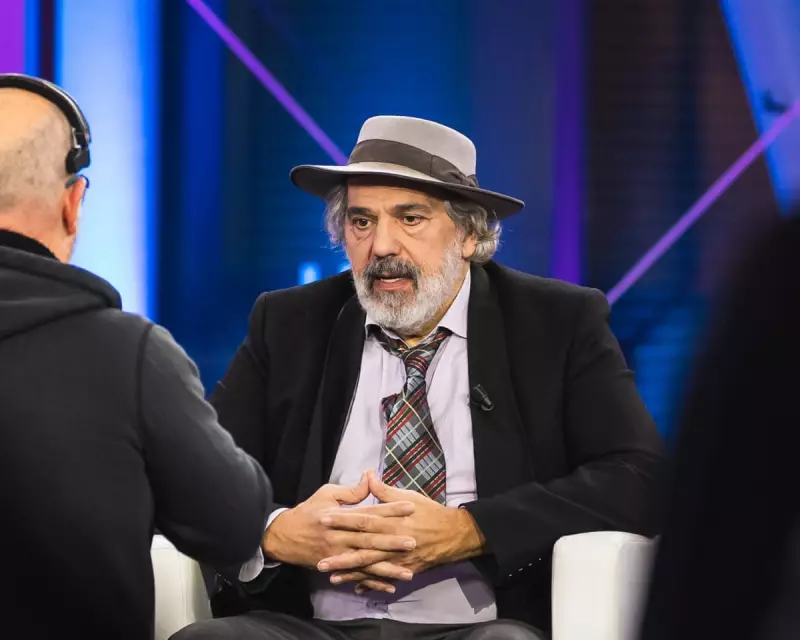
Portugal's upcoming presidential election has taken an unexpected turn, with a satirical candidate promising Ferraris for all and wine on tap capturing public attention. As the country prepares to vote on Sunday, the race among eleven contenders remains wide open, with no candidate expected to secure an outright victory in the first round.
The Absurdist Campaign Against Political Apathy
At the heart of this unusual political moment is Manuel João Vieira, a renowned Portuguese artist and comedian running as Candidato Vieira. His official yet satirical campaign features a series of deliberately outlandish pledges designed to critique the political mainstream. Beyond the promise of a Ferrari for every citizen, his platform includes installing wine taps in every home, founding a futuristic city called Vieirópolis where AI handles all work, and even a skin-tone homogenisation treatment to combat racism.
Vieira, who has previously run in 2001, 2006, 2011, and 2016, has for the first time gathered enough support to appear on the official ballot. Polls currently show him securing around 1% of voting intentions, placing him just behind candidates from the historic Portuguese Communist party and the leftwing Livre party.
A Fragmented Political Landscape
The election marks a significant shift in Portuguese politics, being the first in forty years that will almost certainly proceed to a second-round runoff. The incumbent, Marcelo Rebelo de Sousa, is stepping down, leaving a fractured field. André Ventura, leader of the far-right Chega party, is narrowly leading the polls, closely followed by the Socialist party's António José Seguro.
Political scientist António Costa Pinto of Lisbon University notes that this election signals the end of a tradition where the presidency was sought by figures firmly associated with the political elite. This change was underscored when Henrique Gouveia e Melo, the retired admiral who led Portugal's Covid vaccination campaign, chose to run as an independent.
Despite the president's role being largely ceremonial—though it holds powers to dissolve parliament and veto legislation—the outcome carries considerable weight. A strong showing for Ventura could further upend the political system, following Chega's surge in last May's general election where it became the main opposition party.
Mobilising Imagination in an Age of Disillusionment
Vieira's campaign, conducted largely through viral social media posts and intentionally crude AI-generated memes, aims to expose what he sees as the absurd vernacular of modern politics. He has stated his desire to be "more absurd than Donald Trump" to spark public imagination. His approach borrows from Portuguese popular imagery and often employs vulgar language, resonating particularly with younger voters disillusioned with traditional options.
At Lisbon's Campo de Ourique market, reactions were mixed. While one fishmonger pledged his vote to Vieira for his humour and anti-establishment stance, another remained committed to Ventura. An 18-year-old student, Manuel Gil, said he would vote for Vieira to help counter the misinformation attracting young people to Chega.
Vieira dismisses comparisons between himself and Ventura as fellow anti-system candidates, arguing that Ventura merely repackages old ideas. For Vieira, his surreal promises serve a deeper purpose: to reintroduce utopian thinking and fantasy into a political discourse marred by apathy. He believes mobilising the collective imagination is the first step towards creating genuine solutions and happiness in society.
As Portugal heads to the polls, the candidacy of Candidato Vieira stands as a surreal mirror to the nation's political discontent, proving that even in the most serious of democratic exercises, there is room for satire to provoke, challenge, and perhaps even inspire.




