
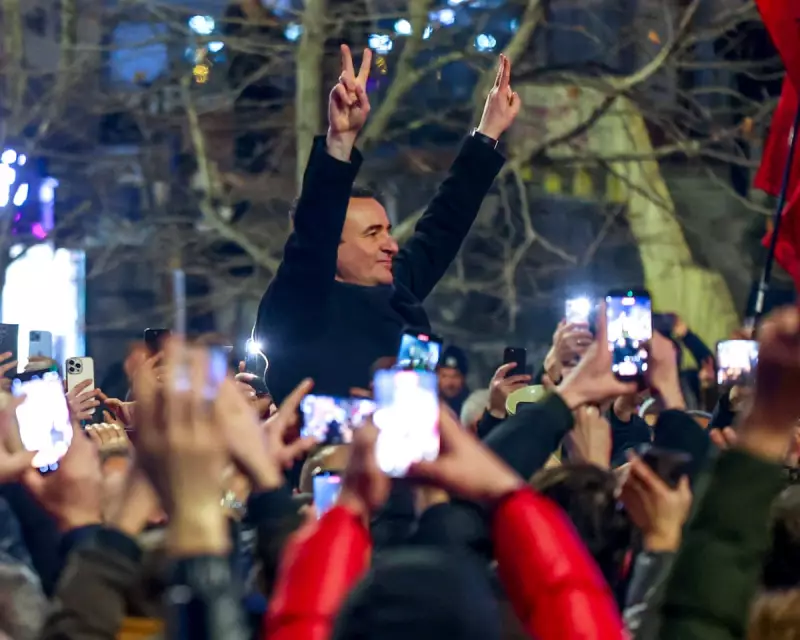
Kosovo's Prime Minister, Albin Kurti, has secured a resounding victory in a snap parliamentary election, breaking a prolonged political stalemate in the young Balkan nation.
A Decisive Mandate for Reform
With nearly all votes counted, official results show Kurti's Self-determination party (Vetëvendosje) led with more than 49% of the vote. This emphatic win provides him with a powerful mandate to pursue an ambitious domestic agenda, which includes expanding welfare provisions and increasing salaries for public sector workers.
The election on Sunday marks a significant political turnaround. Following an inconclusive poll in February, Kurti failed to form a coalition, leading to a nine-month parliamentary blockade throughout most of 2025. This political paralysis delayed the delivery of approximately €1 billion in crucial international funding for one of Europe's poorest economies.
Diaspora Vote and Domestic Challenges
The timing of the snap poll is seen as a key factor in Kurti's success. It was held during the holiday period when a significant portion of Kosovo's large diaspora typically returns home. According to an exit poll by Ubo Consulting, a striking 61.7% of diaspora voters supported Kurti's party.
Voters like Tahir Shabani, 58, who travelled from Germany to vote in the capital Pristina, expressed relief. "We are tired of this nine-month blockade that has cost us our nerves, cost Kosovo millions of euros, and set back our development," he said.
Despite the strong mandate, Kurti's new government faces immense challenges. These include chronically underfunded health and education systems that lag behind regional neighbours, deep-seated poverty, and organised crime.
International Relations at a Crossroads
Kurti's fresh term will be critically defined by Kosovo's foreign policy, particularly its fraught relationship with Serbia and its aspirations for European Union membership. Tensions with Belgrade flared violently in 2023, leading the EU to impose sanctions on Kosovo—partly in response to Kurti's policies towards the Serb minority in the country's north.
These measures are estimated to have cost Kosovo's economy hundreds of millions of euros. However, in a significant development as campaigning began this month, the EU announced it would lift the sanctions. Political commentator Ilir Deda suggested that the electorate interpreted this as a sign of repaired relations between Kurti and Western allies.
Deda described the election result as a "political earthquake" that could reshape Kosovo's political landscape for a decade, moving towards a model of strong government and weak opposition common in the region.
Kosovo, which declared independence from Serbia in 2008 with US backing following the 1998-99 war, is still not recognised by Serbia, Russia, Spain, Greece, and several other nations. For its 1.6 million citizens, the immediate demand, as voiced by voter Skender Halimi, 52, is for functional institutions and tangible progress in their quality of life.




