
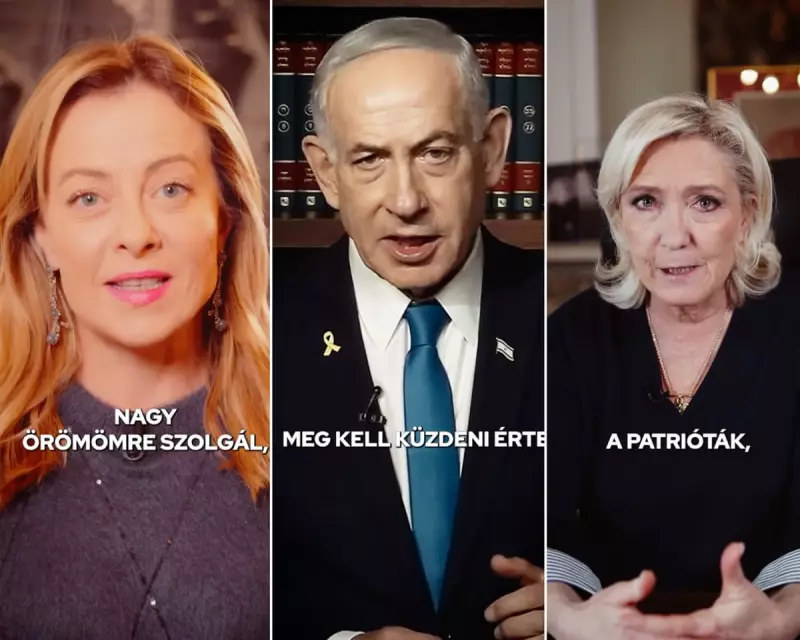
In a striking display of international political alignment, Hungary's Prime Minister Viktor Orbán has released a campaign video featuring endorsements from a host of prominent right-wing and far-right leaders worldwide. The video, published online this week, arrives as Orbán and his Fidesz party face an unexpectedly tight race ahead of the Hungarian parliamentary elections on 12 April.
A Coalition of Support from Abroad
The nearly three-minute video assembles messages of support from nearly a dozen figures. Key European allies include Italy's Prime Minister Giorgia Meloni and her deputy Matteo Salvini, France's Marine Le Pen of the National Rally, and Germany's Alice Weidel, co-leader of the Alternative für Deutschland (AfD).
Their statements frame Orbán as a crucial figure for a specific vision of Europe. "Europe needs Viktor Orbán," asserts Weidel. Meloni emphasises shared values, stating, "Together we stand for a Europe that respects national sovereignty [and] is proud of its cultural and religious roots." Le Pen praises Orbán for contributing to the success of the "camp of patriots and defenders of nations."
The video's reach extends beyond the EU, featuring Serbia's President Aleksandar Vučić, Argentina's libertarian President Javier Milei, and Czech former Prime Minister Andrej Babiš. Notably, Israel's Prime Minister Benjamin Netanyahu also appears, commending Orbán's qualities in protecting his country, stating "security cannot be taken for granted, it must be won."
Domestic Challenges and a New Opponent
This international show of force comes at a critical domestic juncture for Orbán, the EU's longest-serving leader. He is confronting a formidable challenge from Péter Magyar, a former insider from his own Fidesz party. Recent polls suggest Orbán is trailing behind Magyar's newly formed Tisza party, as Hungarians contend with economic stagnation, a high cost of living, and strained public services.
Political analyst Márton Bene of the TK Institute for Political Science in Budapest notes that Fidesz is strategically highlighting Orbán's global connections as a national asset. "Something his opponent – as a political newcomer – simply does not have," Bene observed. In contrast, Magyar's campaign is squarely focused on domestic issues, pledging to fight corruption and unlock billions in frozen EU funds to revitalise the economy.
Symbolism and the 'Illiberal' Model
The carefully curated video carries heavy symbolic weight for the global far-right movement. Orbán's Hungary has long been cited as a pioneering "success story" for illiberal populism. Analysts suggest a potential electoral defeat would resonate far beyond Hungary's borders.
"For this ideological camp, a potential collapse of the Orbán regime would be significant primarily in symbolic terms," explained Bene. He added that Orbán's Hungary has been a "prototype and early model" for the advance of the illiberal-populist right. Its downfall would challenge the narrative of a uniform, unstoppable global trend and call a frequently cited example into question.
The video also touches on foreign policy, with several leaders praising Orbán's stance on Ukraine. Alice Weidel says he is "fighting for peace in Ukraine," while Matteo Salvini directly links a vote for Fidesz with a desire for peace. Orbán, who maintains the closest ties to Vladimir Putin within the EU, has repeatedly frustrated Brussels' efforts to present a united front in support of Ukraine.
The election on 12 April now presents Hungarian voters with a clear choice: endorse Orbán's vision of a Hungary bolstered by powerful international alliances within a certain political sphere, or opt for Magyar's promise of a renewed focus on domestic reform and governance.




