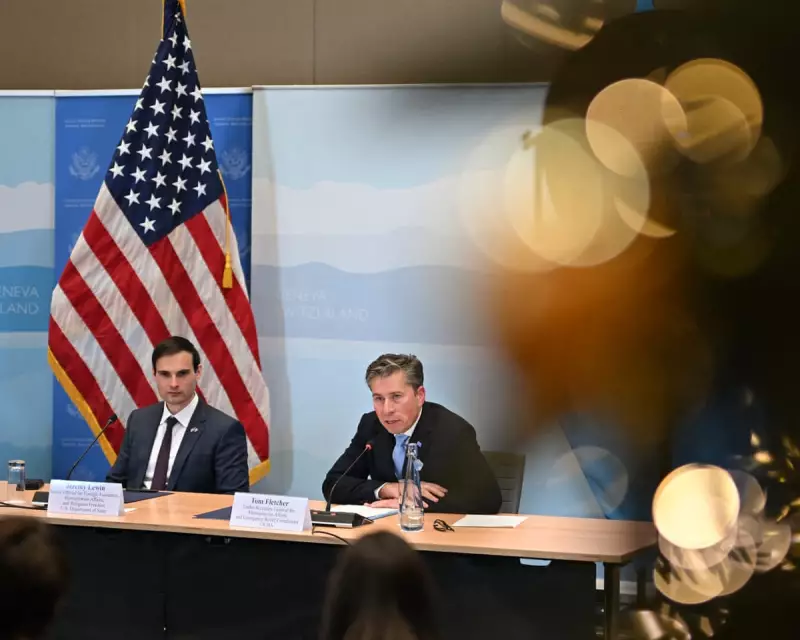
In a significant shift of strategy, the United States has pledged $2 billion to support a new United Nations model for delivering life-saving humanitarian assistance. The announcement was made in Geneva on Monday by senior US and UN officials, aiming to address a severe global funding shortfall.
A New Mechanism for Efficiency and Accountability
The substantial funding pledge is designed to assist tens of millions of people confronting hunger and disease across more than a dozen countries in the coming year. This initiative represents a fresh approach to aid delivery, established in response to drastic foreign aid reductions implemented by the previous Trump administration.
Jeremy Lewin, the US Under Secretary of State for Foreign Assistance, and Tom Fletcher, the UN Under Secretary General for Humanitarian Affairs, outlined the new framework. The model, agreed upon with the UN Office for the Coordination of Humanitarian Affairs (OCHA), seeks to make funding and delivery more efficient while enhancing accountability for how the money is spent.
Sharp Decline in US Contributions Triggers Crisis
This new partnership arrives amidst a dire financial crunch for UN aid operations. Recent data reveals a precipitous drop in total US humanitarian contributions to the UN, falling to roughly $3.38 billion in 2025. This figure equates to just 14.8% of the global sum, a stark decline from $14.1 billion the prior year and a peak of $17.2 billion in 2022.
The funding crisis has been exacerbated not only by US cuts but also by leading Western donors like Germany scaling back assistance to redirect funds towards defence spending. Earlier in December, the UN launched a 2026 aid appeal for $23 billion, a sum that is half the $47 billion sought for 2025, reflecting plunging donor support despite record global needs.
Priority Countries and Notable Exclusions
Officials confirmed that the US and UN will sign 17 memorandums of understanding with individual nations identified as priorities. Countries confirmed to be included in Monday's package are Ukraine, the Democratic Republic of Congo, Nigeria, and Sudan.
However, the new mechanism will not cover several areas the UN considers critical. UN aid chief Tom Fletcher stated that Yemen, Afghanistan, and Gaza will not receive US funding under this new programme, adding that the UN will seek support from other donors for these regions.
Jeremy Lewin specifically addressed Gaza, confirming it is not covered in this announcement and will be handled on a separate track. He noted the US had approved over $300 million following a ceasefire brokered with help from the Trump administration to fund UN agency pipelines in Gaza, with plans to attract additional donors for a pooled mechanism under a separate phase of the deal.
Focus on Life-Saving Aid and Impartial Delivery
Lewin emphasised that the focus of this $2 billion funding is strictly on life-saving assistance. Funding for climate-related projects and other initiatives not deemed a priority by the current administration will be cut. Despite donors having "specific requirements" about which countries and projects are funded, Tom Fletcher stressed that humanitarian action "must always be neutral and impartial and independent." He asserted that the new partnership does not undermine these core principles.
Despite a tough year marked by sweeping cuts and surging crises in war-torn nations like Sudan, Fletcher expressed optimism following the US pledge. He concluded that the new model would have a direct and vital impact, stating, "Millions of lives will be saved across 17 countries."