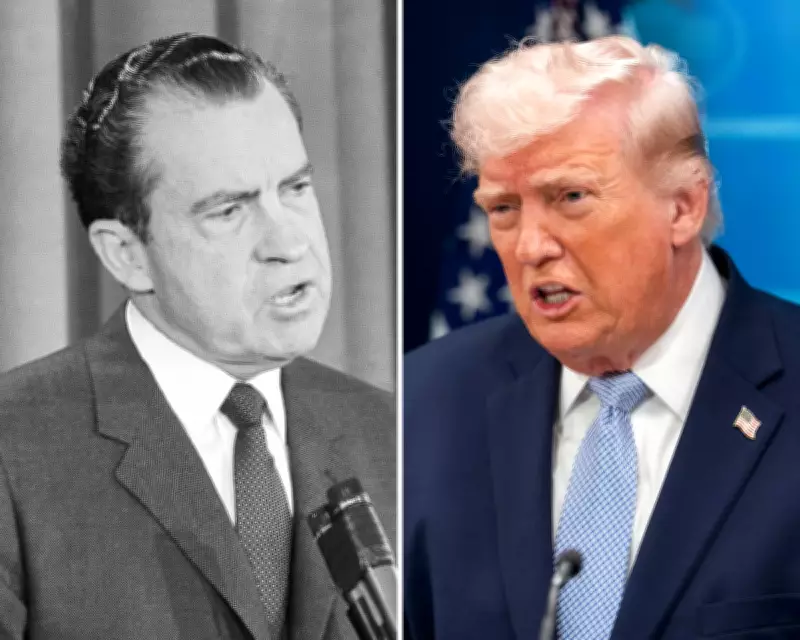
In a striking parallel to historical political maneuvers, recent analysis has drawn comparisons between Donald Trump's approach to governance and Richard Nixon's infamous "madman theory" employed during the Iran crisis. This strategy, which involves projecting an image of unpredictability and volatility to intimidate adversaries, appears to resonate in modern political tactics, particularly in foreign policy contexts.
Historical Context of the Madman Theory
The "madman theory" was a psychological strategy famously utilized by President Richard Nixon during the late 1960s and early 1970s, particularly in dealings with Iran and other international actors. Nixon and his administration sought to convince foreign leaders, especially in the Middle East, that he was capable of irrational and extreme actions, thereby coercing them into concessions out of fear. This tactic was part of a broader effort to assert U.S. dominance during a period of geopolitical tension, including the Cold War and conflicts in Iran.
Trump's Modern Application
Observers note that Donald Trump's political style, characterized by abrupt policy shifts, aggressive rhetoric, and a penchant for dramatic announcements, mirrors the core principles of Nixon's madman theory. During his presidency and subsequent political activities, Trump has often employed tactics designed to keep opponents, both domestic and international, off-balance. For instance, his handling of diplomatic relations with Iran involved sudden escalations and de-escalations, creating an aura of unpredictability similar to Nixon's approach.
This strategy is not merely about personal temperament but is seen as a calculated method to gain leverage in negotiations. By fostering an image of being unconstrained by conventional norms, Trump aims to pressure adversaries into making favorable deals, much as Nixon did with Iran. Critics argue that while this can yield short-term advantages, it risks destabilizing international relations and eroding trust among allies.
Implications for Foreign Policy
The revival of madman theory tactics in contemporary politics raises significant questions about the long-term impacts on global diplomacy. In the case of Iran, both Nixon and Trump's approaches have contributed to complex and often tense relationships, influencing everything from nuclear agreements to regional stability. Experts suggest that such strategies, while potentially effective in coercive contexts, can lead to miscalculations and increased conflict if not carefully managed.
Moreover, the comparison highlights a broader trend in political strategy, where leaders use perceived irrationality as a tool of power. This has implications beyond Iran, affecting U.S. relations with other nations and shaping the overall landscape of international affairs. As political analysts delve deeper, they emphasize the need for a balanced approach that combines strategic assertiveness with diplomatic consistency to avoid the pitfalls of past madman theory applications.
In summary, the echoes of Nixon's madman theory in Trump's political playbook underscore a continuity in the use of psychological tactics in foreign policy. While the specifics may evolve with changing geopolitical dynamics, the underlying principle of leveraging unpredictability remains a potent, if controversial, tool in the arsenal of modern leaders.