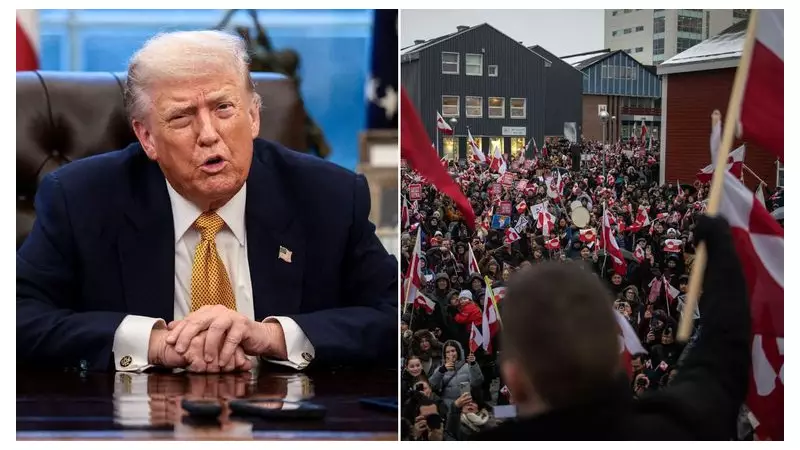
Former US President Donald Trump has ignited a fierce transatlantic dispute by threatening to impose punitive tariffs on the United Kingdom and seven other European nations unless the United States is permitted to purchase Greenland.
Tariff Timeline and Target Nations
In a detailed post on his Truth Social platform on Saturday, 17 January 2026, Mr Trump declared that a 10% tariff would be levied on imports from eight countries starting 1 February 2026. The nations targeted are Denmark, Norway, Sweden, France, Germany, the United Kingdom, the Netherlands, and Finland.
He further warned that if no agreement for "the complete and total purchase of Greenland" is reached, the tariff rate would escalate dramatically to 25% on 1 June 2026. The threat appears to follow through on previous warnings from Mr Trump regarding his ambition to acquire the vast, strategically important Danish territory.
Swift and Unified Condemnation from Allies
The announcement prompted immediate and strong criticism from political leaders across Europe. UK Prime Minister Sir Keir Starmer stated that Mr Trump was "completely wrong" to apply tariffs on NATO allies dedicated to collective security, vowing to challenge the US administration on the issue.
French President Emmanuel Macron labelled the tariff threat "unacceptable," promising a coordinated European response if it is implemented. The leadership of the European Union, Commission President Ursula von der Leyen and Council President Antonio Costa, expressed "full solidarity" with Denmark and Greenland in identical social media statements.
They warned that such tariffs "would undermine transatlantic relations and risk a dangerous downward spiral." The European Union has called an emergency meeting of ambassadors from its 27 member states for Sunday, 18 January.
In the UK, opposition leaders joined the condemnation. Tory leader Kemi Badenoch agreed the move was "completely wrong," noting it would place a burden on British businesses. Reform leader Nigel Farage warned it would "hurt" the UK, while Liberal Democrat leader Sir Ed Davey accused Mr Trump of "punishing" the country.
Protests and Political Reassurances
The tariff threat coincided with significant public demonstrations in support of Greenland. On Saturday afternoon, thousands of people marched through Copenhagen, waving Danish and Greenlandic flags and carrying signs with slogans like "Make America Smart Again" and "Hands off."
Similar rallies were planned in Nuuk, Greenland's capital, and other parts of the Danish kingdom. Protester Elise Riechie captured the mood, stating, "There are many small countries. None of them are for sale."
Amid the tensions, a bipartisan US congressional delegation, led by Delaware Democratic Senator Chris Coons, visited Copenhagen to offer reassurances. Senator Coons emphasised his desire to de-escalate the situation, expressing deep respect for Denmark and the NATO alliance.
"There are no current security threats to Greenland," Mr Coons asserted, directly contradicting Mr Trump's stated rationale that Russia and China have designs on the territory. He cautioned that alienating a close ally like Denmark could damage America's global credibility.
Mr Trump framed the tariffs as retaliation for European nations deploying military personnel to Greenland in a show of support. He claimed these actions introduced an untenable level of risk. Reports indicate France sent up to 15 personnel, Germany sent 13, and the UK deployed one military officer to the territory.
The situation remains fluid, with the White House not ruling out forceful action to secure Greenland, which is rich in critical minerals. The international community now awaits the outcome of the EU's emergency talks and the 1 February deadline.