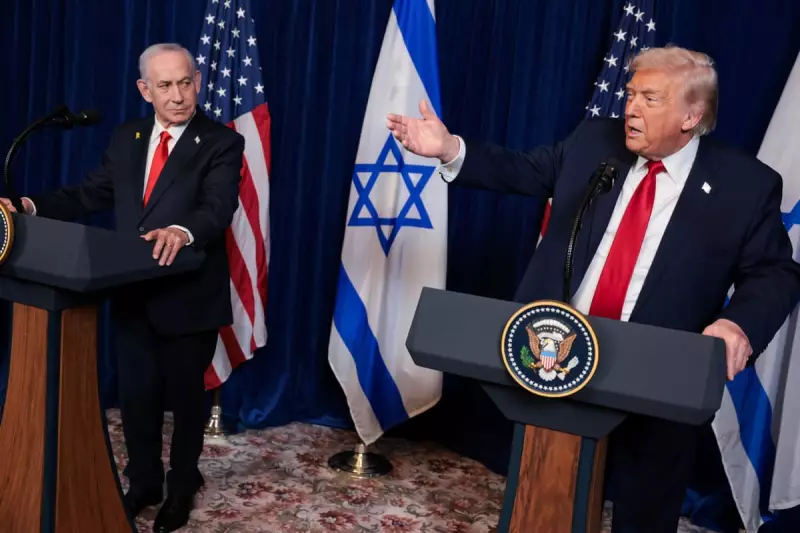
In a display of unorthodox diplomacy, former US President Donald Trump has pledged his unequivocal and immediate support for Israeli Prime Minister Benjamin Netanyahu should Israel launch another attack on Iran's nuclear facilities.
Mar-a-Lago Meeting Defies Diplomatic Convention
The declaration came during an impromptu 15-minute news conference on the steps of Trump's Mar-a-Lago resort in Florida. This marked the fifth meeting between the two leaders since Trump returned to the White House eleven months ago, a frequency Trump himself noted with an offhand remark to journalists.
Trump proceeded to trample diplomatic norms by confirming he had personally asked Israel's President, Isaac Herzog, to pardon Netanyahu in his ongoing bribery and corruption trial. This move appeared to show a disregard for the perception of interfering in the judicial affairs of a sovereign ally.
Pledges on Iran and Comments on Global Conflicts
On the critical issue of Iran, Trump stated he would back Netanyahu "immediately" if the Prime Minister ordered strikes on nuclear installations like those at Fordow, Isfahan, and Natanz. This follows US strikes ordered by Trump last June, which he claims "obliterated" Iran's nuclear capabilities, despite reports Tehran is now rebuilding them.
Trump added a caveat, noting that while "Iran may be behaving badly," it had not been confirmed. He expressed hope for a negotiated deal but was clear on consequences: "If they continue with [ballistic] missiles, yes; the nuclear [program]? Fast... we'll do it immediately." However, he explicitly ruled out supporting regime change in Iran.
In a startling diversion, Trump appeared to accept Russia's claim that Ukraine had attacked President Vladimir Putin's residence, admitting he had no independent US intelligence to verify it. This came just a day after hosting Ukrainian leader Volodymyr Zelenskyy, who denounced the story as a lie.
Underlying Tensions and Mutual Flattery
Despite the public display of camaraderie, the meeting occurred against a backdrop of friction. The White House is pressing Netanyahu to enter the second phase of Trump's 20-point Gaza peace plan, while Netanyahu insists Hamas must be disarmed first. Trump acknowledged the need to disarm Hamas but suggested reconstruction of Gaza would begin "pretty soon."
Netanyahu, maintaining a poker face throughout, lavished praise on Trump, calling him the "best friend" Israel had ever had in the White House. He later announced Trump would be the first non-Israeli awarded the prestigious Israel Prize. Trump reciprocated with hyperbolic praise, suggesting Israel might not exist today under a different, weaker prime minister.
The leaders also discussed Syria, where Trump expressed hope Netanyahu would "get along" with its president, Ahmed al-Sharaa, whom he called a "tough cookie." Netanyahu offered a more guarded response, focusing on Israel's need for a safe border free from terrorists, indicating an "understanding" open to interpretation.