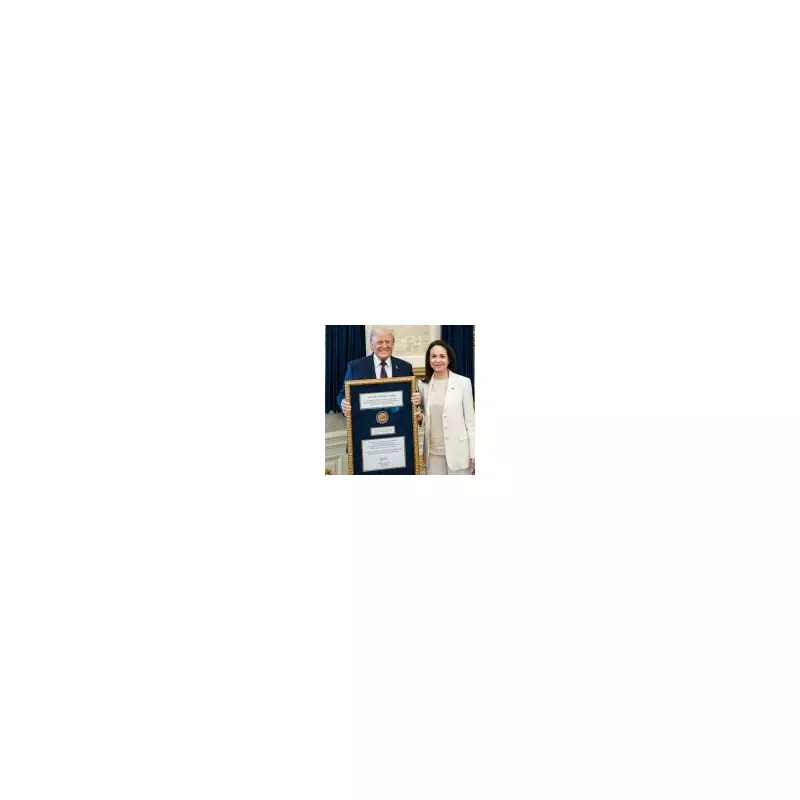
In a striking political spectacle, former US President Donald Trump has finally achieved his long-held ambition of being pictured with a Nobel Peace Prize medal. The moment, however, came not through an award from the Norwegian committee, but as a personal gift from a Venezuelan opposition leader seeking his support.
A Second-Hand Prize and a Calculated Gesture
The event unfolded during a meeting at the White House on January 16, 2026. Venezuelan opposition figure María Corina Machado, who was barred from her country's 2024 presidential election and later fled persecution, presented Trump with the physical medal from her own Nobel Peace Prize. She was awarded the honour for her work advancing democracy in Venezuela.
This theatrical transfer allowed Trump, who has openly coveted the accolade for years, to hold a Nobel medal. The Norwegian Nobel Institute was swiftly forced to clarify a fundamental point: while the gold disc can be handed over, the title and honour cannot be gifted. The institute's statement underscored that legitimacy is not transferable through a photo opportunity.
The Realpolitik Behind the Photo Op
Machado's move, while stark, is born of desperate political calculus. Facing an existential struggle for her country's future, she is leveraging any available tool to secure backing from a figure who holds immense sway. Trump's administration has shown notable warmth towards the deputy of the Venezuelan leader he helped depose, leaving Machado in a perilous position.
Her gesture, however understandable, carries a dangerous precedent. When democrats start offering symbolic trinkets to strongmen, it teaches the wrong lessons. It suggests that institutions are negotiable and that legitimacy can be acquired like a souvenir, eroding the very democratic principles the medal represents.
Britain's Lesson in 'Soft Power' and Sycophancy
This incident holds a sharp mirror up to British foreign policy. The UK has long prided itself on 'soft power'—using culture, diplomacy, and pageantry to exert influence. This approach has recently manifested in Prime Minister Keir Starmer's unprecedented decision to extend a second state visit invitation to Trump.
The theory was classic British statecraft: deploy unparalleled soft power to gain respect, influence, and concessions. The reality has been less impressive. While there have been murmurs of marginally lower tariffs, the UK has secured no meaningful strategic wins, particularly regarding crucial support for Ukraine.
At some point, the world began treating Trump like a monarch, and he has internalised the role. The transaction cannot be 'We flatter you so you won't hurt us.' It must be: 'We will cooperate when it benefits both nations, and we will stand firm against you when it does not.'
Reclaiming Democratic Dignity
The path forward is demonstrated by figures like Zohran Mamdani, the Mayor of New York City, who built his profile in opposition to Trump. Their notably polite Oval Office meeting suggested a begrudging respect earned through principle, not obsequiousness. Mamdani's instinct was correct: you do not manage a planet-sized ego by forever orbiting it.
This must become the British instinct. No more breathless capitulation. No more treating royal invitations as bargaining chips. Britain's moral core, evidenced by its unwavering stance against Russian aggression, must not be sacrificed for a 'special relationship' defined by geopolitical sycophancy.
María Corina Machado handed over her medal. The agenda is clear, but the execution is perilous. The UK and Europe must lead by example and cease playing along. If global politics devolves into a series of offerings to one man's vanity, we risk losing the very greatest export that defines Britain: democracy itself.