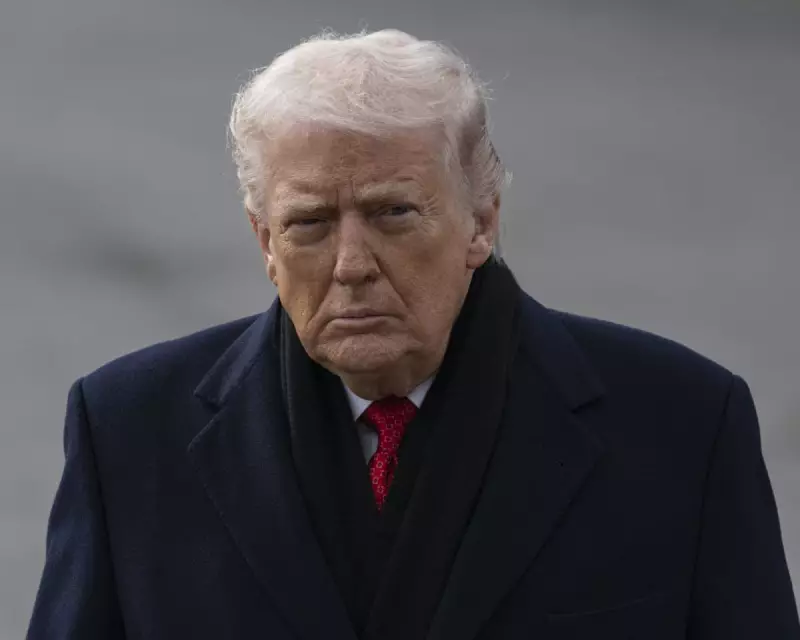
The international order faces a historic rupture as former US President Donald Trump's declared intention to annex Greenland, by force if required, has triggered a crisis of leadership. Writing in the wake of the announcement, former UK Prime Minister Gordon Brown warns this aggressive move definitively ends any hope that the liberal, rules-based system can survive a second Trump term.
A Moment of Reckoning for Global Democracy
The plan, which has been met with firm resistance across Europe led by Prime Minister Keir Starmer, represents more than a territorial dispute. On 16 January 2026, as Trump departed the White House, the world witnessed the culmination of a presidency that has systematically dismantled America's postwar principles. Brown states that the US has abandoned its championing of the rule of law, human rights, and the territorial integrity of nations, casting aside the very tenets of the Atlantic Charter.
"We cannot doubt any longer," Brown writes, that Trump meant his dismissal of international law. The president's worldview, articulated by adviser Stephen Miller, is one governed solely by "strength ... force ... [and] power." This shift renders the traditional expectation of US leadership obsolete, creating a vacuum that democracies must now fill.
Charting a New Path: A Charter for a Multipolar World
Brown argues that this moment demands proactive courage from Europe and the democracies of the global south. The solution is not to seek a new single hegemon but to forge a renewed coalition. He proposes the drafting of a short, powerful values statement, echoing the "We the peoples" preamble of the UN Charter, to establish a new framework for cooperation.
This charter would have two core sections. The first must reaffirm foundational commitments: self-determination, the outlawing of war and coercion, and the primacy of law and democratic accountability. A second section would outline rules for essential global cooperation on food and water security, economic justice, climate resilience, and pandemic prevention.
UN Secretary General António Guterres met with Keir Starmer at 10 Downing Street on 16 January 2026, a meeting that underscored the urgent diplomatic response. Starmer has argued for reinvigorating the shared values of 1945 to meet new-age challenges.
Confronting Modern Realities Beyond 1945
Any new framework must account for realities ignored in the postwar settlement. Brown lists the existential climate crisis, demands for gender equality, modern terrorism, and the power of non-state actors with vast wealth and technology. Crucially, it must address the rising aspirations of the global south and our inescapable global interdependence.
This interdependence, Brown notes, is a double-edged sword. While it makes cooperation essential, it can also be weaponised, as seen with China's monopoly on rare earths or control of maritime choke points. The only defence is for democracies to act in concert.
The article highlights a stark choice offered by Trump's administration: while withdrawing from 66 international organisations this month, it is simultaneously forming an alternative "board of peace" with a remit for global intervention, inviting around 60 favoured states including Russia.
Brown concludes that Trump rejected a pragmatic victory in Greenland—Denmark had offered virtually unlimited military bases and access to 25 critical minerals—in favour of conquest. This choice truly ends the era of America as a "shining city on a hill." The path forward, he asserts, is the one outlined by John F. Kennedy: building "a new world of law where the strong are just and the weak are secure." The world must now walk that path without, or in spite of, American leadership.