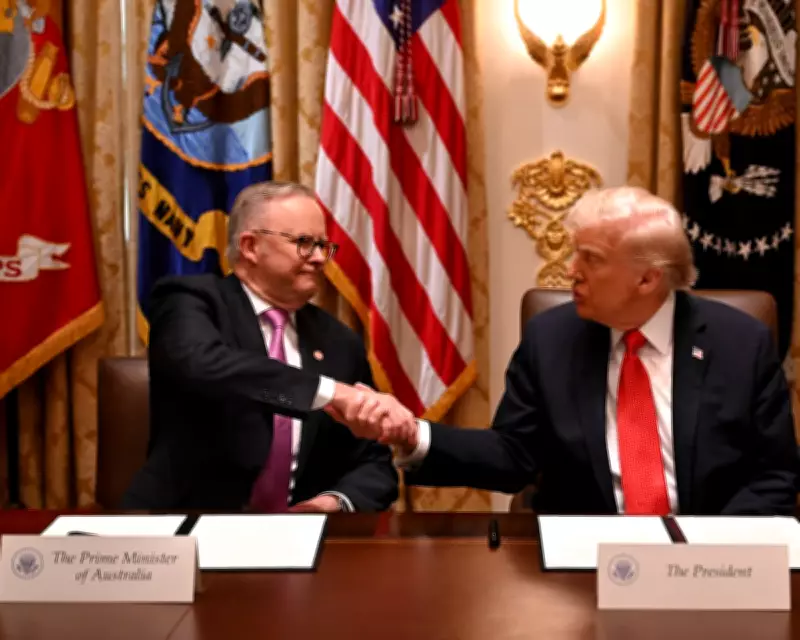
Albanese's Calculated Silence Shattered by Trump's Iran Threats
Australian Prime Minister Anthony Albanese has meticulously maintained a diplomatic strategy toward US President Donald Trump since his return to the White House in early 2025: avoid engagement and refrain from retaliation. This deliberate approach has been grounded in the pragmatic calculation that responding to Trump's frequent social media outbursts would yield minimal benefits while potentially jeopardizing critical agreements like the Aukus security pact.
The Breaking Point in Diplomatic Restraint
For months, Albanese has steadfastly adhered to this non-confrontational stance, even when confronted with Trump's provocative suggestions, including his controversial proposal to transform war-torn Gaza into what he termed the "Riviera of the Middle East." The prime minister has consistently argued that his restrained diplomatic approach has delivered tangible results: the Aukus agreement remains on track, a multi-billion dollar critical minerals deal has been finalized, Julian Assange has been freed, and Australia has maintained favorable trade terms with the United States.
However, as Trump's rhetoric escalated dramatically following the outbreak of conflict with Iran, including direct criticisms targeting Australia, Albanese's carefully crafted strategy became increasingly difficult to sustain. The situation reached a critical juncture when Trump publicly threatened widespread bombing of civilian infrastructure in Iran unless the regime surrendered.
A Rare Moment of Public Criticism
Faced with what he perceived as an unprecedented escalation, Albanese broke his diplomatic silence during a pre-recorded interview with Sky News. The prime minister described Trump's threats as "extraordinary" and explicitly stated that such language from the US president was inappropriate and would likely cause significant international concern.
This marked a notable departure from Albanese's established practice of refusing to provide what he has previously termed a "running commentary" on Trump's statements. The prime minister's criticism, while carefully worded and delivered in a controlled media environment, represented a clear shift in his diplomatic approach.
Analyzing the Strategic Shift
Several factors appear to have contributed to Albanese's decision to break his diplomatic silence. The prime minister evidently believed that Trump's specific threats regarding the bombing of bridges and power plants crossed a new threshold that demanded a public response. Many observers, including senior Labor figures and party members, argue that this line had been crossed much earlier, particularly when the United States and Israel initiated bombing campaigns against Iran that many experts assessed as clear violations of international law.
Albanese's criticism of Trump's language follows his recent questioning of the objectives of a war that the Australian government had initially endorsed. These developments should not be interpreted as signaling a broader decoupling from the United States or an alignment with more openly critical international leaders like French President Emmanuel Macron. Rather, they appear to reflect the prime minister's response to growing domestic discontent with both Trump and the Iran conflict, which has directly contributed to soaring fuel prices affecting Australian consumers.
The Political Calculus Behind Diplomatic Decisions
As prime minister, Albanese operates under different constraints than opposition figures like Andrew Hastie or Nationals leader Matt Canavan, who described Trump's threats as "well beyond the realms of acceptability." While Albanese cannot employ the same colorful language as his political counterparts, his recent statements suggest a recognition that, as Canavan noted during a National Press Club appearance, leaders must occasionally "call a spade a spade."
The diplomatic landscape now awaits Albanese's response to Trump's next inevitable outburst. What remains clear is that the prime minister's long-maintained strategy of diplomatic restraint has undergone a significant recalibration in response to what he perceives as unprecedented circumstances.