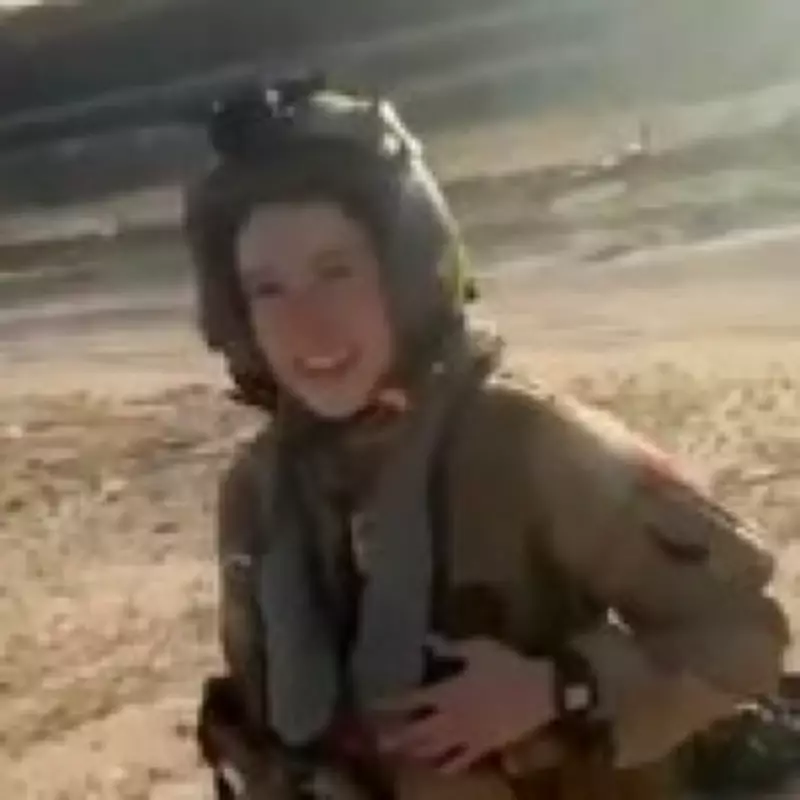
US Pilot Survives Kuwait Desert Crash After F-15 Shot Down in Friendly Fire Incident
In a remarkable display of survival, an American pilot was captured on video shouting "I'm OK" to locals after crash-landing in the Kuwaiti desert, following a mistaken friendly fire incident during an Iranian air assault. The US military confirmed that all six US Air Force members parachuted to safety and were in stable condition after being recovered from the scene.
Dramatic Desert Encounter and Rescue Efforts
The astonishing moment unfolded as one female F-15 crew member was seen standing alone in the vast Kuwaiti desert, brushing sand from her jumpsuit but appearing unharmed. A local man approached her, asking, "You're fine? Really? Do you need something to help you?" She calmly replied, "No, I'm OK," to which he responded, "No problem, you're safe, you're safe... Everything good, no problem. Thank you for helping us."
Another crew member was approached by a group of locals armed with AK-47s, who initially presumed he was a shot-down Iranian pilot. He is seen surrendering, with one local holding up a pipe, before being whisked away to safety. A third was pictured with a badly damaged hand before being loaded into the boot of a car for transport.
Background of the Incident and Broader Conflict
The F-15E Strike Eagles, capable of reaching speeds just shy of 2,000 mph, were shot down during an attack by Iranian aircraft, missiles, and drones. Iranian state television claimed that Iran had targeted one of the US planes that crashed in Kuwait, without providing further details. Witness Ahmed al-Asar reported hearing explosions as one of the planes fell from the sky in flames, rushing to the scene with about a dozen others as an airman parachuted to the ground. Al-Asar initially thought it was an Iranian pilot but recognized he was American before rescuers arrived.
It is reported that US pilots carry messages printed in local languages offering rewards if they are returned to friendly forces. One such message reads: "I am an American and I do not speak Arabic/Turkish/Persian/Kurdish. I will do you no harm. My friend, please provide me with food, water, shelter, clothing, and a doctor. Also, help me get to the American forces or those of other friendly nations. When you give my name and this number to the American authorities, you will be rewarded for helping me."
Escalating Regional Tensions and Casualties
The intensity of the attacks, coupled with the killing of Iranian Supreme Leader Ayatollah Ali Khamenei and the lack of an apparent exit plan, has set the stage for a prolonged conflict with far-reaching consequences. Safe havens in the Middle East, such as Dubai, have seen incoming fire; hundreds of thousands of airline passengers are stranded globally; oil prices have surged; and US allies have pledged to help stop Iranian missiles and drones.
With no sign of the conflict abating, former US President Donald Trump stated that operations are likely to last four to five weeks but that he was prepared "to go far longer than that." He emphasized that US forces are determined to destroy Iran's missile capabilities, wipe out its naval capacity, prevent the country from obtaining a nuclear weapon, and ensure Iran cannot continue to support allied groups like Lebanon's Hezbollah, which fired missiles at Israel, drawing retaliatory airstrikes. Trump declared, "This was our last, best chance to strike, what we're doing right now, and eliminate the intolerable threats posed by this sick and sinister regime."
Iran has long threatened to drag the region into total war if attacked, targeting Israel, Gulf Arab states, and the flow of crude oil crucial for global energy markets. Trump added that he would not get "bored" with continuing the operation, saying, "I don't get bored. There's nothing boring about this." He noted that the US had projected it would take four weeks to eliminate Iran's military leadership, but this was quickly accomplished, putting them "ahead of schedule."
Rising Death Toll and International Impact
Meanwhile, the death toll has grown on all sides. The Iranian Red Crescent Society reported that the joint US-Israeli operation has killed at least 555 people. On the US side, four American troops have been killed, with additional casualties reported: three people in the United Arab Emirates, and one each in Kuwait and Bahrain. An Iranian drone strike on a hotel in Manama, Bahrain's capital, injured two Department of Defense employees over the weekend, according to a diplomatic cable from the State Department seen by The Washington Post.
This incident underscores the volatile nature of the ongoing conflict, highlighting both the resilience of military personnel and the broader geopolitical stakes involved.