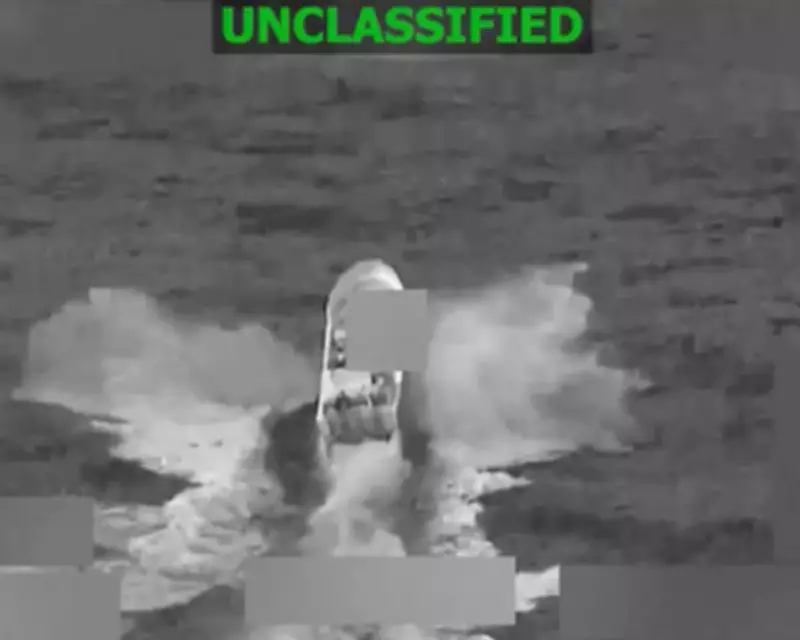
The United States military has confirmed the execution of another lethal strike in the eastern Pacific Ocean, resulting in the deaths of two individuals suspected of involvement in drug smuggling. This operation, announced by the US Southern Command, underscores the Pentagon's continued aggressive stance against narcotics trafficking in the region.
Details of the Deadly Strike
According to an official statement released on Monday, the strike targeted a boat that was transiting along known narco-trafficking routes. The US Southern Command, which oversees military activities across Latin America and the Caribbean, reported that the attack was carried out under the direction of its newly appointed commander, General Francis L. Donovan. General Donovan was sworn in at a Pentagon ceremony just last Thursday, taking over from Admiral Alvin Holsey, who retired amid reported disagreements over the controversial boat-strike policy.
The Pentagon accompanied its announcement with video footage showing the boat before it was struck, which was shared on the Southern Command's X account. Following the attack, the US Coast Guard was dispatched to search for a lone survivor, though the outcome of that rescue effort remains unclear at this time.
Escalating Toll and Legal Concerns
This latest incident brings the total death toll from such strikes to at least 130 people across 38 separate operations, based on Pentagon statements tallied by investigative sources. Legal experts have repeatedly criticised these actions as a series of extrajudicial killings, raising significant human rights and international law concerns. The strikes are part of a broader strategy to disrupt drug smuggling networks, but they continue to spark debate over their legality and ethical implications.
Broader Context: Venezuela Sanctions and Tanker Interdictions
In a related development earlier on Monday, US military forces boarded a sanctioned tanker in the Indian Ocean as part of ongoing efforts to enforce oil quarantines targeting Venezuela. Defense Secretary Pete Hegseth explained that the ship had been tracked from the Caribbean Sea, highlighting the Trump administration's determination to squeeze Venezuela's oil exports, which have been subject to US sanctions.
Venezuela has relied on a shadow fleet of tankers with false flags to smuggle crude oil into global supply chains, circumventing these sanctions. Following a US raid in early January aimed at apprehending then-president Nicolás Maduro, several tankers fled the Venezuelan coast, including the vessel boarded in the Indian Ocean.
The Aquila II Tanker Incident
The tanker in question, the Aquila II, is a Panamanian-flagged ship under US sanctions for its alleged role in shipping illicit Russian oil. Unlike previous actions where vessels were formally seized, defense officials stated that the Aquila II is being held while its ultimate fate is decided by US authorities. A navy official, speaking anonymously, confirmed the involvement of destroyers USS Pinckney and USS John Finn, as well as the mobile base ship USS Miguel Keith, in the operation.
Owned by a company with a listed address in Hong Kong, the Aquila II has spent much of the past year with its radio transponder turned off—a practice known as "running dark" commonly used by smugglers to conceal their locations. According to Samir Madani, co-founder of TankerTrackers.com, this vessel was among at least 16 tankers that fled Venezuela last month, with movements documented through satellite imagery and surface-level photos.
Data transmitted from the ship on Monday indicated it was not currently carrying a cargo of crude oil. The Pentagon described the action as a "right-of-visit, maritime interdiction," asserting that the Aquila II was operating in defiance of President Trump's established quarantine of sanctioned vessels in the Caribbean. "It ran, and we followed," the Pentagon stated, reflecting a persistent pursuit policy.
Political and Strategic Implications
Defense Secretary Hegseth has vowed to capture all such ships, telling shipyard workers in Maine, "I don't care if we got to go around the globe to get them; we're going to get them." This rhetoric aligns with the Trump administration's broader efforts to take control of Venezuela's oil, having already seized seven tankers. The administration's aggressive posture continues to shape US foreign policy in the region, with significant implications for international relations and global oil markets.
As these operations unfold, they highlight the complex interplay between military action, law enforcement, and geopolitical strategy in combating drug trafficking and enforcing economic sanctions. The use of social media to disseminate video evidence, as seen with the Pacific strike, also points to a modern approach to public communication in military affairs.