
Trump's Middle East Military Move Creates Strategic Opening for China
The United States military has launched Operation Epic Fury against Iran, marking a significant escalation in Middle East tensions under Donald Trump's administration. This aggressive military posture, while demonstrating American power projection, has created an unexpected vulnerability that China appears poised to exploit through its dominance in critical mineral supply chains.
Diverted Resources and Strategic Weakness
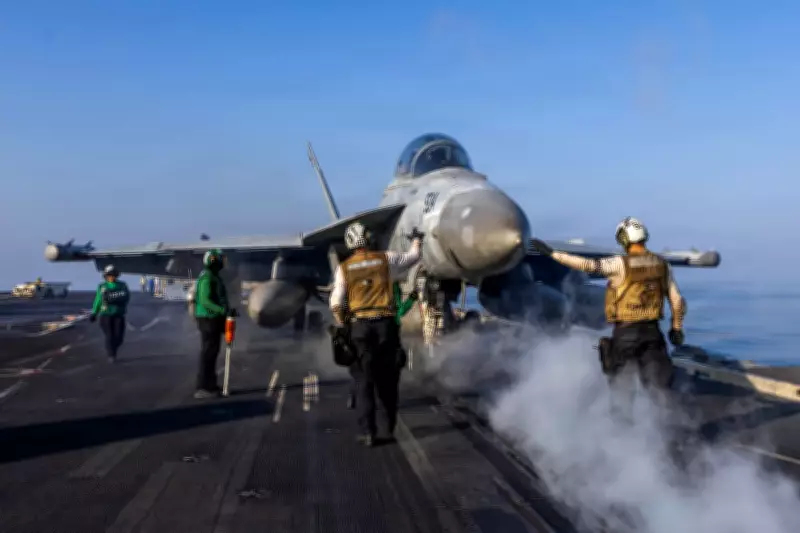
As the US commits substantial military assets to the Middle East conflict, including advanced F-35 fighter jets, Patriot missile defense systems, and Thaad missile systems, analysts warn this deployment creates strategic gaps elsewhere. The Pentagon's focus on Iran comes at a time when concerns about Taiwan's security have been mounting, with Beijing watching closely as Washington's attention shifts to another theater of operations.
Joseph Webster, a senior fellow at the Atlantic Council thinktank, observes that "Beijing will be delighted to see the US expending scarce munitions and interceptors in a secondary theatre." This resource diversion not only reduces what's available for potential Taiwan contingencies but also highlights America's dependence on Chinese-controlled critical minerals for advanced weapons systems.
China's Critical Mineral Leverage
The advanced weaponry deployed in Operation Epic Fury relies heavily on semiconductors and radars manufactured with gallium, a critical mineral where China maintains overwhelming supply chain control. During last year's US-China trade tensions, Beijing demonstrated this leverage by restricting gallium exports, nearly crippling global industrial supply chains and forcing Washington back to negotiation tables.
Matthew P Funaiole, a senior fellow at the Center for Strategic and International Studies, explains that "the more sustained vulnerability is not in firing them, but in the ability to manufacture, upgrade and repair the broader ecosystem of gallium-enabled systems." American efforts to develop alternative supply chains for critical minerals remain in early stages, unlikely to change supply dynamics meaningfully in the immediate future.
Oil Supply Complications and Economic Calculations
The conflict presents complex energy implications for China, which imports approximately 80% of Iran's shipped oil, accounting for about 13% of China's seaborne imports. While losing this supply would be manageable given China's strategic stockpiling efforts, it represents another challenge following recent disruptions to Venezuelan oil supplies.
Alicia García-Herrero, chief economist for Asia Pacific at investment bank Natixis, notes that "this is not coming at a good time for China" given surging energy demands from artificial intelligence infrastructure development. However, China has been preparing for such geopolitical shocks, increasing crude oil imports by 4.4% last year with over 80% of that increase going to strategic reserves.
Diplomatic Positioning and Strategic Calculations
China has officially condemned the US-led attacks, with Foreign Minister Wang Yi calling them "unacceptable" and demanding a ceasefire. This diplomatic positioning allows Beijing to present itself as a defender of international stability while avoiding direct material support to partners facing American pressure.
The conflict also threatens China's substantial $400 billion strategic partnership agreement with Iran signed in 2021, though only minimal portions have actually been delivered. Analysts at the Shanghai-based Hualue American Studies Center warn that regime change in Tehran could jeopardize this arrangement entirely.
Broader Strategic Implications
The widening Middle East conflict creates multiple strategic considerations:
- Reduced American focus on Asia-Pacific security concerns
- Depletion of US weapons stockpiles that could affect multiple theaters
- Potential strengthening of China's negotiating position ahead of Trump-Xi meetings
- Questions about China's diplomatic influence following the targeting of strategic partners
While some analysts suggest that the elimination of Iranian leadership could dent China's appeal to Global South countries, most experts agree that a US foreign policy establishment preoccupied with another sprawling conflict far from China's neighborhood ultimately benefits Beijing's strategic position.
The Pentagon's current vulnerability stems not just from diverted resources but from fundamental supply chain dependencies that China has carefully cultivated. As Operation Epic Fury unfolds, Washington finds itself simultaneously managing military operations while confronting the reality that advanced American weaponry depends on minerals controlled by a strategic competitor.




