
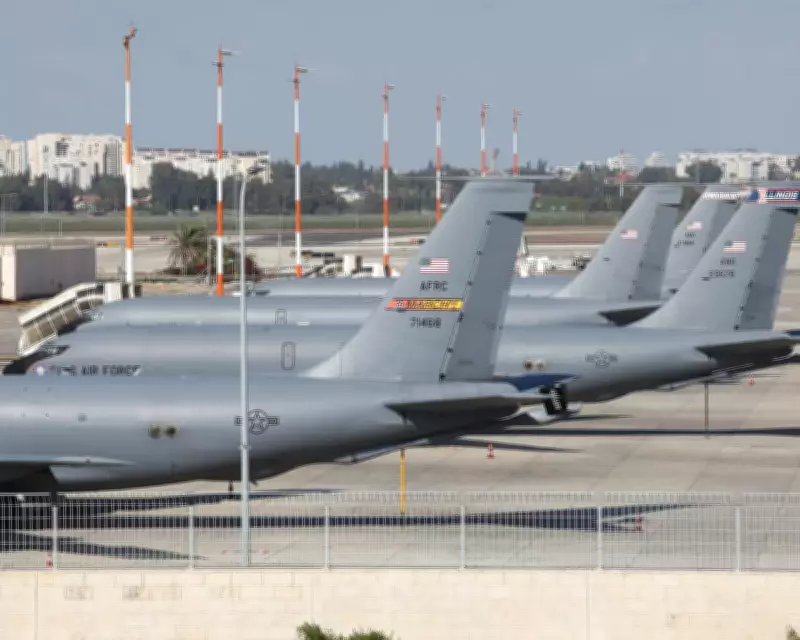
United States military aircraft were clearly visible at Ben Gurion International Airport in Tel Aviv, Israel, this Wednesday, as escalating geopolitical tensions between the United States and Iran continue to intensify. This significant military presence coincides with a substantial expansion of travel advisories across the Middle East and a notable reduction in commercial flight operations throughout the volatile region.
Global Diplomatic Withdrawals and Travel Advisories Escalate
In response to the deteriorating security situation, Australia has formally advised the dependants of its diplomatic officials stationed in Israel and Lebanon to depart those countries immediately. The Australian foreign ministry has extended this voluntary departure offer to family members of diplomats based in the United Arab Emirates, Qatar, and Jordan, citing serious concerns over regional stability.
This move follows the United States' own decision earlier this week to withdraw non-essential personnel and eligible family members from its embassy in Lebanon after a comprehensive security review. A growing list of nations, including Cyprus, Germany, India, Poland, Serbia, and Sweden, have now instructed their citizens residing in Iran to leave the country without delay. Singapore has reinforced its existing advisory, urging citizens to continue deferring all travel to Iran, while Brazil reiterated its recommendation for nationals to depart.
Critical Nuclear Talks Underway Amidst Military Posturing
The observable US military buildup unfolds as a pivotal day of negotiations concerning Iran's nuclear program commences. The Trump administration has issued stark warnings, threatening severe consequences if Iranian negotiators fail to make substantial concessions during these critical discussions.
US Vice President JD Vance articulated a firm stance to reporters, stating, "The principle is very simple: Iran cannot have a nuclear weapon." Echoing this sentiment, Secretary of State Marco Rubio highlighted a major obstacle, noting, "I would say that the Iranian insistence on not discussing ballistic missiles is a big, big problem." The US leadership consistently maintains that Iran is actively reconstituting its nuclear weapons capability, a claim Tehran vehemently denies, accusing the US of disseminating "big lies" while expressing cautious optimism that dialogue could lead to a viable agreement.
Commercial Aviation Reacts to Regional Instability
For several weeks, the heightened risk of a potential military confrontation between the US and Iran has compelled major airlines to curtail their flight schedules to and over the affected region. KLM, the Dutch subsidiary of the Air France-KLM group, announced it will temporarily suspend all flights between Amsterdam and Tel Aviv starting March 1st. While the airline's statement did not explicitly reference the US-Iran tensions, it clarified that operating flights to Tel Aviv was no longer "commercially or operationally feasible" under the current circumstances.
This pattern of flight reductions and cancellations reflects the broader aviation industry's response to the perceived threat environment, disrupting normal travel corridors and impacting international connectivity across the Middle East.
A Coordinated International Response to Rising Threats
The convergence of visible military movements, diplomatic withdrawals, and aviation disruptions underscores a coordinated, multinational response to the escalating crisis. The situation remains fluid, with governments balancing the protection of their citizens and personnel against the complex diplomatic and military dynamics at play. The ongoing nuclear talks represent a crucial juncture, with their outcome likely to significantly influence whether tensions de-escalate or advance toward a more direct confrontation, further destabilizing an already fragile region.




