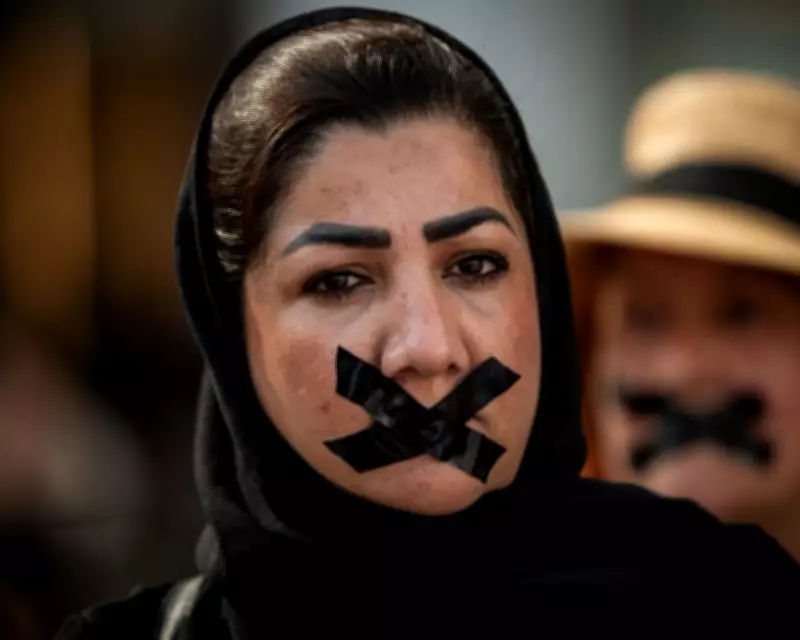
A Tactical Assault: Global Pushback Against Women's Rights Reaches Critical Juncture
In a Madrid silent protest, a woman stands holding a sign decrying the loss of fundamental rights for women and girls in Afghanistan. This image captures a growing global crisis as women's rights face coordinated attacks from multiple fronts. From Taliban-controlled Afghanistan to influential think tanks in the United States, patriarchal forces are mounting what activists describe as a "tactical assault" on gender equality.
Extreme Oppression in Afghanistan
Under Taliban rule, Afghanistan has implemented what human rights organizations term "gender apartheid." A recent case saw a judge tell a woman seeking divorce from her abusive husband that "a few beatings won't kill you," then sending her back to the violent marriage. This barbarity represents the extreme end of a spectrum of violence against women that extends far beyond Afghanistan's borders.
The Taliban's systematic dismantling of women's rights includes banning education for girls beyond primary school, restricting women's employment, and enforcing strict dress codes. Women who protest these restrictions face arrest, torture, and disappearance.
The Heritage Foundation's Patriarchal Vision
Meanwhile, in the United States, the Heritage Foundation has published "Saving America by Saving the Family," a report that outlines a deeply patriarchal model for American society. The document recommends policies that would encourage women to have more children earlier in life while discouraging higher education and careers outside the home.
Given Project 2025's significant influence on Donald Trump's policy platform for a potential second term, this vision represents a frightening projection of a future America where women's agency is systematically stripped away. The report's recommendations include eliminating no-fault divorce, restricting contraception access, and defunding reproductive healthcare services.
UN Agency Merger Sparks Alarm
Against this backdrop of global regression, a United Nations proposal to merge UN Women with the UN Population Fund (UNFPA) has triggered widespread alarm among feminist organizations and human rights advocates. Hundreds of groups have warned that consolidating these agencies could lead to reduced funding for gender equality programs and create opportunities for countries hostile to women's rights to further undermine global structures supporting gender equality.
One activist speaking ahead of the UN's Commission on the Status of Women described the proposed merger at this critical moment as "feeling like a tactical assault" on women's rights globally. The concern is that merging the agencies would dilute their specific mandates and make them more vulnerable to political pressure from anti-rights governments.
Global Patterns of Regression
The assault on women's rights extends across multiple continents and political systems. In Africa, AI-powered mass surveillance systems purchased from China are violating citizens' privacy rights while being used to crack down on protesters, including women's rights activists. These systems have cost African governments over $2 billion despite human rights experts declaring them neither "necessary nor proportionate."
In Latin America, Peru's highest human rights court recently found the government responsible for the death of Celia Ramos, one of 310,000 mostly Indigenous women targeted in a brutal forced sterilization campaign during the 1990s. The landmark ruling highlights how reproductive rights violations continue to have devastating consequences decades later.
Broader Human Rights Concerns
The global regression extends beyond women's rights to encompass multiple human rights domains. In Sudan, experts using satellite data have documented what they describe as a "starvation strategy of extraordinary cruelty" by the Rapid Support Forces, who have systematically destroyed farming infrastructure in Darfur to prevent communities from producing food.
The number of incarcerated women globally approaches one million, prompting the UN to adopt a groundbreaking agreement on justice for women that includes those in prison for the first time. Campaigners hope this move will bring meaningful change to penal systems that often fail to address women's specific needs and vulnerabilities.
Cultural and Historical Dimensions
The struggle for women's rights intersects with broader questions of identity and history. In his book "Chasing Freedom," Oxford professor Simukai Chigudu explores how being "born free" after colonial rule yet steeped in British traditions shaped his identity and that of a generation of Africans. His work asks what it means to stand up to the past without being trapped by it—a question relevant to women's rights movements navigating patriarchal traditions while forging new futures.
As UN Secretary-General António Guterres told the Commission on the Status of Women: "We still live in a male-dominated world and a male-dominated culture." With well-funded actors working to maintain this status quo, the coming months will prove critical for determining whether global institutions can effectively defend women's rights or will succumb to political pressures that threaten to roll back decades of progress.