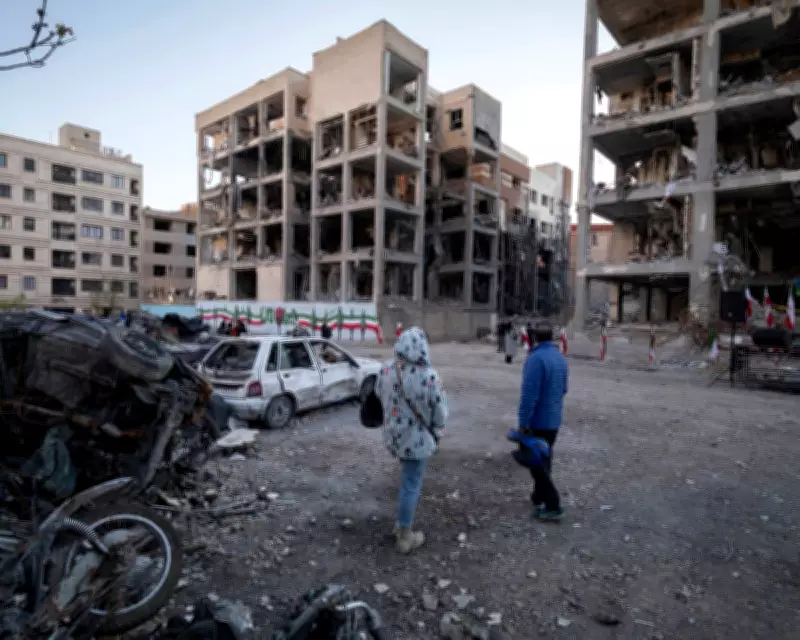
Trump's Iran Fiasco Escalates into Grave International Law Violations
Donald Trump's disastrous military engagement with Iran has spiraled into what experts describe as the gravest territory of international law violations. The president's escalating threats, which have progressed from hateful rhetoric to explicit calls for war crimes and genocide, reveal a leader consumed by fear of his own failure.
From Intimidation to International Law Violations
Throughout the White House, Trump has hung nine portraits of himself, each projecting variations of intimidation. Yet this self-aggrandizement has failed to calm a president staring into what he perceives as the worst failure of his life. His response to the Iran fiasco has been a dramatic escalation of profane, vile, and vicious threats that have crossed what should be inviolable red lines of international law.
When Trump launched his war against Iran, he reportedly believed it would conclude within days, with complete Iranian capitulation and control of their oil resources. Despite warnings from military leadership about geographical challenges, Trump dismissed these concerns. Iran quickly gained superior leverage by controlling the Strait of Hormuz, where a single drone or mine could destabilize the global economy.
The Descent into War Crime Rhetoric
Trump's public statements have progressively deteriorated from confident declarations of imminent victory to explicit threats against civilian infrastructure. In his only significant national address on the war, delivered on April 1, Trump claimed to have "beaten and completely decimated Iran" while simultaneously passing responsibility to other nations and declaring victory.
This confused address was followed by increasingly dangerous rhetoric. Trump introduced the phrase "We're going to bring them back to the Stone Ages, where they belong," signaling his intention to target civilian infrastructure like power plants and oil fields. Secretary of Defense Pete Hegseth immediately adopted this language, posting "Back to the Stone Age" as official messaging the following day.
Historical Echoes and Dangerous Parallels
The "Stone Age" rhetoric echoes air force general Curtis LeMay's Vietnam War strategy to "bomb them back to the Stone Age." LeMay, who criticized John F. Kennedy's diplomacy as "almost as bad as the appeasement at Munich," later became George Wallace's vice-presidential running mate in 1972. Trump's adoption of this language represents a dangerous revival of extremist military thinking.
Trump's threats reached their most alarming point on April 5 when he tweeted: "Tuesday will be Power Plant Day, and Bridge Day, all wrapped up in one, in Iran. Open the Fuckin' Strait, you crazy bastards, or you'll be living in Hell – JUST WATCH. Praise be to Allah." This explicit targeting of civilian infrastructure constitutes a war crime under international law.
Genocide Incitement and International Law Violations
By Easter morning, the 37th day of the conflict, Trump escalated further, threatening genocide with the statement: "A whole civilization will die tonight, never to be brought back again." Legal experts immediately identified this as incitement to genocide, which violates multiple international treaties ratified by the United States.
The Geneva Convention's Additional Protocol I explicitly prohibits attacks on civilian populations and objects indispensable to civilian survival. The Genocide Convention, which the U.S. has ratified, specifically punishes "direct and public incitement to commit genocide." This crime originated in the trial of Nazi propagandist Julius Streicher at Nuremberg in 1946.
Legal and Military Repercussions
Conservative legal scholar Robert P. George, a preeminent figure in the Federalist Society, issued a statement declaring: "I don't see any way to interpret President Trump's 'prediction' that 'a whole civilization will die tonight' as other than a threat to order the military to commit crimes against civilians. If he issues such an order, it will be the duty of military leaders to refuse to comply."
Remarkably, after these extreme threats, Trump abruptly declared a ceasefire rather than following through with his doomsday deadline. He then proposed a joint venture with Iran to charge tolls at the Strait of Hormuz, suggesting "big money" could be made and calling it "a beautiful thing."
The Psychology of Escalating Threats
Experts analyzing Trump's behavior note that the level of his threats measures the degree to which he feels threatened himself. His progression from targeting military objectives to civilian infrastructure to outright genocide incitement reveals a leader increasingly frightened by the prospect of failure and potential political extinction.
Trump's rhetoric throughout the conflict has consistently reflected his earlier patterns of dehumanizing language, including his Muslim ban and descriptions of immigrants as "bloodthirsty killers" and "vicious monsters." His mockery of Islam in his threats against Iran represents a continuation of this pattern of contempt for perceived Others.
The president's disastrous handling of the Iran conflict has exposed fundamental weaknesses in both his strategic thinking and his understanding of international law. From initial overconfidence to desperate escalation to abrupt reversal, Trump's approach has demonstrated the dangers of a foreign policy driven by personal psychology rather than strategic principles or legal constraints.