Trump Administration's Iran Strategy Faces Scrutiny Over War Crime Implications
The Trump administration's approach to the Iran conflict has generated significant controversy, with critics arguing that recent statements and actions border on war crimes. Following President Trump's threat to "wipe Iran's whole civilization off the map" and subsequent ceasefire announcement, administration officials have defended aggressive military tactics while claiming diplomatic victory.
Hegseth's Defense of Operation Epic Fury
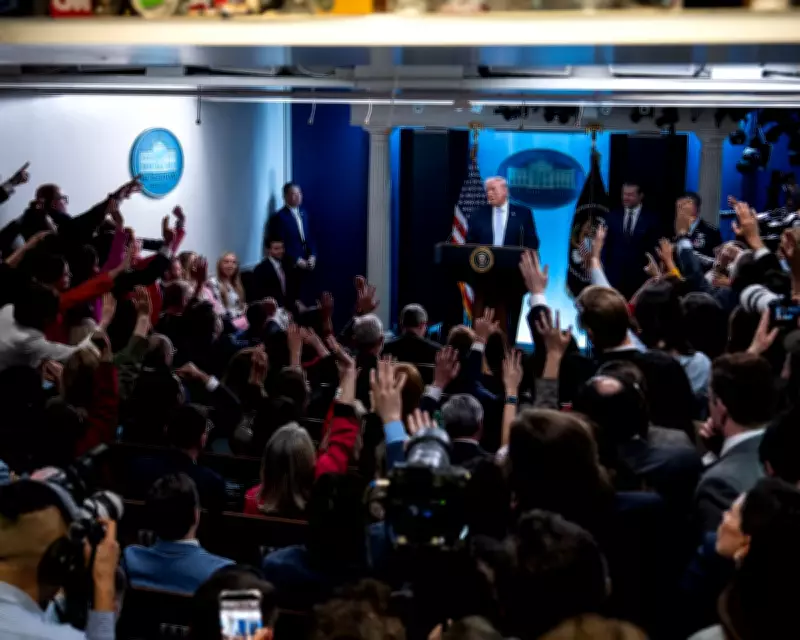
Secretary of War Pete Hegseth held a press briefing where he strongly suggested that threatening genocide works as a diplomatic tool. He praised Operation Epic Fury for destroying Iranian military assets while enumerating potential future targets that included power plants, bridges, and energy infrastructure - targets whose deliberate destruction constitutes war crimes under international law.
Hegseth appeared in his characteristic blue suit but looked unusually tired as he detailed the operation's successes. "America's military achieved every single objective on plan, on schedule, exactly as laid out from day one," he declared, despite observers noting little evidence that the main stated goal of eliminating Iran's nuclear capacity had been achieved.
Mixed Republican Response and Constitutional Questions
The administration's rhetoric received mixed responses from Republican lawmakers. While former Georgia representative Marjorie Taylor Greene called Trump's statements "evil and madness" and demanded his removal via the 25th amendment, most Republicans offered little objection. Texas representative Nathaniel Moran posted that he did not support "the destruction of a 'whole civilization'" but has consistently voted against Democratic attempts to invoke the 1973 War Powers Act.
Republicans have preferred to call the conflict a "combat operation" rather than a war, which would require congressional approval under the Constitution. This semantic distinction allows lawmakers to avoid taking a formal position on military engagement that could prove politically damaging.
Ceasefire Complications and Business Opportunities
The ceasefire announced by Trump began unraveling almost immediately, complicated by Israel's ongoing assault on Lebanon. Despite Trump's request that Israel make its campaign "more low-key," Israeli Prime Minister Benjamin Netanyahu has continued aggressive actions. Trump later expressed irritation about reports of Iran charging fees to tankers in the Strait of Hormuz, claiming this violated their agreement.
Meanwhile, Trump has highlighted potential business opportunities emerging from the conflict. "Big money will be made," he posted on Truth Social, while suggesting a "joint venture" between Iran and the US to run the Strait of Hormuz. Administration allies Jared Kushner and Steve Witkoff have already taken advantage of multibillion-dollar opportunities through their roles as US Middle East envoys.
Human Cost and Strategic Failures
The conflict has resulted in thousands of Iranian and American deaths, with schools, homes, hospitals, and mosques obliterated. The US has spent approximately $40 billion, while Gulf nations have suffered losses estimated at $200 billion. More significantly, critics argue the administration missed a crucial opportunity to support Iranian protesters who were challenging the regime in January before it was violently suppressed.
As one Iranian poet anonymously wrote from Tehran: "We stand against both the foreign invaders and the regime. We are left doubly alone." The administration's focus has shifted from liberating the Iranian people to military and economic objectives, with Trump now requesting $80-100 billion in supplementary Pentagon funding rather than the originally planned $200 billion.
The president's attention appears to be moving toward legacy projects, including moon missions and triumphal arch designs, even as the Iran conflict continues to simmer with uncertain long-term consequences for regional stability and international law.