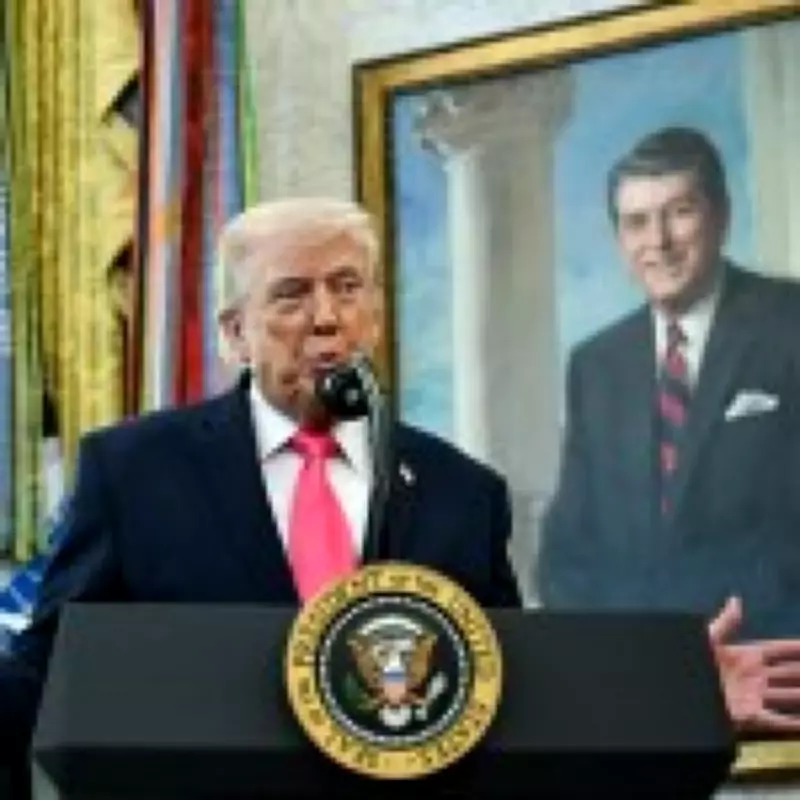
Trump Hints at Secret Iranian 'Gift' While Threatening Troop Surge in Middle East
Former President Donald Trump has hinted at a mysterious gift presented to him by an Iranian peace delegation, while simultaneously threatening to deploy additional American troops to the Middle East. The enigmatic comments came during a White House briefing on Tuesday, where Trump discussed ongoing tensions with Tehran.
Mysterious Present and Military Mobilization
Speaking to reporters, Trump revealed that Iran had delivered what he described as "a very big present worth a tremendous amount of money" that arrived earlier that day. When pressed for details, the president would only say the gift was "oil- and gas-related" but refused to elaborate further.
"It was a very nice thing they did," Trump stated. "But what it showed me is that we're dealing with the right people."
This cryptic revelation coincided with reports that approximately 3,000 troops from the Fort Bragg-based 'The All American' brigade are prepared for mobilization. Trump has been pushing Tehran to capitulate and end the conflict that has already claimed more than 2,000 lives and sent global oil prices surging.
Diplomatic Claims and Denials
Trump told reporters that Iran wants "to make a deal" and claimed his administration has held talks with Iranian leadership, though he declined to specify with whom. He did confirm that the United States has not communicated with Supreme Leader Ayatollah Mojtaba Khamenei, whose whereabouts remain unknown following a strike that killed members of his family and triggered the current conflict.
Iranian officials have vehemently denied any negotiations have taken place. Iranian parliament Speaker Mohammad Bagher Qalibaf posted on social media platform X that "no negotiations have been held with the US," adding that "fake news is used to manipulate the financial and oil markets."
Escalating Threats and Regional Impact
Over the weekend, Trump threatened to "obliterate" Iran's power plants unless the country releases its stranglehold on the Strait of Hormuz within 48 hours. Before the conflict, approximately one-fifth of all globally traded oil passed through this critical waterway.
Iran has maintained that "safe passage" through the Strait of Hormuz remains possible for non-enemy vessels, with ships linked to China, India, and Pakistan reportedly having already navigated through the area.
The ongoing conflict has sent shockwaves through global markets, with oil prices experiencing dramatic surges. Missile strikes continue to erupt across the Middle East, creating instability that affects international trade and energy security.
Military Developments and International Response
Israeli military spokesman Effie Defrin stated in a televised address that while Iran initially fired dozens of missiles during the war's opening days, this number "dropped quickly" to approximately ten missiles daily. He attributed this reduction to continued Israeli strikes on Iranian military infrastructure, including headquarters, launch sites, and missile production facilities.
Despite decreased missile volume, Iran has maintained and even increased launch frequency, forcing millions of Israelis into shelters multiple times daily. Failed interceptions have resulted in additional casualties and injuries.
In a potential diplomatic breakthrough, Pakistani Prime Minister Shehbaz Sharif announced his country's readiness to "facilitate meaningful and conclusive talks" to end the Iran conflict. "Subject to concurrence by the US and Iran, Pakistan stands ready and honored to be the host to facilitate meaningful and conclusive talks for a comprehensive settlement of the ongoing conflict," Sharif wrote on X.
Domestic Political Fallout
Trump's approval ratings have fallen to their lowest point since his return to the White House, largely due to public dissatisfaction with his handling of the Iran conflict. Americans' views have soured significantly regarding his stewardship over cost-of-living issues, particularly as gasoline prices have surged dramatically.
The president's promise to avoid "stupid wars" appears to be weighing heavily on public perception. A recent survey found only 35% of Americans approve of US strikes on Iran, indicating growing domestic concern about military escalation in the region.
As tensions continue to mount, the mysterious Iranian "gift" remains shrouded in secrecy, while the prospect of additional American troops deploying to the Middle East creates further uncertainty in an already volatile situation.