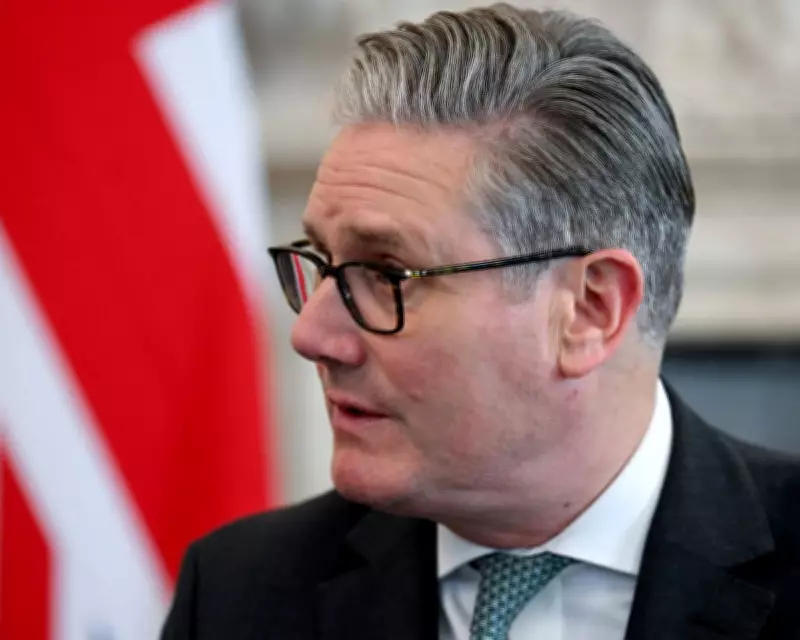
Starmer's 'Defensive Strikes' Position Faces Mounting Pressure Amid Trump's Escalating Iran Rhetoric
Prime Minister Keir Starmer has consistently sought to position the United Kingdom as a responsible international actor deeply concerned with regional security, while carefully avoiding direct participation in the ongoing conflict. His administration has repeatedly emphasized that British bases may only be utilized by the United States for what it terms "defensive" strikes against Iranian military targets.
A Legal Tightrope: Defense Versus Offense
This nuanced stance, however, is coming under intense strain as former US President Donald Trump escalates his threats against Iran, including menacing statements about bombing civilian infrastructure. Trump declared on Monday that he was "not at all" concerned about the potential commission of war crimes, starkly contrasting with Starmer's more measured approach.
The British government took the unusual step of releasing a summary of its legal position, asserting it was acting "in the collective self-defence of regional allies who have requested support." Yet from the outset, many legal experts have expressed profound skepticism about the UK's attempt to distinguish defensive operations involving US bombers from offensive actions in a conflict widely viewed in international law circles as having been illegally initiated by the US and Israel.

Expert Analysis: Questioning the Distinction
Professor Susan Breau, an expert in international law and senior research fellow at the Institute of Advanced Legal Studies, poses a critical question: "How do you distinguish what's defensive from what's offensive? It will be extremely complicated for the UK to maintain that distinction given what Trump has said – his whole battle plan is changing."
Breau highlights the specific concern about Trump's shifting strategy, noting, "Today, the Israelis issued a warning about trains [and for Iranians not to use them]. Trump's whole battle plan now is to attack civilian infrastructure." For Breau, the core issue lies in permitting US utilization of UK bases. "I could see the UK still having bases and having ships there to defend its Gulf neighbours but it's allowing the US to use their bases that's problematic," she explains.
A Contrary Legal Perspective
In contrast, Victor Kattan, an assistant professor of public international law at the University of Nottingham, argues that the UK's existing legal position could remain defensible, even if Trump follows through on his threats. Kattan suggests the British government could maintain a tenable, if fine, distinction.
"They [the British] could say, 'Look, we're only allowing our systems, hardware, our personnel to shoot down rockets and the launchers as well that shoot those rockets that are being targeted at, say, the Qataris or the Kuwaitis or the Emiratis or the Saudis,'" Kattan posits. He adds a crucial caveat: "But our bases and hardware's not being used to punish the government of Iran, for example, or to participate in attacks on bridges, critical infrastructure, oil and gas, bunkers, that kind of thing.'"
Constant Review and Reconsideration
Both experts concur on one pivotal point: the UK government will be compelled to continuously scrutinize its legal stance. Kattan states it is a given that authorities would be "constantly reviewing" the position. Breau is more direct, asserting, "They need to reconsider it. And I would be surprised if they're not [already]."
As the conflict dynamics evolve and Trump's rhetoric intensifies, Starmer's carefully crafted position—aimed at balancing alliance responsibilities with legal and ethical boundaries—faces its most severe test. The distinction between defensive and offensive operations, always legally contentious, now confronts the practical reality of an ally openly threatening actions that could constitute war crimes.
The coming days and weeks will reveal whether this legal tightrope can be walked, or if the UK's stance must fundamentally shift under the weight of escalating threats and intensifying international scrutiny.