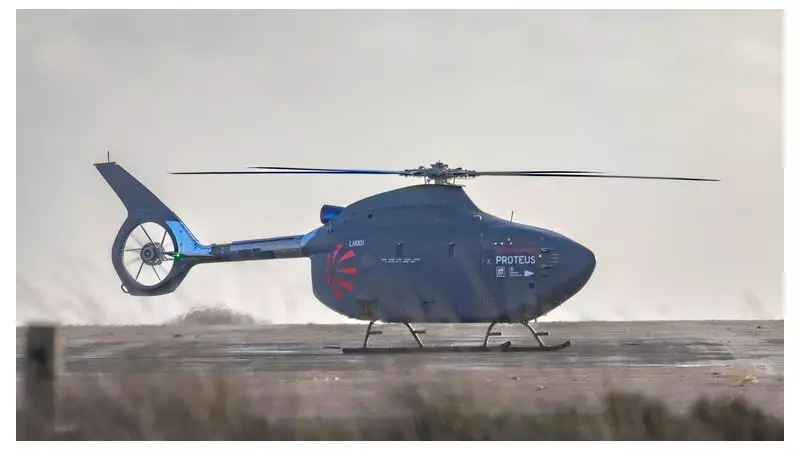
In a landmark moment for British military aviation, the Royal Navy has successfully launched the first flight of its full-sized autonomous helicopter. The windowless aircraft, named Proteus after the shape-shifting Greek god of the sea, took to the skies from Predannack in Cornwall this week.
A New Era for Maritime Defence
The £60 million warfighting machine represents a significant technological leap. Unlike traditional helicopters, it has no cockpit. Instead, its nose is packed with advanced sensors and computer systems that allow it to fly and conduct missions entirely on its own. The Royal Navy states that Proteus is designed specifically for treacherous, high-risk operations where putting personnel in danger is a major concern.
Its primary role will be to track submarines across the vast expanse of the Atlantic Ocean. The helicopter is engineered to conduct anti-submarine warfare and patrol missions, drawing on data from a networked fleet of allied ships, other helicopters, submarines, and detection systems to hunt vessels beneath the waves.
Responding to Global Tensions
The development and deployment of Proteus come at a time of heightened global instability. The Royal Navy directly links the need for such autonomous systems to the current climate of unprecedented global tension, citing ongoing conflict in Ukraine and increasingly inflammatory international rhetoric.
A Navy spokesperson confirmed the aircraft is central to the Atlantic Bastion programme announced by the Ministry of Defence last month. This programme aims to create an "advanced hybrid naval force" to defend the UK and its NATO allies against evolving threats. "It will enable the UK to find, track and, if required, act against adversaries with unprecedented effectiveness across vast areas of ocean," the spokesperson said.
Leadership and Innovation in Defence
The defence firm Leonardo designed and built the pioneering helicopter. Senior figures in defence and the Royal Navy have hailed its first flight as a critical achievement.
Luke Pollard, the Minister for Defence Readiness and Industry, called it "a proud moment for British innovation." He emphasised that "autonomous systems like this will be vital in protecting our seas without putting personnel in harm's way."
Commodore Steve Bolton, Royal Navy Deputy Director Aviation Future Programmes, stated: "The successful first flight of Proteus is a significant step in delivering the Royal Navy's maritime aviation transformation vision... This milestone signals our intent to lead technological innovation, to enhance the fighting effectiveness of the Royal Navy in an increasingly complex operating environment."
While the Navy already operates drones and a smaller autonomous surveillance helicopter, Proteus is the first autonomous aircraft of its size and capability in British military service. Its entry into service marks a decisive move towards integrating cutting-edge AI and robotics into the heart of the UK's national defence strategy.