Israel Unleashes Massive Airstrike Wave Across Lebanon
Israeli military forces executed their most extensive coordinated assault on Lebanon since the conflict with Hezbollah began on March 2, launching a devastating wave of airstrikes without warning that targeted more than 100 locations across the country. The attacks focused particularly on Beirut, where warplanes leveled multiple buildings in the capital's center, filling the skies with smoke and triggering emergency sirens throughout the city.
Devastation in Beirut's Streets
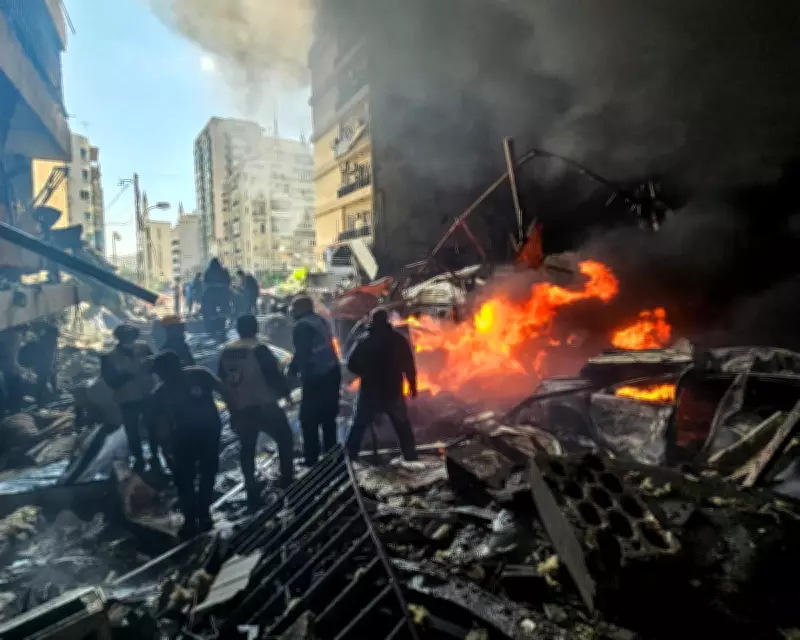
Emergency personnel rushed to impact sites throughout Beirut's Corniche al-Mazraa neighborhood and other affected areas, where buildings were reduced to flaming wreckage and cars were crumpled by powerful explosions. First responders struggled to extinguish fires while civilians desperately searched for family members amid the chaos. Social media circulated harrowing images of children covered in rubble as people attempted to locate missing parents.
A man was filmed running toward a struck building in the Chiyah neighborhood, screaming "There are people inside!" as the scale of destruction became apparent. Lebanese hospitals issued urgent calls for blood donations in anticipation of massive casualties, while the health ministry pleaded with citizens to clear streets for ambulance access.

Military Justification and Civilian Impact
The Israeli military described the operation as their "largest coordinated strike" against Hezbollah, claiming they targeted more than 100 command centers and military sites. Military officials acknowledged that much of the Hezbollah infrastructure they struck was located "within the heart of the civilian population," explaining the extensive collateral damage.
The Lebanese Red Cross reported "a huge number of dead and wounded" though exact casualty figures remained unconfirmed. This attack followed an earlier strike in Saida that killed eight people and wounded 22 when Israel bombed a car near beachside cafes.
Ceasefire Confusion and Diplomatic Tensions
The massive assault occurred less than twelve hours after Iran announced a ceasefire agreement, creating confusion about whether Lebanon would be included in any pause in hostilities. Israeli Prime Minister Benjamin Netanyahu's office explicitly stated that the two-week ceasefire "does not include Lebanon," while military leaders vowed to "continue to strike with determination."
This position contradicted statements from Iran and Pakistan, who claimed the ceasefire would apply to Lebanon as well. Hezbollah officials indicated they would abide by a ceasefire if Israel halted strikes, with MP Ibrahim Moussawi warning that the armed group and Iran would retaliate if attacks continued.
Humanitarian Crisis Deepens
The nearly five weeks of conflict have pushed Lebanon to its breaking point, with over 1.1 million people forcibly displaced and many living on streets. Official figures from Lebanon's health ministry indicate more than 1,530 people killed and 4,812 wounded by Israeli airstrikes since the war began.
Highways leading south in Lebanon were choked with traffic as dawn broke, with residents attempting to return home despite Hezbollah warnings about Israeli troops remaining in certain villages. WhatsApp chats filled with anxious messages as Lebanese citizens tried to determine whether their country would be included in ceasefire arrangements.
Political Fallout and Strategic Concerns
Israeli opposition leader Yair Lapid sharply criticized Netanyahu's handling of the situation, calling it "a political disaster" and noting that "Israel wasn't even at the table when decisions were made concerning the core of our national security." This referred to diplomatic negotiations mediated in Pakistan between the US and Iran that concluded without Israel's immediate input.
According to leaked information, Iran's 10-point peace plan accepted as a negotiation basis by the Trump administration calls for ending the war against "all components of the 'axis of resistance,'" which includes Hezbollah. However, Trump's ceasefire statements focused exclusively on Iran, leaving Lebanon's status ambiguous.

Israel continued striking Lebanon into Wednesday morning, conducting artillery fire in the south and executing separate drone strikes on Qana and al-Qleileh. The military also issued warnings in Arabic to residents in Tyre to evacuate specific buildings, typically a precursor to airstrikes in populated areas.