
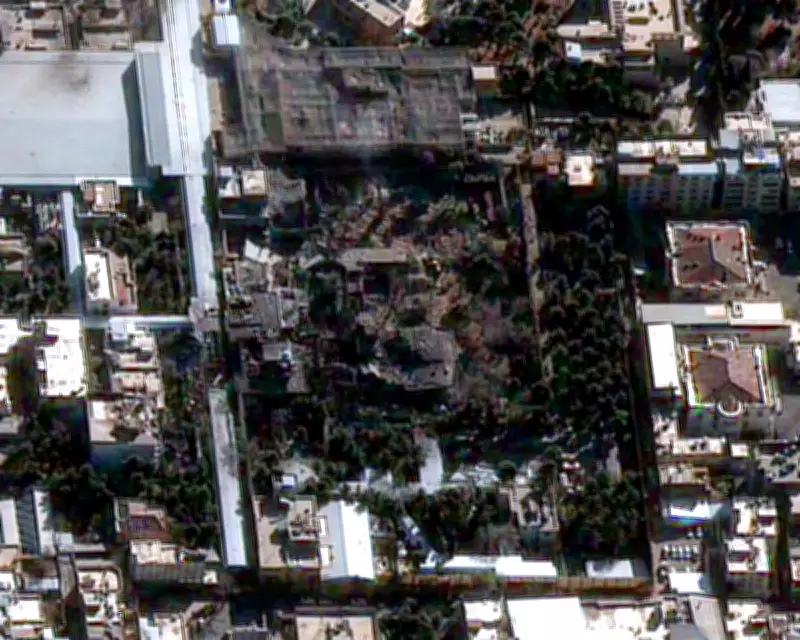
Decades of Intelligence Gathering Culminates in 60-Second Strike
The assassination of Iran's Supreme Leader, Ayatollah Ali Khamenei, represents the culmination of painstaking intelligence operations spanning decades, according to experts, veteran spies, and officials in both Israel and the United States. The operation, which took just sixty seconds to execute, resulted from meticulous planning and unprecedented cooperation between Israeli and American intelligence agencies.
A Coordinated Assault on Iranian Leadership
Military officials in Israel confirmed that Khamenei was killed alongside seven top Iranian security leaders who had gathered at multiple locations in Tehran. Additionally, around a dozen members of his family and close entourage perished in near-simultaneous strikes. The attack claimed the lives of forty other senior Iranian leaders, marking a significant decapitation of the regime's leadership structure.
The killing of the 86-year-old supreme leader initiated the air offensive launched this weekend by Israel and the United States, aimed at overthrowing the radical clerical regime in Tehran. This development has plunged the Middle East into renewed chaos and violence, with unpredictable consequences for regional stability.
Intelligence Networks and Technological Superiority
The timing of the assassination was determined by critical information the CIA gathered about a meeting of top Iranian officials scheduled for Saturday morning at a leadership compound in central Tehran. Most importantly, American intelligence was able to confirm Khamenei's presence at the site and provide precise timing details to Israeli counterparts.
Israeli spies had been tracking Khamenei for many years, compiling an exhaustive file on his daily routines, family members, associates, and security details. According to a former CIA veteran with decades of experience tracking high-profile targets, "It's like a giant jigsaw puzzle. You put all these scraps of information together. Where you don't have reliable data, you look further. We all get up and go to bed, we all eat and drink. Everything you do leaves a print."
Strategic Concerns and Historical Context
Despite the operational success, some experts and intelligence veterans have raised concerns about potential strategic errors. Yossi Melman, a respected Israeli analyst specializing in intelligence, noted, "The problem is that Israel is in love with assassinations, and we never learn that it is not the solution. We have killed all the leaders of Hamas. They are still there. It's the same with Hezbollah. The leaders are always replaced."
Israel has a long history of conducting assassinations overseas but had never before killed a head of state. Amos Yadlin, former head of Israel's military intelligence service, described the strike as "a tactical surprise, an operational surprise" because expectations had been that Israel would attack under cover of darkness, similar to the surprise strike that opened the 12-day war in June.
Technological Assets and Human Intelligence
Reuel Gerecht, a former CIA targeting officer who worked on Iran, emphasized that while the United States brought significant technological assets to the operation, Israel had developed the crucial networks of agents on the ground capable of supplying human intelligence and executing covert operations within Iran.
"The technological capacity of the US is extremely impressive and the tech does matter a lot," Gerecht explained. "But I don't think that the CIA had a lot to bring to the table in terms of human intelligence or covert action networks. If you combine the technological capacity with the networks on the ground, that would certainly amplify its effectiveness."
Mossad's Evolution and Operational Capabilities
The Mossad, Israel's Institute for Intelligence and Special Operations, has focused on Iran for decades, building deep networks of informants, agents, and logistical support. This infrastructure has enabled numerous operations, including the assassination of a top Iranian nuclear scientist using a remote-controlled machine gun, cyberattacks on Iran's nuclear program, and the theft of nuclear documents.
Melman revealed that the Mossad implemented a key strategic shift nearly twenty years ago, deciding to recruit local agents within Iran who received state-of-the-art equipment and extensive training. David Barnea, who has led the Mossad since 2021, established a special department for a "foreign legion" of agents deployed across the Middle East on sensitive missions.
Political Considerations and Regional Implications
Israel had been prepared to assassinate Khamenei last year, but then-President Donald Trump expressed reluctance to risk regional escalation and alienate allies concerned about killing a head of state. These reservations appear to have dissipated in the months following the brief conflict last year, which concluded after US bombers attacked Iranian nuclear facilities.
Israeli military officials reported "really very enhanced cooperation" between Israel and the United States on Iran since that time. Intelligence from the Mossad's networks in Iran was merged last week with communications intercepted by American agencies, creating a comprehensive operational picture.
Oded Ailam, former head of the Mossad's counterterrorism division, reflected on the operation's significance: "Sixty seconds. That's all it took for this operation, but it is the product of years in the making. The modern battlefield is no longer defined only by tanks and aircraft. It is defined by data, access, trust, and timing. One minute can change a region."
Long-Term Strategic Concerns
The former CIA veteran expressed reservations about the assassination's long-term implications: "I think it was the wrong thing to do. Not from an ethical perspective—I have been fine with killing people, a lot of them in fact—but from a long-term strategic perspective. I know that when you take out someone's leader, you don't solve the problem. You just create a new one."
As the Middle East confronts this dramatic escalation, questions remain about whether the elimination of Iran's supreme leader will achieve its intended objectives or simply pave the way for more radical elements within the Iranian regime to emerge, potentially exacerbating regional tensions rather than resolving them.




