
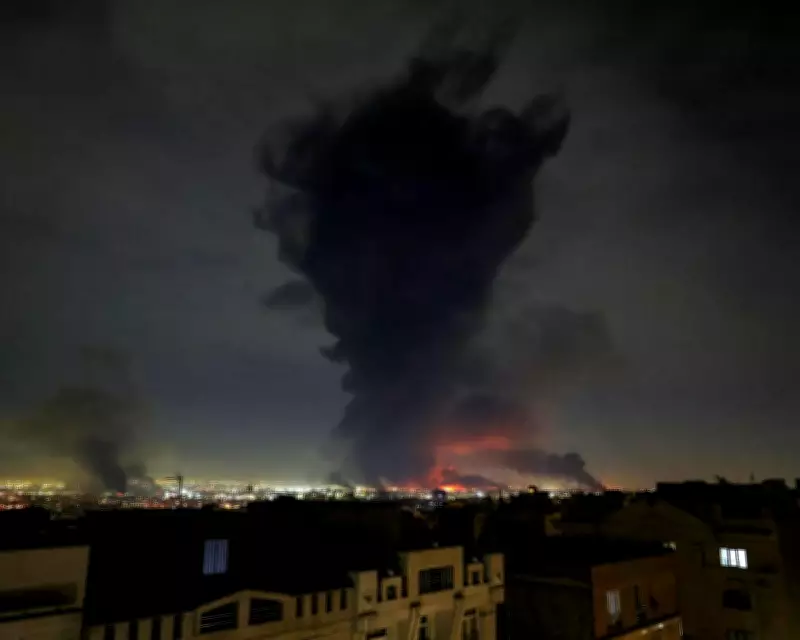
Israel Unleashes 80-Fighter Jet Blitz on Tehran Airport
In a dramatic escalation of the Middle East conflict, Israel has confirmed launching a fresh wave of strikes against Iran, deploying eighty fighter jets in a pre-dawn assault that set one of Tehran's primary airports on fire. The massive aerial blitz targeted multiple strategic locations across the Iranian capital, including a military academy, an underground command center, and a missile storage facility.
Photographic evidence from the scene shows flames and thick plumes of black smoke billowing from Mehrabad International Airport, one of two major airports serving Tehran. The attack represents one of the most significant direct strikes on Iranian soil since the conflict began eight days ago.
Iran's President Rejects Trump's 'Dream' of Surrender
Meanwhile, Iranian President Masoud Pezeshkian delivered a prerecorded address on state television, forcefully rejecting U.S. President Donald Trump's call for Iran's "unconditional surrender" as nothing more than a "dream." The Iranian leader declared that his country would never capitulate, stating that Iran's enemies "must take their dream of the Iranian people's unconditional surrender to their graves."
In a surprising diplomatic move, Pezeshkian issued a rare apology to neighboring Gulf states for Iranian strikes that had targeted sites in their territories. "I personally apologise to neighbouring countries that were affected by Iran's actions," he stated, while simultaneously announcing that Iran's temporary leadership council had approved suspending attacks on nearby countries unless assaults on Iran originated from those states.
Regional Conflict Widens with Multiple Fronts
The war, now entering its second week, has rapidly expanded beyond its initial boundaries:
- Iran retaliated against Israel's latest strikes with air raid sirens sounding and explosions reported above Jerusalem
- Gulf cities including Dubai and Manama experienced renewed attacks
- Saudi Arabia intercepted a ballistic missile aimed at an airbase hosting U.S. military personnel near Riyadh
- Iran's Islamic Revolutionary Guards targeted the oil tanker Prima in the strategically vital Strait of Hormuz
- Israel intensified airstrikes in Lebanon, repeatedly targeting southern suburbs of Beirut
The conflict has created severe global disruptions, choking oil supplies and dramatically reducing international air travel. Civilian casualties continue to mount, with Iran's health ministry reporting at least 926 civilians killed and approximately 6,000 injured, while Lebanon's health ministry confirmed at least 217 fatalities.
Humanitarian Crisis Deepens Across Region
Lebanese Prime Minister Nawaf Salam has warned of an impending humanitarian disaster as approximately 300,000 people have fled their homes according to the Norwegian Refugee Council. The war, triggered by joint U.S.-Israeli airstrikes that killed Iran's Supreme Leader Ali Khamenei, has now spread across multiple theaters including the eastern Mediterranean and Indian Ocean.
Regional analysts remain uncertain whether Pezeshkian's remarks signal a genuine shift in Iranian strategy or represent temporary diplomatic maneuvering. Reports suggest some Iranian strikes continued against Gulf states even as the president delivered his address, indicating the complex and fluid nature of the escalating conflict.




