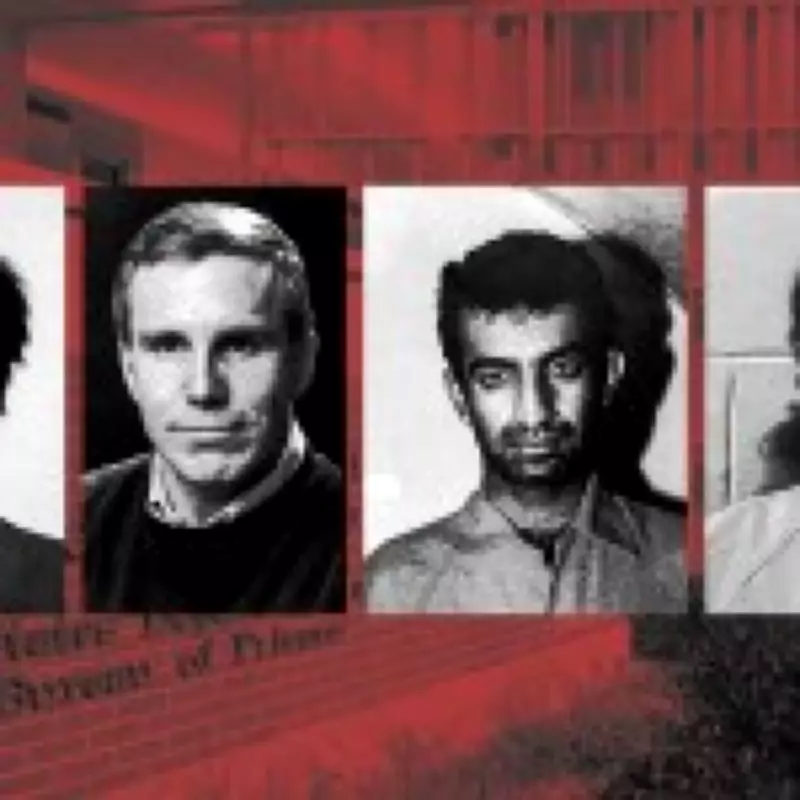
Prison vans arriving at America's highest security facility drive a final stretch of road that reveals the stunning Rocky Mountains in the background. It's quite the sight. Inmates bear witness to an awe-inspiring vista of vast open space and natural majesty just before entering the facility. None of them will likely ever see or experience anything like it again. And they know it too. It's a hell of an introduction to the rest of your life locked up inside a supermax prison.
The Last Glimpse of Freedom
Talking to Daily Mail, former warden Bob Hood said the moment stands out. 'As they're pulling up, they see the Rockies. It is absolutely beautiful,' He made clear what follows… A realisation. 'That's the last time they're going to see freedom.' Hood worked at the ADX Florence Supermax prison in Colorado from 2002 to 2005. His role involved daily checks across the facility, moving between cells and speaking to inmates. Every single day he dealt directly with some of the most high-profile, dangerous and notorious criminals in the world.
Housing the 'Worst of the Worst'
The prison houses inmates described as the 'worst of the worst'. Most are serving multiple life sentences with absolutely no chance of release. The effect of that prospect builds over time and can have quite the effect on a prisoner's psyche. 'I would say that 97% to 98% of all inmates at the Supermax, I could see the impact of it,' Hood said. He noticed it most at certain points in the year. 'I'd see guys in tears sometimes during Christmas, you know, talking about their kids, and yet they're doing multiple life sentences.'
Notable Inmates and Their Behaviors
Ted Kaczynski, known as the Unabomber, was among those held there. He kept his distance from staff and didn't engage with anyone or anything at first. Months passed without him speaking to Hood at all, who said Kaczynski was one prisoner able to 'beat the system' because being locked up 'never seemed like it ever got to him'. Hood tried a different approach. 'I said, "Kaczynski, over the weekend, I was reading some stuff," and again very distant, he said, "That's good, what was it?"' It was the first response. 'I said, "The manifesto that you wrote." And that's the first time, after like six months or seven months, that he finally really connected with me. I could tell that I hit a nerve.'
Kaczynski's Reaction and Routine
The subject got his attention. Kaczynski reacted immediately. 'He goes, "You read my manifesto?" I just simply said, "I read it," and then I played the Columbo guy.' From there, the conversation opened up. Hood compared the manifesto to a novel. 'I said, "You know what, Kaczynski, it's almost like Shelley, the lady that wrote Frankenstein. That was almost like the manifesto, where there's a monster but it's technology. Technology could be for the good. In this case, you're seeing the negative part of the technology".' Kaczynski spoke about how widely known he believed he still was. Hood pushed back. 'I said, "The average person now, the average kid growing up, no one knows about the manifesto. They're not reading your manifesto".'
The exchange turned to motive and consequence. 'I told him that. I said, "You know, you killed several people – couldn't you just have put the damn thing in a book?"' He didn't shift. 'He goes, "No, I had to kill somebody to get the attention".' 'I said, "Well, you have to look at that, you're sitting in the Supermax for the rest of your life, you die here," and he did.' That outcome was fixed. Kaczynski kept to routines inside his cell. One involved running in circles while tracking distance in his head, measuring out a journey he could not take. During a visit from FBI Director Robert Mueller, he repeated the same line each time he passed. 'Hey, warden, I just want you to know I'm in Walla Walla, Washington, right now.' Hood understood what he meant. Kaczynski was calculating the distance to where his brother lived. Each lap was part of that.
Richard Reid: The 'Shoe Bomber'
Richard Reid, known as the 'Shoe Bomber', was different from the outset. Hood described the Londoner as a 'street punk', and their first meeting reflected that. 'I walk up to him. He's in the cell. The door opens. The officers are standing there with batons left and right of me, and he stands up from his bed, and I say, "Good morning," and he's a punk type of guy.' Reid pushed back immediately. 'He goes, "Oh, who are you?" He doesn't know. I said, "Well, I'm the warden." And I said, "So who are you?" And he says, "I'm Richard Reid." I go, "Oh yeah, you're the guy who couldn't even blow up his own shoe".'
Managing Reid's Behavior
Reid was openly hostile towards authority. 'He wasn't very happy with the judge. He wasn't very happy with administrative types like me.' So Hood set clear terms early on. 'I said, "Let me ask you a question, do you love your mother? Well, you're never going to see her again unless I allow it".' Reid was told to work towards a GED qualification and keep his cell in order. He questioned it at first. 'He goes, "Why would I want to get a GED?"' Hood kept the answer simple. 'I said, "Well you're not getting out of here, you're going to basically die here. Sometimes you do it for others, do it for your mother in England."' Reid completed the GED and kept his cell clean. His behaviour settled. 'He wasn't Mr Happy with me, but he'd say a "Good morning, warden," and we'd not get any incident reports, any problems with the staff.'
Other High-Profile Inmates
Ramzi Yousef, the Pakistani terrorist who was one of the principle perpetrators of the 1993 World Trade Center bombing, had minimal interaction with staff. His day was structured around prayer, often on the hour. 'Yousef was looking at getting up on the hour, praying,' Hood said. 'He hardly ever talked to me. He was just like, "Good morning, warden".'
Michael Swango: The Reclusive Serial Killer
Serial killer Michael Swango kept even more distance. A former Marine and doctor, he's been linked to around 60 fatal poisonings and had been attacked in another prison before being moved to Supermax. 'In all the years that I was there, he never once came out for recreation,' Hood said. The outdoor space the prison allows limited access to fresh air and daylight. Hood described the set-up like this: 'Here's a medical doctor who can come out for one hour a day and see the sunshine above. You can't see the mountains, you can't see the beauty, it's all intentionally built so you don't see all that beautiful stuff, but you can see the sky.' Swango chose not to leave his cell. Chances are, he sticks to that decision to this day. He'd rather not be reminded of what he's missing. Even if it is only the clouds.