
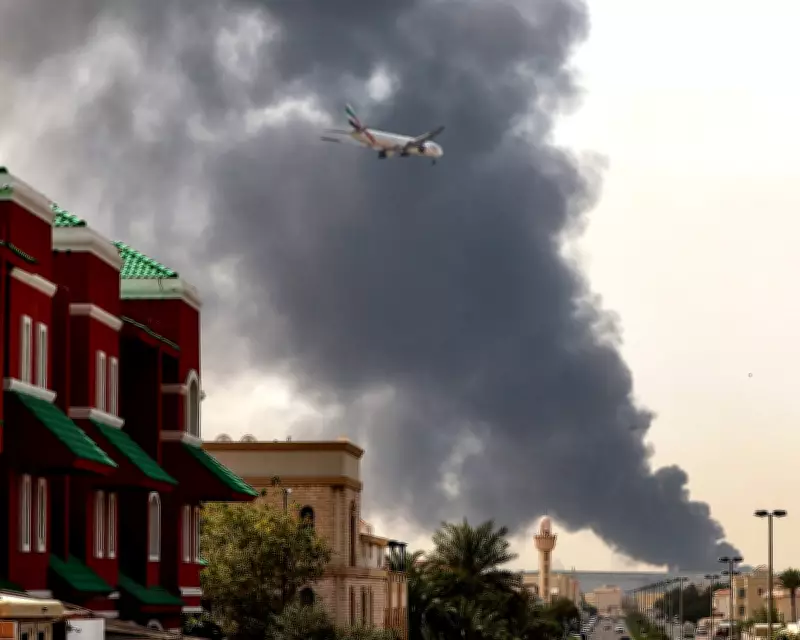
Gulf States' Stability Strategy Faces Critical Test as Regional War Escalates
Flights have been gradually resuming at Dubai International Airport following a drone strike on Monday, but the disruption represents just one visible symptom of a much deeper crisis unfolding across the Gulf region. For more than two weeks, missiles and drones have been crossing Gulf skies as the conflict between the United States, Israel, and Iran continues to escalate dangerously.
Economic Foundations Under Threat
The war is directly threatening the economic transformation projects that Gulf states have invested billions to develop. Saudi Arabia's Vision 2030 initiatives, the United Arab Emirates' position as a global aviation and logistics hub, and the region's broader push into tourism, finance, and technology all depend fundamentally on one essential factor: regional stability. The very reputation these states have spent decades cultivating is now at risk.
Shipping routes are being severely disrupted as the effective closure of the Strait of Hormuz has impacted one of the world's most critical energy and shipping corridors. Insurance costs have soared dramatically, forcing commercial vessels to halt operations or reroute traffic across the region. Port activity has slowed sharply at major logistics hubs including Jebel Ali in Dubai, while global supply chains struggle to adjust to mounting risks.
Security Partnerships Reveal Limitations
The crisis is exposing significant limitations in the Gulf's longstanding reliance on the United States as its ultimate security guarantor. While U.S. airbases dot the region and Washington remains the primary supplier of advanced weapons systems, the current confrontation reveals a troubling asymmetry in this arrangement. When Washington escalates tensions with Iran or backs Israeli military operations, it does so according to its own strategic calculations. Gulf states, by contrast, are left to manage the consequences affecting their cities, citizens, economies, and critical infrastructure.
Diplomatic Diversification Shows Cracks
In response to these vulnerabilities, Gulf governments have spent recent years attempting to diversify their diplomatic relationships. The Chinese-brokered rapprochement between Saudi Arabia and Iran in 2023 reflected a broader regional effort to reduce tensions and avoid direct confrontation. The UAE reopened diplomatic channels with Tehran, while Qatar and Oman continued to maintain dialogue with Iranian officials.
These initiatives demonstrated pragmatic recognition that stability in the Gulf ultimately requires some form of coexistence with Iran. Yet the current war is demonstrating the clear limits of that strategy. Even when Gulf states actively seek to lower tensions with Tehran, they cannot insulate themselves from escalating confrontation between Iran and Israel or the United States.
Regional Integration as Potential Solution
The crisis may nevertheless carry an important lesson for Gulf leadership. It strengthens the compelling case for deeper regional defence integration. Coordinated air-defence networks between states, shared early-warning systems, and closer maritime security cooperation could help reduce vulnerabilities and create more resilient security architectures.
However, military coordination alone cannot provide lasting stability. The region's security challenges remain fundamentally tied to unresolved conflicts that continue to drive cycles of escalation across the Middle East from Yemen to Gaza, Lebanon, and now Iran itself.
For Gulf states, the immediate priority remains containing escalation and avoiding further strikes on energy infrastructure and civilian facilities. But the more consequential challenge lies in shaping the conflict's endgame. Neither a prolonged war nor a significantly weakened Iran offers a clear path to stability. Both scenarios risk producing a more fragmented and unpredictable regional order with continued threats to Gulf security for years to come.
This reality requires sustained and proactive diplomatic engagement aimed not only at limiting immediate escalation but shaping its trajectory to avoid establishing a prolonged and more dangerous regional order that could undermine decades of economic progress and strategic planning.




