
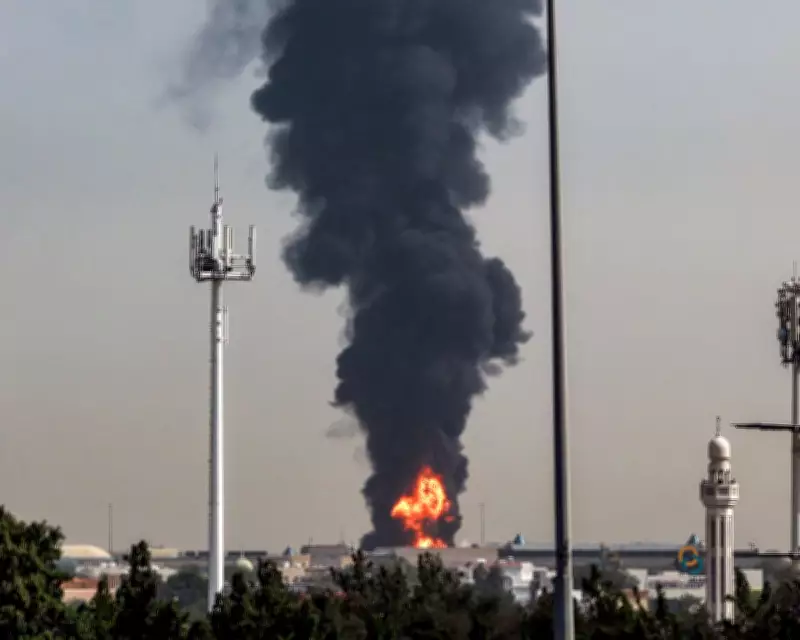
Dubai Airport Attack Reveals Critical Gaps in US Strategy on Iran
Flames and thick smoke billowed from Dubai International Airport on Monday following a targeted drone strike, marking the latest in a series of Iranian attacks against US allies across the Gulf region. This incident starkly exposes the glaring absence of a coherent United States strategy for dealing with Iran, as the White House appears to have failed to anticipate Tehran's retaliatory measures aimed at imposing significant costs on Western interests.
Trump's Demands and NATO's Reluctance
Over the weekend, former President Donald Trump issued a forceful demand for the United Kingdom, China, France, Japan, and other nations to participate in a naval escort mission for oil tankers navigating the strategically vital Strait of Hormuz. Despite initiating military actions against Iran in collaboration with Israel, the US administration seemingly did not fully prepare for the obvious Iranian countermeasures. Iran, possessing limited conventional military options, has logically turned to asymmetric warfare, targeting US bases, allied nations, and commercial shipping in the Gulf to exact a price from the West.
The White House's strategic miscalculation is further highlighted by the muted international response to Trump's appeal. Japan cited legal complexities regarding international military deployments and noted it had not received a formal US request. China has remained silent, potentially jeopardizing a planned presidential visit to Beijing. In a recent interview, Trump warned NATO allies of "a very bad future" for the alliance if they declined to assist, a threat complicated by NATO's geographic focus on Europe and North America and over a year of US pressure for Europe to prioritize continental defense over Middle Eastern engagements.
Naval Unpreparedness and the Hormuz Challenge
The lack of allied naval readiness is particularly alarming. Prior to the conflict's escalation, none of the key nations—Britain, France, China, or Japan—had warships positioned and prepared to assume convoy duties in the Gulf. France has deployed eight warships to the eastern Mediterranean but stated it would not commit to the Hormuz region until the most intense combat subsides. The United Kingdom has faced difficulties, hastily preparing the HMS Dragon destroyer after removing it from dry dock, following criticism for not anticipating the need for regional naval presence as the US assembled carrier strike groups.
According to Richard Meade, Editor-in-Chief of Lloyd's List, a viable escort operation might require eight to ten destroyers, yet this would only protect five to ten vessels transiting every day and a half—approximately ten percent of pre-war shipping volumes. This logistical reality underscores the immense challenge of securing the Strait of Hormuz, through which a substantial portion of global oil shipments passes.
Iran's Asymmetric Tactics and Economic Pressure
Iran has been preparing for prolonged resistance, with Supreme Leader Ali Khamenei reportedly instructing subordinates to outline four levels of succession in anticipation of potential losses. In the ongoing two-week bombing campaign, US strikes have concentrated on Iranian naval assets and missile sites but have failed to neutralize the asymmetric threats to merchant shipping. Data from Lloyd's List indicates sixteen ships have been attacked, causing tanker owners to avoid the perilous passage through the strait.
Iran theoretically possesses a range of small-scale attack options, including Islamic Revolutionary Guard Corps speedboats, aerial drones, and up to 5,000 sea mines, though mines have not yet been deployed. Reflecting lessons from the conflict in Ukraine, Iran appears to be finding success with sea drones—uncrewed surface vessels resembling speedboats. One such drone is suspected of striking the Thai vessel Mayuree Naree last week.
Ten days ago, Trump urged tanker owners to "show some guts" and navigate the strait, despite the apparent reluctance of the US Navy to undertake escort missions. Matthew Savill of the Royal United Services Institute thinktank noted, "The US has not done it because the Abraham Lincoln carrier strike group can sit 200km off Oman and strike Iran with little risk." US Energy Secretary Chris Wright suggested last week that after additional airstrikes, the US Navy might be positioned to escort tankers by the month's end.
The Broader Strategic Vacuum
Trump's focus on military power, with a primary desire to collaborate only with Israel, has resulted in a lack of multilateral cooperation, as no other nation wished to participate in initiating a war against Iran. This isolation has left a strategic vacuum, with the Dubai airport attack serving as a potent symbol of Iran's capacity to retaliate and the West's unpreparedness. The Royal Navy's concurrent focus on deploying the Prince of Wales aircraft carrier to the North Atlantic for an Arctic protection mission—a demand previously made by Trump during discussions about Greenland—further illustrates competing priorities and strategic diffusion.
The drone strike on Dubai International Airport not only represents a direct security threat but also amplifies the economic and geopolitical tensions surrounding the Strait of Hormuz. As Iran leverages its most powerful card—the potential blockade of the strait—the absence of a unified, effective Western strategy continues to leave allies vulnerable and global energy markets in a state of heightened uncertainty.




