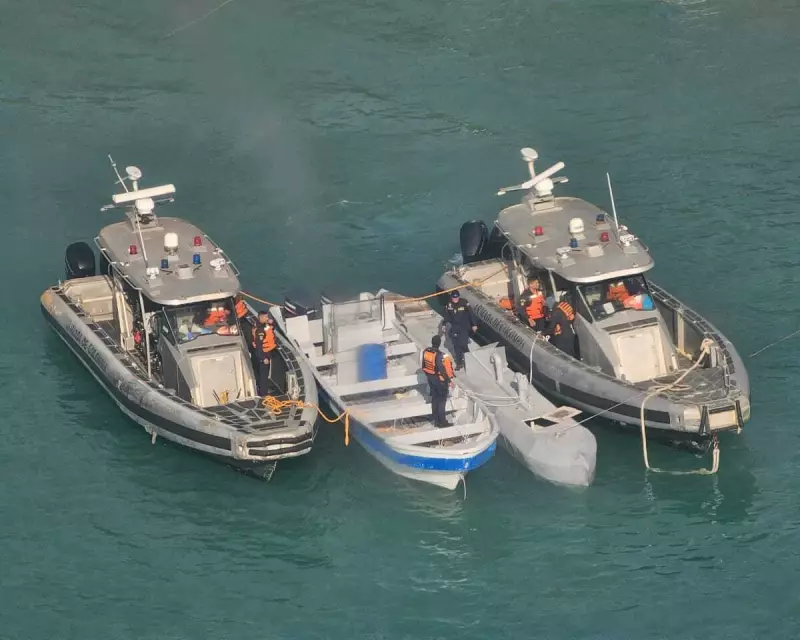
A dramatic fall in the wholesale price of cocaine is forcing international drug cartels to change their tactics, reusing expensive custom-built 'narco-submarines' they would previously have sunk after a single voyage from South America to Europe.
The Economics of a Changing Trade
According to a senior Spanish police officer, the plummeting value of the drug has made the old business model unsustainable. Wholesale prices have halved to around €15,000 (£13,000) per kilo in recent years, a result of massive production leading to market saturation. This means traffickers can no longer afford to treat their sophisticated vessels as disposable.
"These semi-submersibles used to head to the area around the Canaries on one-way voyages and they'd then be sunk," explained Alberto Morales, head of the central narcotics brigade of Spain's Policía Nacional. He noted that when carrying three to four tonnes of cocaine, the profit margin justified destroying a vessel costing about €600,000 (£524,000). "But what's happened lately is that the price of the merchandise is really, really low, so the organisations have, logically, had a rethink."
A New Life for Narco-Subs
The new strategy involves recovering the vessels after they deliver their cargo. Instead of being scuttled in a deep-sea 'narco-sub graveyard' between the Azores and the Canary Islands, the boats are now refuelled at sea and sent back to South America for multiple trips. This represents a significant shift in a trade that has seen these semi-submersibles used in Colombian waters since the 1980s but only detected in European waters from 2006 onwards.
Spanish authorities have spotted or seized ten such vessels in the last two decades, but Morales admits the true number in operation is certainly higher. "Logically speaking, we can't detect everything that reaches the Spanish coast as we have 8,000km of coastline," he stated. This increase in narco-sub activity over the past two years has coincided with a decrease in the use of sailboats for drug transport to Spain.
Broader Trends in Europe's Drug Market
The evolving use of narco-submarines is not the only trend alarming European law enforcement. Spanish police report a sharp rise in the dismantling of clandestine laboratories producing synthetic drugs within Spain itself. While the Netherlands has historically been Europe's primary production hub, gangs are increasingly setting up operations in countries with more space, like Spain, France, and Germany.
Officers from the synthetic drugs and precursors department have dismantled more amphetamine, methamphetamine, and MDMA labs in the past two years than in the previous eighteen. Since 2023, raids have netted over five tonnes of MDMA, 450kg of amphetamine sulphate, and 27kg of methamphetamine. These labs are often located in remote rural areas, with gangs using drones for surveillance and paying locals to watch for police.
The overall seizure figures underscore the scale of the challenge. Spanish police and customs officers confiscated 123 tonnes of cocaine in 2024, up from 118 tonnes in 2023 and 58 tonnes in 2022. In a single operation this September, the Policía Nacional arrested 14 people and seized 3.65 tonnes of cocaine allegedly delivered to Galicia by a narco-submarine.
As Morales summarised, the drug trade is adapting to economic pressures and law enforcement efforts, employing a mix of merchant ships and reusable semi-submersibles to move product year-round, while simultaneously expanding synthetic drug production across the continent.