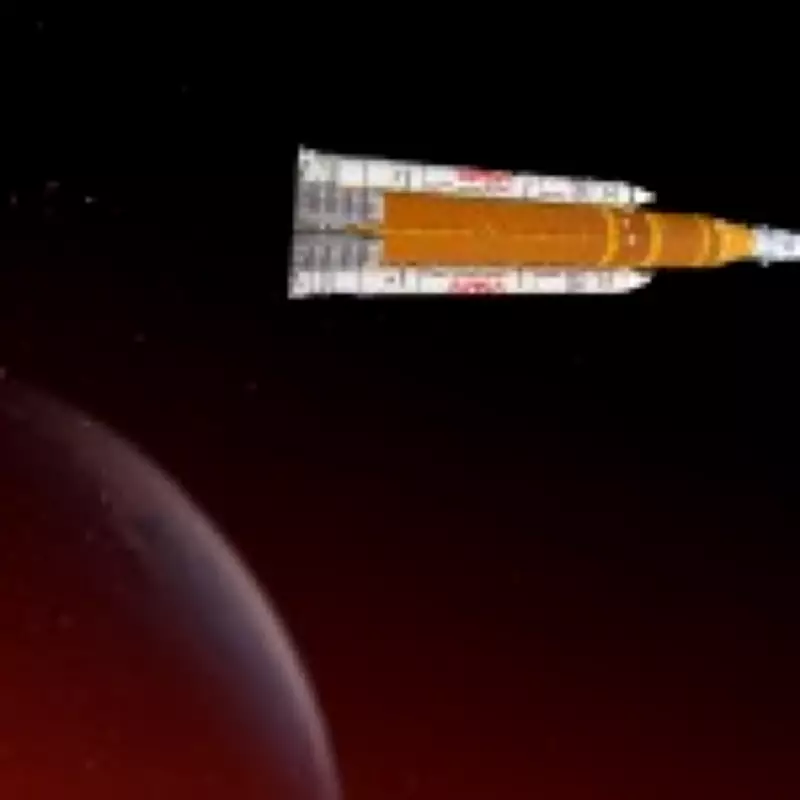
Artemis II Crew Confronts Solar Radiation Peril on Historic Moon Mission
If there's one significant hazard the Artemis II astronauts must contend with—aside from potential technical malfunctions like a broken toilet—it's the threat of solar flares, according to a leading space expert. This warning comes as NASA's towering Intergry rocket successfully launched yesterday evening, propelling four astronauts toward the moon for the first time in over fifty years.
The Mission and Its Critical Objectives
The crew, comprising Reid Wiseman, Victor Glover, Christina Koch, and Jeremy Hansen, will spend ten days inside the Orion deep-space capsule, which is roughly the size of a minivan. While the primary goal of this mission is to test essential systems aboard Orion, including life support and deep-space communications, a secondary focus is evaluating the capsule's ability to shield the crew from the harsh realities of space weather.
Our sun, an immense sphere of turbulent plasma, continuously emits radiation with the force of millions of volcanic eruptions. Some of these emissions, known as solar flares, can travel to Earth, disrupting satellites, interfering with GPS networks, and generating phenomena like the Northern Lights. Fortunately, Earth's magnetic field acts as an invisible protective barrier, safeguarding inhabitants from these flares. However, astronauts venturing into deep space lack this natural defense.
Expert Insights on Space Weather Risks
Dr. Ben Clewer, a space weather system developer at the Surrey Space Centre, emphasizes the gravity of this issue. He states, 'This is a major concern for space travel beyond Low Earth Orbit (LEO), as the travel is outside the protection of the Earth's magnetic field.' The consequences are extensive, ranging from radio communication interruptions and electronic system errors to increased radiation exposure for the crew and potential damage to the spacecraft itself.
Dr. Clewer further explains, 'Limiting the impacts of any increased radiation will be an important aspect of the Artemis mission as space radiation can put astronauts at significant risk for radiation sickness, increased lifetime risk for cancer, central nervous system effects, and degenerative diseases.'
Protective Measures and Worst-Case Scenarios
In the event of a solar flare, which can reach Earth in under twenty minutes, the astronauts would seek refuge in two stowage lockers located beneath their seats. NASA asserts that the dense materials used in Orion's construction will provide some shielding. Additionally, the capsule is equipped with a radiation sensor, the Hybrid Electronic Radiation Assessor, designed to alert the crew if solar flares are detected.
Despite these precautions, Dr. Clewer cautions that complete protection is unattainable. 'The particles won't be fully shielded against, however, and the capsule could experience impacts,' he notes. In severe cases, such as a once-in-a-century solar flare, astronauts might experience radiation sickness or spacecraft system failures.
Current Solar Activity and Future Implications
Dr. Clewer warns that a massive sunspot, approximately fifteen times the size of Earth, is currently oriented toward our planet. This sunspot is capable of emitting solar flares and coronal mass ejections—large bursts of particles. Earlier this week, a coronal mass ejection even posed a risk of delaying the Artemis II launch.
Looking ahead, Dr. Clewer highlights the broader challenges for human space exploration. 'Space weather scientists are constantly monitoring the Sun, and the Artemis missions have a whole team just for this purpose, ready to advise what to do,' he says. 'In the longer term of human spaceflight, space weather and solar radiation are the biggest danger to humans travelling to Mars.'
Key Details About the Artemis II Mission
- Mission Purpose: To test Orion's life-support systems and docking capabilities for future lunar missions. If successful, Artemis III is scheduled for 2028, aiming to land astronauts on the moon's surface.
- Travel Speed: Artemis II travels at about 17,000 miles per hour—fast enough to cross London from east to west in roughly seven seconds.
- Timeline: The crew is expected to reach the moon by April 6, becoming the first humans to view certain areas of the far side. Using lunar gravity, Orion will then return to Earth, with a splashdown planned for April 10, concluding the ten-day journey.