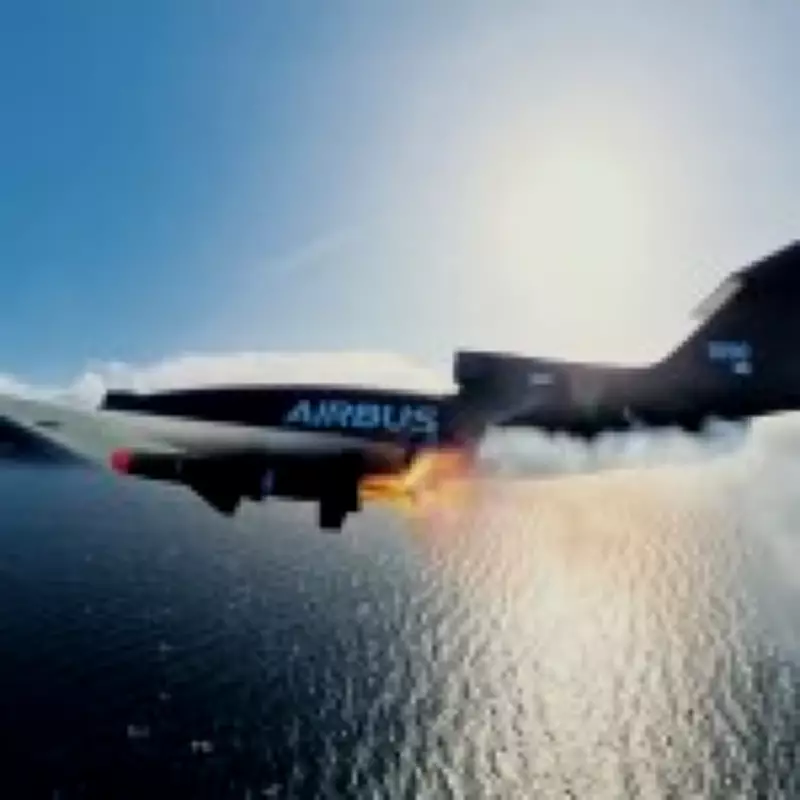
Airbus Unveils 'Bird of Prey' Interceptor Drone to Counter Iranian and Russian Kamikaze Threats
In a significant development for modern air defense, Airbus has introduced an experimental unmanned aircraft dubbed the 'Bird of Prey', specifically engineered to hunt and destroy kamikaze drones deployed by Iran and Russia. This innovative interceptor drone, developed in a remarkably short timeframe of just nine months, represents a tactical response to the growing proliferation of one-way attack drones in contemporary conflict zones, including the war in Ukraine and Middle Eastern hostilities.
Realistic Mission Trial Demonstrates Lethal Capabilities
During a recent test conducted high above Germany, the Bird of Prey successfully executed a realistic mission scenario where it searched for, detected, and classified a medium-sized kamikaze drone. Upon target identification, the drone engaged and neutralized the threat using a Mark I air-to-air missile, developed by defense technology startup Frankenburg Technologies. This demonstration underscores the system's potential to effectively counter notorious Iranian Shahed drones and similar Russian assets.
Strategic Importance and Executive Insights
Mike Schoellhorn, Chief Executive of Airbus Defence and Space, emphasized the urgency of this initiative, stating, 'Against the current geopolitical and military backdrop, defending against kamikaze drones is a tactical priority that urgently needs to be tackled.' He further highlighted the cost-efficiency of the solution, noting, 'With our Bird of Prey and Frankenburg's affordable Mark I missiles, we are providing armed forces with an effective, cost-efficient interceptor, filling a crucial capability gap in today's asymmetric conflict theatres.' The integration of this drone into Airbus's Integrated Battle Management System (IBMS) is poised to act as a force multiplier, enhancing overall air defense architecture.
Technical Specifications and Operational Details
The Bird of Prey prototype is based on a modified Airbus Do-DT25 drone, featuring a wingspan of 2.5 meters, a length of 3.1 meters, and a maximum take-off weight of 160 kilograms. In its test configuration, the drone carried four Mark I missiles, with operational versions expected to accommodate up to eight. These high-subsonic, fire-and-forget missiles boast a range of up to 1.5 kilometers and weigh less than 2 kilograms each, ranking them among the lightest guided interceptors ever developed. Equipped with fragmentation warheads, they are designed to neutralize targets at close range with precision.
Industry Collaboration and Future Prospects
Kusti Salm, Chief Executive of Frankenburg Technologies, hailed the project as 'a defining step for modern air defence,' adding, 'Together with Airbus, it marks the first integration of a new class of low-cost, mass-manufacturable interceptor missiles onto a drone, creating a new cost curve for air defence and enabling defence against mass aerial threats at a fundamentally different scale.' The reusable drone system is engineered to engage multiple targets during single missions at relatively low costs, offering a scalable response to the escalating use of kamikaze drones. Designed to operate within NATO's integrated air defense framework, it utilizes established command-and-control systems centered on Airbus's IBMS. Additional test flights, including trials with live warheads, are scheduled throughout 2026 to further validate its capabilities.