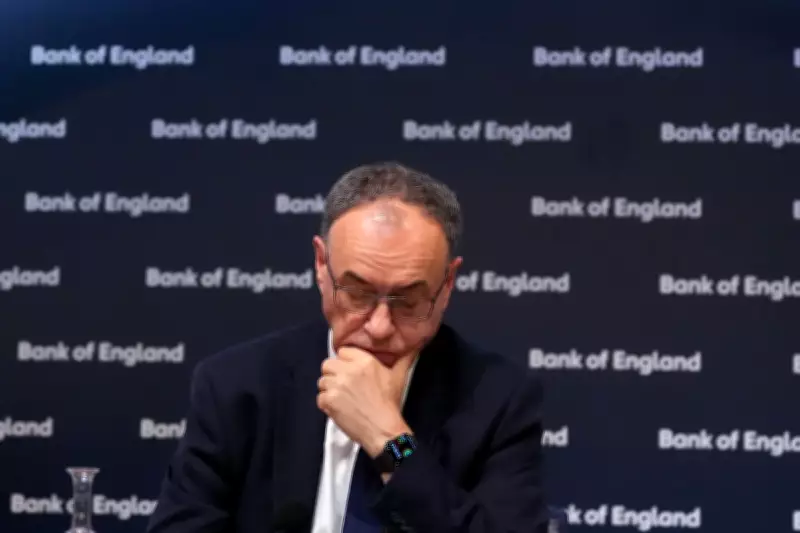
The Bank of England, headed by Andrew Bailey, held interest rates last week. The Bank's Monetary Policy Committee (MPC) is acting as if its role is to support the Chancellor and protect the real economy, rather than control inflation, writes Paul Ormerod.
Inflation Persistently Above Target
The Bank proclaims on its website that 'We set monetary policy to achieve low and stable inflation. This is our primary monetary policy objective.' It further notes that in practice this means 'keeping inflation at two per cent over the medium term.'
Taking the broad measure of inflation, the consumer price index (CPI), the last time it was below two per cent was in September 2024, at 1.7 per cent. However, that was the only month in the past five years when this was the case. In April 2021, inflation was 1.5 per cent. By the end of that year, it had risen to 5.4 per cent. It rose almost throughout the whole of 2022, finishing the year at 10.5 per cent. Since then, it has averaged 4.3 per cent, more than double the Bank's target rate.

The MPC believes the main tool to control inflation is Bank Rate, the interest rate the Bank pays on deposits placed with it overnight by commercial banks. Increasing the rate is believed to slow down economic activity, which in turn will lead to a moderation in inflation.
Inflation Not Under Control
Given that inflation has consistently been above target, it seems rather curious that since August 2023, the only movements in Bank Rate have been downward, from 5.25 per cent to 3.75 per cent. At the MPC meeting last week, eight members voted to leave Bank Rate unchanged, with only the Bank's chief economist, Huw Pill, voting for a modest increase to four per cent.
The Bank attempted to justify the decision by publishing three scenarios on the projected path of inflation over the next few years. The scenarios differ essentially on what happens to the price of oil. In the most pessimistic outlook, in which oil is at $130 a barrel for the rest of 2026, inflation peaks at six per cent and remains above the two per cent target even in 2028. Even in the other two scenarios, which assume lower oil prices, inflation is projected to be higher than the target in both 2026 and 2027.
According to the Bank, it is only in 2028 that inflation comes under control – a full eight years since it was last below two per cent. Economics is full of rather elastic phrases such as the 'medium term', the time period over which the Bank is expected to keep inflation at two per cent. But it would require very substantial generosity to describe eight years as being the 'medium term'. And it will be that length of time over which inflation has exceeded its target – always provided that the Bank's call on oil prices proves correct, otherwise it will be for the entire decade of the 2020s.
The Bank of England Is Not Like the Fed
The Federal Reserve, the American counterpart of the Bank of England, has an explicit dual mandate. It is meant to try to control inflation, but it is also expected to pay attention to the consequences of interest rate changes for growth and unemployment. When Gordon Brown made the Bank independent in 1997, its focus was meant to be on controlling inflation. It was not given the wider brief of the Federal Reserve.
The inflation outlook over the next couple of years requires both tight monetary policy and a sharp rise in interest rates. Given the Bank's own scenarios, an immediate increase in Bank Rate to five per cent would be perfectly reasonable. This would, of course, slow down the economy, already in a fragile state. But the MPC is acting as if it thinks its role is to support the Chancellor and protect the real economy rather than its actual job – getting to grips with inflation.
Paul Ormerod is an economist at Volterra Partners LLP and an honorary professor at the Alliance Business School at the University of Manchester.