
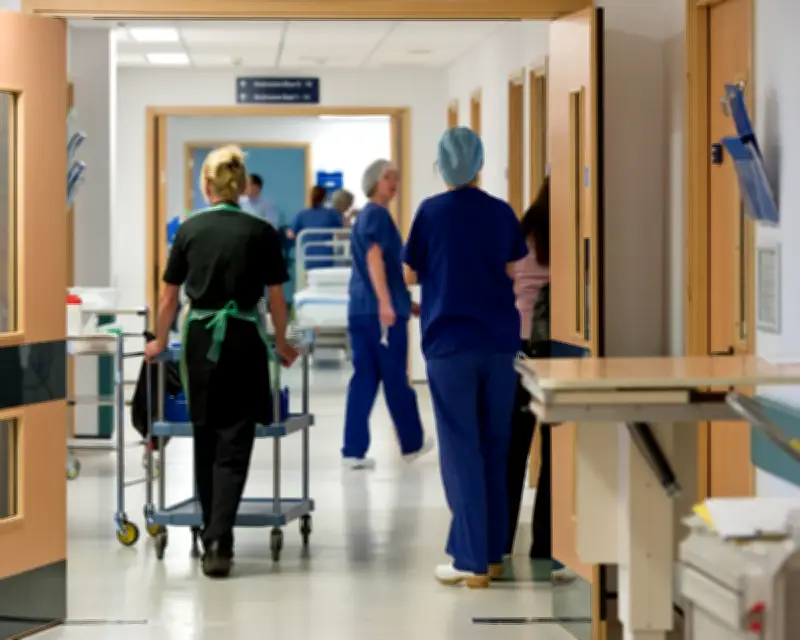
NHS doctors across England are warning that extreme heat in hospitals is creating unsafe and undignified conditions for patients. Four frontline medics describe their experiences during what they call the worst NHS heatwave crisis in years. Temperatures in some wards have reached 36C (96.8F), with no air conditioning and limited ventilation. Equipment failures, including radiotherapy machines, MRI scanners, cooling units and IT systems, have been reported.
Resident doctor in north-west England reports 36C in shared office
A resident doctor in north-west England described leading a ward round on an acute medical unit (AMU) on Wednesday. The office shared with eight other staff had a wall-mounted thermometer reading 36C. No spare fan or air conditioning was available. Out of seven patients reviewed, four had adverse effects due to extreme heat, including falls from postural hypotension and multiple pre-renal acute kidney injuries (AKIs). Almost all received IV fluids to compensate for insensible losses in a ward lacking air-conditioning or ventilation. Patients on medications known to cause issues in extreme heat had not been given specific advice on adjusting them during extreme weather and were admitted as a result. The doctor also described resuscitating a seizing patient in a side room with poor insulation and no air conditioning, with sweat falling on the patient from staff. The doctor said: “The climate crisis is already happening. It’s clear that the number of admissions due to extreme heat needs to be taken seriously. It increases strain on the physical infrastructure not built to cope, and staff who shouldn’t have to.”
Consultant in Surrey describes ‘reverse parking’ patients in corridors
A consultant in Surrey stated that the heatwave has pushed patient care into concerning territory, making corridor care more serious and unsafe. They described “reverse parking” patients opposite one another due to lack of space, causing privacy and dignity to disappear instantly. Bad news is broken in corridors with other patients listening, and resuscitation after cardiac arrest is performed in corridors. Blood tests, catheter insertions and examinations are attempted in cramped spaces unsafe for stroke patients needing urgent assessment. The consultant said: “Infection control becomes almost impossible.” The elderly and frail suffer most, with some spending up to 24 hours in a corridor, some without a bed, sitting through the night in a chair. In some hospitals, there are now five active “care corridors”. The consultant added: “This heat has made an already dangerous situation even more urgent.”
London resident doctor notes older patients struggle to regulate body temperature
A resident doctor in London working on a ward for older people reported difficulty keeping patients safe in the heat. The hospital has closed curtains to the sun and uses some portable air conditioning units, but wards remain unbearably hot. Keeping patients hydrated is challenging, as older people struggle to regulate body temperature. A colleague prescribed intravenous fluids to many patients on Wednesday as they could not drink enough, even with staff efforts. Having curtains closed during the day can confuse and worsen delirium for older patients. The doctor said: “This week has really brought it home to me: the reason we need to do something about climate change is because it is a health crisis. Ultimately, if we carry on burning fossil fuels it is those most vulnerable in society, like my older patients, who are suffering.”
London consultant reports 35C offices and equipment failures across three hospitals
A consultant in London worked in three hospitals during the heatwave, all unable to maintain healthy working temperatures. Colleagues recorded 35C in their office on Wednesday. There is concern that cooling and access to fans for vulnerable patients, such as those with dementia and terminal illness, is insufficient. A colleague has an end-of-life patient on a ward at 32C with no fan. Maternity units cannot maintain reasonable temperatures for mothers giving birth. On Thursday, computers on wheels (COWS) stopped working due to heat. The consultant said: “There are many simple things that staff and institutions can do to mitigate the impact and advice that we are not adequately giving to the population to reduce the risk. What is coming in terms of future worse heatwaves is also predictable and requires urgent review of resilience.”




