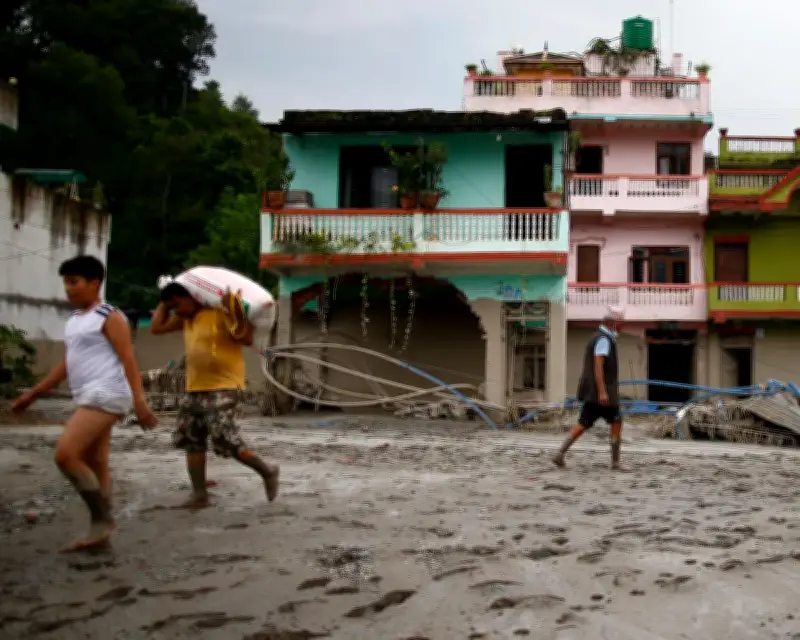
The death toll from Nepal's devastating flash floods has climbed to 750, with more than 3,000 people missing, including 43 Australians, as international aid begins to arrive in the affected region.
Rescue operations under way at army barracks
The main army response centre at the entrance to Nepal's flood zone has become the focal point of the crisis, with helicopters ferrying survivors, supplies, and the dead. The sound of chopper blades is constant, and the smell of blood and bone from bodies packed in white bags is overwhelming. Families wait to identify their loved ones as bodies are laid out in a designated area.
Plan International's Unni Krishnan, overseeing the response in the Nuwkot district, described the scene: "It's a scene of hope and despair - there are families here who have been waiting for three days to hear about their loved ones. Some of them will arrive, and some of them will not."
The single road entering the flood zone is busy with supply trucks, though the response remains in crisis mode, focusing on clean water, food, and shelter. Krishnan noted, "We're seeing the true nature of the floods. It's reconfigured landscapes and lives. Homes are destroyed. We can see spaces, doorways, where barely a cat or a dog could get through now, where people used to walk through. It's all gone."
Australian aid and donations increase
The Australian government has confirmed an additional $3 million in aid on Monday morning, on top of the $5 million already announced. This follows a $1 million contribution on Sunday evening, bringing the total, including public donations, to $3.8 million. The funds are part of a coalition of Australian charities operating under the emergency action alliance.
Logistics remain challenging. Huge trucks drop supplies at the beginning of the flood zone, where they are stored in makeshift storerooms. Smaller 4WDs then transport the aid up the valley. The government tightly controls distribution, a lesson learned from the 2015 earthquake response, which was rapid but disorganised. International charities are not allowed to distribute items themselves; instead, aid is registered with an official who handles distribution.
Workers have reached the worst-hit district, Rasuwa, but have not been able to get as far as the border checkpoint where many missing Australians were last heard from.
Survivors face dire conditions
An aid worker in Bidur, who was not cleared to speak to the media, estimated that as many as 70% of people living in the upper valley may have been lost. "Because down here they had warning, maybe 10-15 minutes," he said. "But up there it was seconds. So there will be bodies trapped in the mud, that will be difficult to identify and difficult to rescue. And the smell, the smell."
Survivors have moved to higher ground, staying in makeshift relief centres or with relatives. Many villages are cut off completely. In Bidur, hundreds of people are stuck on the wrong side of the river after the bridge was washed away. There is a market, but once supplies run out, the only option will be aid drops by helicopter.
On Sunday night, hundreds gathered across Australia for candlelight vigils for Nepal. The connection between the two countries is strong, with 200,000 Nepalese diaspora living in Australia.
Personal stories of loss and survival
Bhagat Lal, 68, sits outside his house, just 100 metres from the river. One of his sons is studying in Brisbane. Through a translator, Lal explains that his relatives—two mothers and two children—are missing. Their house was found washed up on the riverbank, 100 metres from where they lived. "From the ground level, the river was flowing nine, 10 metres high," Lal says. "It shook the house… the house got carried 100 metres away."
At a relief centre in Bidur, 92 displaced Nepalese are staying, including 53 children. A worker points to a young boy whose parents are gone, and a girl whose mother is missing but father is present. Many are from the Rasuwa district, some found by the Nepalese army, others walked for over six hours to reach safety. They sleep on floors or makeshift hospital beds, with meals of noodles and vegetables. Some children receive haircuts, while others wrap themselves in blankets, hiding from the world.
Sulochana Tamang, 30, was rescued from a mountainside with her two children, aged 7 and 2. "When the flood came, me and my husband grabbed our children in our arms, and we just ran. We fled up the mountain," she says. After two days, the army found them and helicoptered them to safety. They survived, but lost relatives. "There are around 80 households in my village. Everything is gone. There is nothing remaining."
Tamang and others will live at the centre for months, with no other options. Plan International plans to bring learning materials for the children, ensure nutritious food, and arrange for clowns without borders to provide some joy.
Krishnan reflected on the situation: "The scale of the distraction is clearer today. But we are also seeing increasingly how people in Nepal are united, and people in the rest of the world are with them. The contributions of the Australian public have been a huge boost, because the relief workers are reminded they're not alone in that crisis."