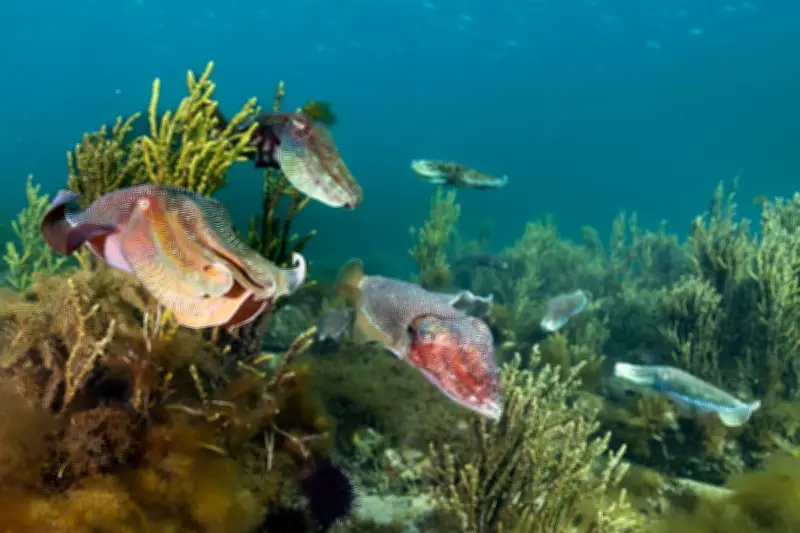
Mid-June is usually the peak time for giant Australian cuttlefish to gather near Whyalla in South Australia's Spencer Gulf, but this year only a few dozen have appeared instead of the usual thousands. The meagre turnout has raised concerns among locals and marine scientists, who suspect a massive toxic algal bloom is to blame.
Algal Bloom Likely Cause
Associate professor Zoe Doubleday, a marine ecologist at Adelaide University, said it is “something we haven’t seen before.” While the exact cause is uncertain, on “the balance of probabilities it is likely to do with the [algal] bloom.” This could be due to direct exposure or a decline in their food source. Australia’s first bloom of toxic Karenia cristata algae, which began in March last year, is still present along the South Australian coastline, including parts of Spencer Gulf. It is the largest and most destructive algal bloom in the nation's history. “We know the effect of Karenia on cephalopods is swift and fatal,” Doubleday said.
Testing Results Show Elevated Levels
The latest testing results show elevated levels of Karenia algae at eight out of 32 testing sites on the southern Eyre peninsula and in southern Spencer Gulf, with the highest concentration of 432,899 cells per litre at Proper Bay. The government considers levels above 10,000 per litre as “elevated,” with higher counts suggesting a bloom could be underway.
Dive Shop Reports Few Sightings
Manny Katz from the Whyalla Dive Shop said that normally by this point in the season, with water temperatures below 17°C, there should be thousands of cephalopods along the entire Cuttlefish Coast. Instead, divers have observed a “couple of dozen hanging around, at a couple of different spots – that’s pretty much it.” The animals that had turned up were “extremely skittish” and hiding underneath rocks. “We’re at this point where, the longer time goes by, the more we’re worried about it,” Katz said. “The cuttlefish should be here by now.”
Economic Impact on Tourism
The missing cuttlefish have also hurt tourism. The Whyalla Dive Shop turned away $50,000 worth of bookings for the June long weekend when the cuttlefish failed to show. But the greater fear is the risk of losing the aggregation entirely, Katz said. “This is a world-renowned dive site. A natural phenomenon that we get to experience. And to not have that is really sad. From an environmental point of view, this is catastrophic.”
Historical Context and Future Outlook
Cuttlefish numbers have varied year-to-year since surveys began in 1998, from a low of 13,500 in 2013 to 247,000 in 2020. Last year, nearly $10 million was spent locally during Whyalla’s winter celebration called “Cuttlefest.” Festivities were underway this year, but “unfortunately the special guests for the celebration weren’t there – our cuttlefish,” Whyalla’s mayor, Phill Stone, said in an update. Formal surveys will be conducted in coming weeks. A spokesperson for the state’s department of primary industries said government researchers are “anecdotally receiving reports that population numbers of giant Australian cuttlefish in northern Spencer Gulf seem relatively low.” Doubleday said there is still uncertainty but added, “We’ll probably need to wait to see what the numbers are. I think the next two weeks will be really telling.”