
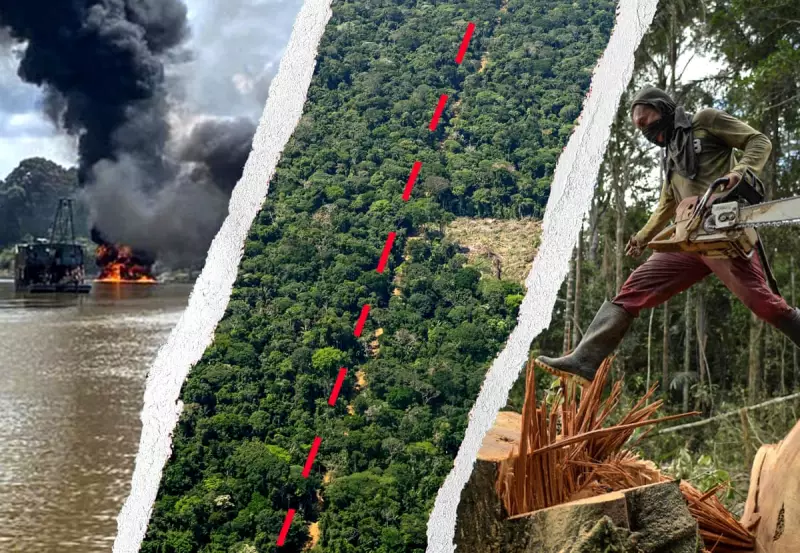
From the air, the Colombian Amazon reveals a landscape under siege. Where an unbroken canopy of rainforest once thrived, widening scars of brown earth now spread like a disease. This transformation is the handiwork of powerful criminal networks, which have constructed a staggering more than 8,000 kilometres of illegal roads since 2018, turning a global ecological treasure into a hub for illicit enterprise.
The Arteries of Crime in the Jungle
Rodrigo Botero, director of the Foundation for Conservation and Sustainable Development (FCDS), has witnessed this devastation firsthand. His team's aerial surveys, covering over 30,000 miles, document how this new infrastructure snakes through the jungle. Colombia now has the highest road density in the entire Amazon basin, but these are not pathways to development. They are smuggling routes for cocaine, illegally mined gold, and cattle reared on deforested land.
"Outside Colombia, there is demand for cocaine, gold and meat; the Amazon supplies that demand," Botero states, highlighting international complicity. "In our environmental deterioration, there is an international shared responsibility." The FCDS's report, 'Amazon in dispute', identifies the north-western Amazon as a hotspot, with 17 illegal groups operating in nearly 70% of its municipalities.
Peace Deal Vacuum Fuels Environmental Collapse
The current crisis has its roots in the 2016 peace agreement with the Revolutionary Armed Forces of Colombia (Farc). The Farc, which had strategically protected parts of the jungle, demobilised, creating a power vacuum. New and existing armed factions, including the National Liberation Army (ELN), the Gulf Clan, and various Farc dissident groups, rushed to fill it.
"When the peace was signed, several Farc dissidents announced they would not surrender their weapons, and immediately an increase in deforestation became evident," explains Botero. 150,000 hectares were lost in 2018 alone. Today, the cumulative devastation has reached approximately 700,000 hectares. According to Global Forest Watch, Colombia lost about 21,000 sq km of primary rainforest between 2001 and 2024.
Kyle Johnson of the Conflict Responses Foundation argues the core issue is the unfulfilled peace deal. "The lack of implementation of the peace agreement is the main cause behind the growth of armed groups in the Amazon," he says. The agreement promised rural reform and programmes to replace coca crops, but implementation has lagged.
Land, Power, and a Failing State Response
In the lawless territories, armed groups act as de facto states. They conduct censuses, levy taxes on all commerce, and meticulously track land use to maximise extortion. The ultimate prize is the land itself. "Bringing all those deforested hectares into the market means the land gains value," Botero notes. "Ultimately, the state finances a speculative land market. That’s the backdrop: land is the big business."
President Gustavo Petro's "Total Peace" initiative and land redistribution of 15,000 sq km to farmers have struggled to make headway. Critics say the state has failed to establish control, leaving environmental officials blocked from vast areas. Sebastián Gómez, an adviser to the Peace Agreement Implementation Unit, admits past failures: "From the start, the government insisted that coca-growing families eradicate their crops without offering them alternatives. And soon they replanted."
The solution, experts agree, is not purely military. It requires transforming local economies. "We have to build a special agricultural economic proposal for this region, one compatible with forest preservation," Gómez asserts. Johnson suggests appealing to the human side of combatants: "We must identify other incentives: family, peace of mind, the desire to retire."
As international demand for commodities continues, and armed groups tighten their grip, the future of the Colombian Amazon hangs in the balance. The convergence of environmental destruction and complex criminality presents a formidable challenge, one that demands a coordinated response reaching far beyond Colombia's borders.



