
New Alliance of Nations Seeks to Pivot Away from Fossil Fuels
As oil prices spike and geopolitical tensions rise, a diverse group of governments is attempting to build momentum and rewrite the global energy script. Last week, oil prices surged after US President Donald Trump warned that a blockade of Iranian ports could last months, causing the price of oil to jump to its highest level since Russia’s invasion of Ukraine. With it, the spectre of global recession looms large.
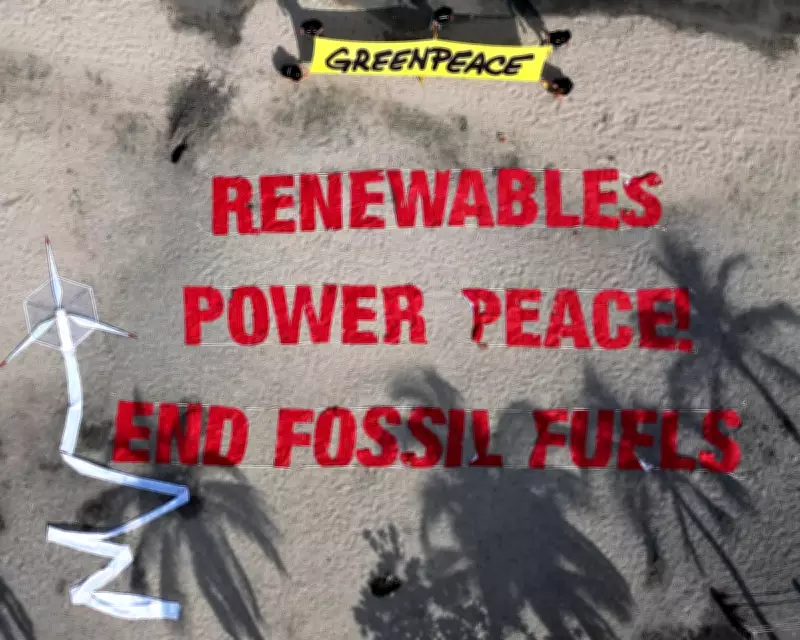
But on the Atlantic coast in Colombia last week, a coalition of the willing was working to break the cycle. Almost 60 governments met in Santa Marta for the world’s first conference on transitioning away from fossil fuels. At the conference, each country agreed to develop roadmaps on how to move away from fossil fuel dependency.
An Immense Irony Unfolds
Amid Donald Trump’s second presidency, the climate crisis has largely disappeared from the global agenda. A coordinated attack on the green movement by his administration has seen the US government leave the Paris agreement once again; withdraw from the UN convention of climate change; defund a swathe of projects around the world helping to improve resilience and adaptation; and demand others follow their example. At the recent International Monetary Fund and World Bank Group spring meetings, the US did all it could to stop countries even mentioning climate change.
But the US is starting to seem out of step globally. As the UN’s climate chief Simon Stiell pointed out on Thursday, an immense irony is unfolding as a result of the war in Iran: the rocketing price of oil driven by US-Israeli attacks on Iran has supercharged the boom in renewable power. Governments, businesses and households around the world are looking to solar power and wind to escape the biting cost of fossil fuels.
While oil and gas companies, particularly those based in the US, may enjoy bumper short-term profits, the genie is already out of the bottle. Fatih Birol, the executive director of the International Energy Agency, told the Guardian that the war has changed the fossil fuel industry forever, shattering its image of reliability, and boosting nuclear power and renewables. The world will need and use fossil fuels still, but countries seem to be losing trust.
“The vase is broken, the damage is done – it will be very difficult to put the pieces back together. This will have permanent consequences for the global energy markets for years to come,” he said.
A Roadmap for Action
The immense irony is not lost on those who wish to see more action on climate. The summit in Colombia, which was organised jointly with the Netherlands, arose out of an immense frustration with the UN climate process. It has caveats, being voluntary, and lacking attendance from most of the world’s biggest emitters. But during what feels like a historic political low for the climate movement, the conference maintains momentum on efforts to avert extreme temperature rises, says Fiona Harvey, the Guardian’s environment editor.
“This summit is not going to solve the problems of the world, or replace the official UN climate process, but in its own way, it can help solve some of the current problems in the climate movement. You need to get buy-in from countries who want action on this issue. They also need to find a way to communicate with governments who do not, which are largely autocracies,” she says.
In the end, 59 countries participated in the talks, representing more than half of global GDP, nearly a third of energy demand and a fifth of fossil fuel supply. But one country in particular loomed large over the talks.
“We have never seen a United States government like this before,” Fiona tells me. “When I first started writing about the climate, George W Bush was in charge and he wasn’t keen on the climate. But he didn’t go around saying things to the tune of we’re going to smash up renewables, halt investment in them, and say that climate change is a hoax. It’s a very different landscape with Trump in charge – and Santa Marta is an expression of how countries are responding to that.”
Petrostates Versus Electrostates
The Trump administration’s rejection of action on the climate and the energy transition has opened up a technological fissure. On one side, there is the US which has full energy independence with fossil fuels and under Trump, wishes to continue using the technologies that have dominated the last century. On the other, there is China which is on its way to becoming the world’s first electrostate, dominating the production of solar panels, wind turbines, affordable electric cars and the supply chains needed to produce them.
“The petrostate v electrostate division has been an issue for the last year or so. The idea is that you’re either hooked on oil, gas and coal, or you move to an electrified future. The discourse has been precipitated by Donald Trump as he has made things very stark,” Fiona says. “We always knew that electrification was the only way to get out of the climate conundrum. It’s much easier to get off fossil fuels if you electrify everything first.”
Many governments are wary about their potential dependence on China if they make this transition, with European governments in particular looking to ensure that they are not entirely reliant on Beijing to make the energy transition. They will need to walk a tightrope between the US and China moving forwards.
Concrete Solutions
As government representatives departed the Colombian Atlantic coast, many left with a hint of optimism for the first time in years. Momentum was already hard to find in official UN climate talks before Trump returned to the presidency, but enough was achieved for this coalition of the willing, which agreed to meet annually alongside Indigenous leaders, scientists and other experts.
Despite the overwhelming weight of scientific evidence that humans are driving global heating due to the consumption of fossil fuels, the official UN climate process still struggles to agree on this simple fact. Now, a significant minority have – and it is up to them to build the world of tomorrow.
“We decided not to resign ourselves to an economy built on the destruction of life,” said Irene Vélez Torres, Colombia’s environment minister and chair of the talks. “We decided that the transition away from fossil fuels could no longer remain a slogan but must become a concrete, political and collective endeavour.”



